Showing posts with label Garden Earth. Show all posts

Monday, May 19, 2014

Garden Earth in Thai


My book Garden Earth is now translated to Thai and will be  launched at the World Environment Day 2014, sponsored by the Ministry of Natural Resources, during the FAO International Year of Family Farming. The event will be held at Royal Paragon Hall, Siam Discovery Department Store, Bangkok on the 4th of June.

I find it amusing that the book launch will be held in one of Bangkok's many shopping malls. It is like holding an atheist speech in the church. Shopping malls are the churches of the new religion of shopping, consumption and eternal progress (and Bangkok is certainly one of the centers of the cult). My book comes with a very different message.

The publishers present the book in these words: 
Gunnar Rundgren’s analysis of the present ‘state of the Earth’ goes back to the agricultural revolution following the era that you and I lived as hunters and gatherers: the dawn of humanity. Such broad and deep perspective is needed to start drafting the ideas needed for shaping our sustainable future. This is a last minute’s effort but there is no other way than what Gunnar Rundgren tells us quietly: analyzing our own lives.
I am very impressed by the fact that the Ministry of Natural Resources of Thailand has pre-ordered 2000 copies of the book.

The book is published by Suan Nguen Mee Ma Publishers.
For more information about the launch, please visit www.suan-spirit.com, www.facebook.com/suan2001


The book is also about the be published in Japan by Doyosha

Monday, December 30, 2013

Garden Earth at a discount

Dear Reader,
Thanks for following my blog.
During 2013 there have been some 5,000 page views per month in average. 

If you didn't already read my book Garden Earth,  from Hunters and Gatherers to Global Capitalism and Thereafter, I could suggest it for reading 2014.

I offer my readers a US$4 discount if you order it from: CreateSpace on this link: https://www.createspace.com/4070847 
and use the campaign code: HWDQQ4JX
The offer lasts until 15 January. 
The book is also available in hard cover.  
ISBN-13: 978-9198089202 published by Regeneration.

You can order it via most bookshops, physically or otherwise.


The book is also available as a Kindle book as well as in other e-book formats.
If you want to order more than 5 copies of the book, please contact me at gunnar at grolink.se 

The coming year there will be many more post based on the upcoming book. Tentatively it will be titled: Global eating disorder - the true cost of cheap food

For those voting for a name or sending suggestions, here, on LinkedIn or by email, thanks.
Happy New Year

Wednesday, June 26, 2013

Transition, Garden Earth and more

It takes seventeen times as much effort today than hundred years ago to get the same catch of fish. At the same time as our energy resources go down we have to work harder to access the same resources as we could get with smaller efforts before. This has created a double crunch.

From right: Claudia French, Irina Almgren and Gunnar Rundgren - in my kitchen

Listen to a conversation (in two parts) between me, Claudia French and Irina Almgren about the challenges and opportunities of today, the Transition Movement, my book Garden Earth etc.

Sunday, June 2, 2013

Someone is reading

The sales of my book Garden Earth is progressing, albeit a bit slowly. I have got some interesting feed back from some readers and a few reviews have been published:
“While this book represents serious and well researched scholarship, abundant with factual data from authoritative sources, it is written in a very accessible style with a sense of personal warmth and lighthearted humor that keeps one’s interest without excessive jargon. [...]  This work gives us an excellent tool for understanding agriculture and food systems through a social ecology compatible lens, and a valuable contribution to the discussion of how to bring about a society that is rational, prosperous, equitable and ecologically based.”
Writes Grace Gershuny in a review of Garden Earth at the web site of the Institute for Social Ecology
You can read the whole review here.

"If you want to read only one book on sustainability, I warmly recommend this one! This one gives me hope for the future. But we are still facing the biggest challenge in the history of the modern human being."
writes Kristian StÃ¥lne in a recent review of Garden Earth.  The book is used as literature in a university course on Sustainable Transition.

Meanwhile this blog now has some 5,000 page views per month and my Swedish blog some 2,500 page views per month. 

Monday, May 13, 2013

Capitalism: The right to extract wealth


"When we buy stock we are not contributing capital: we are buying the right to extract wealth."

(Marjorie Kelly,The Divine Right of Capital, 2001)

The legitimacy of capitalism rests on two arguments, closely related to each other.

The first is a system that in a rational way, through peoples’ self-interest, efficiently organizes production and consump­tion, with little or no government control. This system creates increasing wealth. Although this system has created enormous wealth and a tremendous increase in useful as well as useless ‘things’, the wealth is very unevenly distributed, resulting in enormous gaps in society. It has also not made people more satisfied. Meanwhile, it has created havoc in nature, from pollution of a local water source to disruption in life-supporting cycles such as the carbon and nitrogen cycles. ‘As efficient as markets may be, they do not ensure that individuals have enough food, clothes to wear, or shelter,’ says Stiglitz (2002: 222). There is a need for constant government intervention to correct all so-called market failures. It is wise to exempt large parts of society as well as nature from the logic of the market. Most people who are essentially positive towards capitalism and market economy realize that.

The second argument is a moral defense both for the accumulation of capital and for making profit. Even if it can appear a bit unfair, these mecha­nisms are needed to stimulate innovation and development. In the long view, everyone will benefit. The sometimes absurd profits are explained—and defended—by Schumpeter (1942) as follows: Spectacu­lar profits, much bigger than needed to motivate the action, are gained by a very small group of winners. The possibility, the dream, of these enormous gains stimulates normal business more efficiently than if everybody got only a very modest profit. They overestimate the possibility for the big win in the same way as a poker player or a lottery-ticket buyer. In Schumpeter’s view, one should agree to these giant profits, and the thereby associated differences in income and wealth, because it is the best way to stimulate development. This is the essence also of others’ defense for capitalism, even if modern propo­nents mostly express themselves a bit more politically correctly than Schumpeter did. Let us study this argument a bit more in depth and how well it passes the test of reality.

Capitalism doesn’t require limited companies, but it is the institution that most clearly epitomizes capitalism. Take the example of a small limited company. It has existed for 10 years and its total revenue over 10 years is in the range of US$ 30 million. The start-up capital invested in stocks was US$ 60,000. The shareholders have got small dividends over the year, just corresponding to a typical interest rate; they wanted to keep the profits in the company to allow for rapid growth. Through accumulated profits, the company is now worth some US$ 500,000; that is, the value of the ‘investment’ has increased eightfold in 10 years. This is nothing exceptional but all in all it is a reflection of a moderately successful company.

During the 10 years of existence, some 10 people have been working in the company. They have had a good salary; they even have been part of a profit-sharing programme. One now wonders why the ones who invested the original capital 10 years earlier should be the owners of the whole company. Isn’t it the fruits of the 10 people who work that has made it what it is today? The original capital, representing less than 1 person-year of work in value is now worth more than the 100 person-years of work dedicated to the company over the years. Strangely, this is accepted as the most natural thing.

The stated purpose of limited companies is to supply their owners with profits. This is motivated by the owners supplying the capital that is needed to start and invest in the operations. This is also the reality when many companies start. The bulk of the trade in stocks is not about company start-ups, however, but about stocks that are bought and sold purely speculatively. In the period 1900–1953, new stocks contributed less than 5% of the needed capital for business in the United States. At the end of the 1990s, only 1% of the value of the stock that was bought and sold reached the companies, the rest was only transfer between stockowners (Kelly 2001).

As the system is now, the stockowners have the power over compa­nies and the exclusive rights to profits. Not the total right actually; the other power centre in society, the state, has ascertained its share of the profit through company taxes, in almost all societies. One can also see this as a payment for the services companies get from society, such as an educated work force, health system, legal system and protection. The employees, the clients, the local community or the environment have no right to a share in profits. Between 1987 and 1997, the stocks in the Dow Jones index went up 300%. In the same period, real wages in the United States dropped 7%. That can hardly be fair, reasonable or even efficient. As Schumpeter (1942) noted, when companies are not managed by entrepreneurs but by professional managers, and owned by investors, the whole idea of ownership and entrepreneurship is destroyed.

In a limited company, the owner has unlimited rights to the profits of the company, but only limited responsibility for the losses. This is the essence of limited companies; 200 years ago this didn’t exist. It is an innovation and a privilege extracted by the rich in the same way as the nobles saw to it that their rights were enshrined in law. There were shareholding companies earlier, but the owners were personally responsible. The emergence of limited companies is the first example, and one of the clearer examples, of how the wealthy class tries to privatize gains and socialize losses, something that became very apparent during the financial crisis of 2008/2009 where a trillion of dollars or more were used by governments just to prime the financial markets because they were not willing to take any risks; the same markets that claims the legitimacy of their mere existence with that they are needed to provide businesses with risk capital!

It is an undisputed fact that capitalism is very good in making business out of innovation, but that doesn’t mean that most ground­breaking innovations in society have been made by private companies. On the contrary, most big innovations have taken place in very different arenas. Automobiles, television, radio, nuclear power, antibiotics, wind power, sailing, electrification and the Internet are all examples of groundbreaking technologies that were driven primarily by governments or by curiosity and the ‘wish to know’ rather than by capitalist innovation (Hourihan and Atkinson 2011). When a big leap in technology has already been made, entrepreneurs find commercial uses for the new technology. The Internet is a very good example of this. Entrepreneurs are also very good at moving those technologies out to the people.

Technological development was rather slow before capitalism, and one of the reasons was that there were few incentives for people to improve efficiency. The rich could extract value added by serfs, tenants or slaves and didn’t need mechanization and the poor had neither resources nor real possibilities to turn any innovation into business. Having said that, there is certainly no reason to believe that innovation will cease without the profit motive. To make the job easier or more entertaining is a driver for innovation as well. Human nature is curious and innovative and that will be the case also without profit motives. To do something new, something good, not only for oneself but for the whole community can be a forceful driver, and it is also something that could be highlighted and emphasized more in a way that it renders more status.


(Extract from Garden Earth: from hunter and gatherers to global capitalism and thereafter
Available from Create Space, Amazon.com , Amazon.de, Amazon.es, Amazon.fr, Amazon.it, Amazon.co.uk and most book retailers)

Tuesday, March 19, 2013

Energy-efficient food production – sure but within reason


The forest was burning and the area was in a smoky haze when I visited Pedro. He and the other farmers were clearing land for farming at the edge of the mighty Amazon forest. This was the first time I had visited a farmer practicing swiddening, or slash and burn agriculture. I’d arrived with the idea that swiddening was a primitive method used only by ignorant farmers. I  had this image from my school days, the media and from my own love of forests. Clearly, it must be wrong to burn a forest just to grow crops for a few years. After this visit to Pedro, several other farm visits and a good deal of reading, I realized I was wrong. Partly, at least.

Swiddening is a good example of a method of farming that is rational from the perspective of the farmer. It is also environmentally benign if practiced in a limited extent. Fire is part of nature, and also pristine forests have burnt. Human use of fire has shaped many of the most impressive landscapes in the world, including the savannah and the prairies but also most forest landscapes. However, when population grows, or forest resources dwindle, what was once a good practice becomes negative.

The success of a species is mainly about its ability to capture energy

We get a confusing array of messages about food and diets. Now and again we are advised to eat local, to become vegans, to eat raw food etc. In many of these messages, ethical, environmental and nutritional messages are mixed – and mixed up. Unfortunately it is quite possible to eat ethically produced or procured but nutritionally disastrous food! It is equally possible to eat environmentally benign foods that score badly on animal welfare.

This post is mainly about energy. The reason is that regardless of all other considerations, energy comes first. The whole ecological system is built on energy levels, and the success of a species is mainly about its ability to capture energy. The enormous ‘success’ of humans can, to a large extent, be seen as an ever increasing command over energy resources. 

When we were hunters and gatherers, we captured the energy in game, fish, leaves and plants. While expending energy for hunting or digging, we got energy—in the form of food. When we lived by ‘capture’, we could only skim the surplus of nature. We had to capture as much food-energy as possible from the system to produce and reproduce. Reproduce not only children, but also the small society, the band, to which we belonged. This also included taking care of the elderly and sick, throwing the odd big party to keep spirits high, diverting energy to rock paintings, hair braiding, nose ringing and other cultural expressions. This is the real iron law of human civilization:

A society must command sufficient energy to reproduce itself and its members. 

When we started using fire to cook, we made food more palatable. Some claim that we started getting20–25% more energy from cooked food and that this also allowed our brain to grow (In other words, we were smart to discover fire, and that discovery led us on to become even smarter). The energy contained in the wood we burned largely surpassed the increased energy uptake from the food we cooked. It is important to note that this also meant that at that point, we already developed an energy-deficient food system.

Some capturing societies did manipulate their environment a lot in order to ’”produce’ more of the kind humans like (such as bison) and less of those that humans don’t like (wolves and tigers). Some dropped nuts in fertile soils to have more nuts to collect, and cleared the bush that threatened to crowd out that mouth-watering herb. Some had a tame dog as part of the hunting party.  

Initially there was no distinct line between capturing societies and agrarian societies. A major shift happened when agrarian societies began to manipulate nature to serve man, and dramatically shifted the composition of plants and animals to those desired by man. Domestication of animals and plants to use them for directly servicing us were key steps in this shift. Some level of preparing the land was also part of this. Fire came in handy in this. My visits to farmers practicing slash and burn in Latin America, Africa and Asia taught me that burning down trees is one of the easiest ways to prepare land for farming.

Swiddening allows farmers to save on labor which is why farmers stick to this practice even today, regardless of how much environmentalists complain. However, the energy wastage is enormous. If we assume that about 100 cubic meters  of wood per hectare of land is burnt and that the land is used for farming for three years, it would mean that about 35 cubic meters of wood is ‘used’ per year. That would correspond to the energy of about 3 cubic meters of oil, which would mean appalling energy efficiency, worse than most industrial systems.

Even if agriculture is no longer the key source of income for most people, it still represents the main livelihood for at least one third of the planet’s population. Expenses on food and all its associated items is the key expenditure for perhaps half of the world’s households and it constitutes a big part of the household budgets of even the wealthy. Food and the consumption of food are important social institutions and social markers—tell me what you eat and I will tell you who you are!

Finally, agricultural landscapes now cover more than half of the earth’s land surface. This means that to a large extent, how we manage agriculture is how we manage the ecosystems of the land. Agriculture is also the key contributor to climate change after the energy sector. And if we count the whole food chain, including all ancillary energy use and emissions of all sorts in the chain, food and agriculture is even more important.

Therefore, how we farm and feed ourselves is still of utmost importance. And when food prices rise, which they did in 2008 and again in 2012, it worries even the rich parts of the world.

There is no coincidence that when oil prices soar, food prices follow suit.

When oil prices soar, food prices normally follow. There are many reasons for this:
“Farming uses energy in many different forms: diesel for tractors and pumps; electricity for pumps, fans and indoor machinery such as milking machines, etc. Fertilizers represent a big energy use. Energy represents 90% of the production costs for nitrogen fertilizers, 30% for phosphorus fertilizers and 15% for potassium fertilizers. For production in the United States, energy costs represented 22–27% of the production costs for wheat, maize and cotton and 14% of the production costs for soybeans. These figures do not include embedded costs in buildings, machinery, etc., so the actual share of the costs is substantially higher. In Argentina, energy costs were calculated to 43% of production costs in 2006. [...] Increased energy prices influence food prices:
·     by making the production more expensive;
·     by making biofuel more interesting to produce and, therefore, reducing the production of food, leading to higher prices;
·     through increased transport costs that directly reflect on food prices; and
·     through reduced competition in the food sector (increased transport costs means that the pressure of global competition is reduced).
(Garden Earth, Gunnar Rundgren 2012)

Energy plays a big role after the farm gate as well. As a matter of fact, energy use is much higher after the farm gate. This is particularly marked in industrialized countries. For example, the whole food chain consumes around 16% of the total US energy use. Farm operations consume only 14% of the total energy in the food sector while handling, processing and retail on the one hand and preparation on the other, use more or less equal shares of the rest. 

As we saw earlier, considerable quantities of energy is used in cooking in agricultural societies as well. “Cooking represents more than a fifth of the total energy consumption in Africa and Asia and up to over 90% of household energy consumption in some countries. Another observation is that energy used for cooking is more than the total energy in food. So while farming in developing countries and by traditional systems is energy efficient, cooking is not.” (Garden Earth, Gunnar Rundgren 2012). Some figures point towards the fact that consumers in rich countries use less energy for food preparation. Admittedly, the food industry in these nations has a large proportion of pre-cooked food in the markets.

The United States Department of Agriculture (USDA) estimates that to deliver the average American’s 2,000 Calorie diet requires nearly 32,000 Calories of energy inputs (Energy Use in the U.S Food System, Canning et al., 2010).

Horrified by this, Eric Ganza wrote an interesting essay, In Pursuit of an Energy-Positive Food System, in which he calls for “the need to adopt a food system with a positive energy balance”. I believe this is overshooting the target. Also in the old days, there were several steps in the food chain that used more energy than they produced. Water or wind mills used a lot of energy to grind the grains into flour. Baking is not very energy efficient when compared to making porridge. And not to mention  the enormous expense in terms of both money and man-power to get spices from the East Indies to Europe.

That our food system has a bad energy ratio by itself is not an argument that it is fundamentally wrong. If that were so, all human civilization would be fundamentally wrong. Well, even life is wrong as plants are highly inefficient as well.

Approximately 130 Joules of energy per square centimeter reaches the earth as solar radiation. Some of this energy is absorbed by the atmosphere directly or is reflected. Of the 91 J reaching the surface of the planet, 18 J is reflected, 31 J is radiated as heat, 36 J is used for the evaporation of water, 6 J heats the soil and only about 1 J is locked by plants as chemical energy. It is this little part, less than 1% of the sunlight that reaches the earth’s surface that is the plants’ share of solar energy. And it is this tiny fraction that is used for food, fodder, fiber and biofuels. Or rather, it is only a part of this tiny fraction as the whole plant is rarely used. If one calculates backwards from the crops actually harvested, we find that in 1993 harvested products represented only 0.4% of the solar energy reaching the fields. Of this 0.4%, only 61% was actually used; that is, real use was only around 0.25% of the solar energy reaching the ground.

Therefore, when seeking alternatives to today’s food chains, to have net energy production as a prerequisite might lead us in the wrong direction. Even worse would be to say that we should not use any ancillary energy in the farming system. Additional energy is not always wrong. For example, a smaller quantity of water for irrigation, such as in a nursery or at a critical period of the growth of the crop, can make an enormous difference in yield. Cooking remains an essential part of human life even if it is “a waste of energy”.

The problem today is more with the scale and quantity. As I write in Garden Earth:
“...the total energy harvested per hectare can increase with increased use of ancillary energy; one can increase yield per hectare fivefold with the use of more energy. This energy can be in the form of better (and more timely) soil preparation, irrigation, fertilizers, etc. The ratio between energy output and energy input (i.e. efficiency in use of energy) seems to be fairly constant to a certain level after which it rapidly deteriorates. In industrial farming systems, the optimal use level has since long been passed”.

Energy ratios in agriculture present an interesting perspective but conclusions can’t be taken to the extreme. First we are, at least not yet, in a situation where we have to equalize energy in food and energy in oil, nuclear power and hydro-power. At first glance, one might even consider such comparisons absurd. And they are absurd, if we think that there will be unlimited supplies of energy in the future. Not too many believe that any more. All staple foods (i.e. the foods that provide the bulk of nutrition) are foods with a positive energy balance in their traditional way of production. If that were not the case, they would never have been staple foods in the first place. Second, calories alone don’t give value to food. In such a case, it would be best to stick to sugar (and sugar cane is one of the most energy-efficient crops). Vegetables will always be inferior to grain when it comes to energy ratios. They contain a lot of minerals and vitamins, however. Meat is not primarily consumed for its energy content but for its protein content. Finally, some food is eaten simply because it tastes good or for religious or cultural reasons.

 Bon appetite! 

Market i Vang Vien, Lao PDR Jan 2012

Wednesday, March 13, 2013

Web site for Garden Earth - the book


From now on, information about the book Garden Earth will be posted on the web site, http://gardenearth.info/en/


Below, you can read the concluding short chapter of the book.

33 –
Garden Earth
You may say that I’m a dreamer
But I’m not the only one
I hope someday you’ll join us
And the world will live as one
(John Lennon, ‘Imagine,’ 1971)
Hunters and gatherers lived in a wild nature, although they manipulated it more than most are aware. Their values, religion and society were shaped by their environment and ecological niche. A small fraction of the primary production of ecosystems was taken care of by human beings. With agriculture, it all changed. A part of nature, gradually growing, was occupied fully by the human species, cleared from undesired species and put directly, and uniquely, in our service. In this way, we maximized our share of the biological production, and favoured those species that produced what we needed. Because of more intensive use, buffers were smaller and agrarian society was thus vulnerable to disturbances and shocks, such as climatic events, disease of crops and animals as well as of ourselves. Soil erosion was an ever-present threat and a cause of societal collapses or simply slow decline. Our relationship changed not only with nature but also with each other and with the society that was established to manage this new system. Human society changed from a basically egalitarian society of small bands to agglomerations of authoritarian lordships, kingdoms and empires, and from a society with very limited division of labour to a stratified society where each had his or her well-defined role.

With the Industrial Revolution, based on fossil fuel, human control and reach expanded even more, to almost all nooks and corners of the globe. Humankind went further, climbed and flew higher, dived and dug deeper—all in the effort to find more resources to exploit. More and more parts of the living as well as the dead were put in direct service of humanity. Industrialism also brought new impetus to farming. The first stage brought tools and the power to extend the land under plough, but gradually also more and more machinery to in¬crease productivity per labourer. This was stimulated by an increased use of fossil fuel so that farming from being a net producer of energy became a net consumer. Chemical fertilizers, extracted, manufactured and shipped from far away, were a step towards freeing agriculture from the limitations of the site, to manipulate life processes. These changes were also accompanied by increased use of pesticides and medicines. Now, when the rich supply of genes in nature doesn’t suffice, or there are natural barriers for combining them as desired, genetic manipulation is used.

At the same time as we are dependent on more and more of the bio-geosphere, people live lives increasingly more distanced from it. The warmth doesn’t come from wood that we cut in forests, but from distant power plants, district heating or oil and gas pumped from far away. We rarely touch the soil; the green plants most touch are retarded, tamed and flower-induced pot plants, if they are not plastic. We rarely feel the hot wind on our cheek, the rain in our hair or the bitter cold in our marrow. Still, we are more dependent on nature than ever before. Nature doesn’t care for humankind because it will survive well without it, but humankind has to care about nature.

Modern society has been successful in delivering personal wealth and economic growth, for a few people, that is. It has also broken down old prejudice and expanded human rights, freed people from bonded labour and other oppressive institutions. It has come a long way in ending discrimination of women and other groups often victimized, and been extremely successful in producing more things for the health, comfort and joy of human beings. The system, however, has not been successful in replacing the old system with a new one that gives people a feeling of meaning. Personal wealth and growth have become ends in themselves to such an extent that they remind of cancer.

The economic system and society have reached a critical limit through population explosion, unscrupulous and reckless exploitation of natural resources and constantly increasing energy use. For some resources, the limits have been passed already, which puts increasing pressure on societies, the global community of human beings and the foundations for human existence. We hunt for more and more things and satisfaction through consumption; the enormous choices haven’t made anyone happier. Unprecedented wealth is created, but it has not spread to most citizens of the world, despite everyone living in the same global economy. The gap between the rich and the poor is widening. Despite constant increased productivity leisure time doesn’t increase; contrarily, one’s leisure time and private sphere are invaded by the capitalist paradigm and behaviour patterns—to consume becomes a compulsion as strong as to work.

The capitalist system is a system of colonization, bent and suitable for geographical, physical and economic expansion. Society has now reached a stage of saturation; there is nothing left to colonize. The behaviours that were appropriate or at least acceptable for a species in rapid expansion are not the ones suitable for a life in balance. In some ways humanity seems to adapt to it—how else would one explain population ceasing to grow in developed countries? Organic farming, passive heating, electrical bicycles and solar energy represent technological developments better adapted to ‘householding’ societies with regenerative economics. The wild finds new ways of cohabiting with human beings and human beings find new ways of interacting with the wild. Cooperation within civil society has increased tremendously globally and is revived locally. There is a shift in values, where more and more people want to jump off the treadmill and seek that which gives ‘real’ well-being. This maturity is reinforced by the population ageing. The values of older people are adverse to risk and expansionism, and are more reflective and caring.

In the discussion about growth and limitations for human use of natural resources, it should not be forgotten that the poorest third of humanity needs to increase its use of natural resources, while the rest of humanity takes a break and enjoys life. This increased use is certainly not decoupled from direct exploitation of resources; it is the development of very real things such as electricity, houses, roads, water and sewage. Still, many old and new technologies can be deployed to make this growth less wasteful than previous modernization; these technologies include solar energy, distributed power, separation of water toilets from other water use, or buildings made from adobe, etc.

Most people have not yet realized the extent of the change required; humankind needs a completely new economy, a new society. Another society has to be built on values and conditions other than those of the capitalist society. It is a society oriented to closing gaps—gaps between people, between man and woman, between ruler and ruled, between ‘we’ and ‘them’, between one country and another and between man and nature. It is about unifying the many divisions that currently exist—division of labour, division between production and consumption, between work and leisure, between the individual and society, between economy and society and between beauty and efficiency.

As an alternative vision to the capitalist ideology, I offer Garden Earth.
  • Where capitalism sees self-interest as the major human driver, Garden Earth is built on human needs satisfied in many ways and with voluntary cooperation.
  • Where capitalism is based on private property, the foundation for Garden Earth is stewardship of common resources.
  • Where capitalism sees nature as commons free to exploit, to mine and to use as a dumping ground, Garden Earth sees nature as our home.
  • Where capitalism sees specialization and division of labour as something very good, Garden Earth sees it as a potential evil, a risk that needs to be limited and its effects on individuals and society mitigated.
  • Where human energy in capitalism is used for salaried labour that a few profit from, in Garden Earth people work for their satisfaction and for doing something for the community.
  • Where technology in capitalism is developed and chosen to maximize some peoples’ profits, in Garden Earth it is selected to make life more enjoyable or transcend resource limitations.
We need each other and the existing form for our cooperation is what is called society or community. It is ruled by laws of nature, ecological conditions, human laws, norms inherent in our culture and values. The human being is part of society and vice versa. The well-being of humankind and society is intricately intertwined forever. Markets, the state, civil society and the private have roles to play in the future society. It is about expanding liberty and the notion of liberty to include also the capabilities of the individual and to resolve the false contradiction between the freedom of the individual and that of society.

We simply have to go back to the Garden of Eden. But we can no longer do so as the hunters and gatherers who were driven out. Humankind is no longer equal to the giraffe, the carrot or the sheep, even less to the stone. Man is part of nature; thus, the well-being of human beings and of other species is intertwined. Because of the numbers, intelligence and development of the human species, we have a special responsibility for the survival of other species and for the relative stability and productivity of the earth’s ecosystems. Whether or not we like it, the survival of not only the human species but also many other species is in the hands of the human being.

Wednesday, March 6, 2013

Garden Earth in five ways

Garden Earth - from Hunter and Gatherer to Global Capitalism and Thereafter is now available in five versions. 1 paperback via Createspace and Amazon
1 hard cover via Barnes & Nobles and other retailers
1 paperback via Barnes & Nobles and other retailers
1 Kindle version vi Amazon
1 EPUB-ebook version which also should be available at ebook retailers

The price policies of the different channels is not very clear for me.

At this moment (valid to end of March) I can offer you a discount of 5 dollars, i.e. you pay 11 dollars if you order the book from  Create Space. You must use this discount code: D7RLM4N5

Garden Earth - from Hunter and Gatherer to Global Capitalism and Thereafter. 
420 pages of facts, analysis and challenging ideas.

It is published in this version as a paperback available from
Create Space
Amazon.com
Amazon.de 
Amazon.es  
Amazon.fr
Amazon.it
Amazon.co.uk
It is also available as an e-book for Kindle
Amazon.com Amazon.ca Amazon.com.br Amazon.de  Amazon.es
Amazon.fr Amazon.it Amazon.co.jp (also published in Japanese)
Amazon.co.uk
Garden Earth - From Hunter and Gatherer to Global Capitalism and Thereafter

Garden Earth - From Hunter and Gatherers to Global Capitalism and ThereafterYou can buy the paperback in this version (left) from Barnes & Nobles,
at this moment they charge $9 for it. 

The real deal is to buy the hard back  from Barnes & Nobles, currently with a $14 discount for $15.90.

Note all the price indications were valid 6 March, prices are changed by the retailers without informing us.


 Schools or courses can contact us att info (at) gardenearth.info for a discount

Sunday, February 10, 2013

Garden Earth - a regenerative society


The coming week I will launch the book Garden Earth at the Biofach fair in Germany. Below you find the final chapter of that book. In the final chapter I talk about Garden Earth which is my metaphor for a regenerative society. A regenerative society is a society that regenerates natural and social capital instead of squandering them. 

The book is already available as a paperback and ebook at Amazon (see how to order here), and within a month or so it will also be in selected bookshops in the UK, Canada, USA, Australia and most internet bookshops around the world. It will also be available in Japanese by Dayosha. 

Chapter 33: Garden Earth
 
You may say that I’m a dreamer
But I’m not the only one
I hope someday you’ll join us
And the world will live as one
(John Lennon,‘Imagine,’ 1971)

The book Garden Earth
Hunters and gatherers lived in a wild nature, although they manipu­lated it more than most are aware. Their values, religion and society were shaped by their environment and ecological niche. A small fraction of the primary production of ecosystems was taken care of by human beings. With agriculture, it all changed. A part of nature, gradu­ally growing, was occupied fully by the human species, cleared from undesired species and put directly, and uniquely, in our service. In this way, we maximized our share of the biological production, and favoured those species that produced what we needed. Because of more intensive use, buffers were smaller and agrarian society was thus vulnerable to disturbances and shocks, such as climatic events, disease of crops and animals as well as of ourselves. Soil erosion was an ever-present threat and a cause of societal collapses or simply slow decline. Our relationship changed not only with nature but also with each other and with the society that was established to manage this new system. Human society changed from a basically egalitarian society of small bands to agglomerations of authoritarian lordships, kingdoms and empires, and from a society with very limited division of labour to a stratified society where each had his or her well-defined role. 

With the Industrial Revolution, based on fossil fuel, human control and reach expanded even more, to almost all nooks and corners of the globe. Humankind went further, climbed and flew higher, dived and dug deeper—all in the effort to find more resources to exploit. More and more parts of the living as well as the dead were put in direct service of humanity. Industrialism also brought new impetus to farm­ing. The first stage brought tools and the power to extend the land under plough, but gradually also more and more machinery to in­crease productivity per labourer. This was stimulated by an in­creased use of fossil fuel so that farming from being a net producer of energy became a net consumer. Chemical fertilizers, extracted, manu­factured and shipped from far away, were a step towards freeing agriculture from the limitations of the site, to manipulate life processes. These changes were also accompanied by increased use of pesticides and medicines. Now, when the rich supply of genes in nature doesn’t suffice, or there are natural barriers for combining them as desired, genetic manipulation is used. 

At the same time as we are dependent on more and more of the bio-geosphere, people live lives increasingly more distanced from it. The warmth doesn’t come from wood that we cut in forests, but from distant power plants, district heating or oil and gas pumped from far away. We rarely touch the soil; the green plants most touch are retarded, tamed and flower-induced pot plants, if they are not plastic. We rarely feel the hot wind on our cheek, the rain in our hair or the bitter cold in our marrow. Still, we are more dependent on nature than ever before. Nature doesn’t care for humankind because it will survive well without it, but humankind has to care about nature.

Modern society has been successful in delivering personal wealth and economic growth, for a few people, that is. It has also broken down old prejudice and expanded human rights, freed people from bonded labour and other oppressive institutions. It has come a long way in ending discrimination of women and other groups often victimized, and been extremely successful in producing more things for the health, comfort and joy of human beings. The system, however, has not been successful in replacing the old system with a new one that gives people a feeling of meaning. Personal wealth and growth have become ends in themselves to such an extent that they remind of cancer. 

The economic system and society have reached a critical limit through population explosion, unscrupulous and reckless exploitation of natural resources and constantly increasing energy use. For some resources, the limits have been passed already, which puts increasing pressure on societies, the global community of human beings and the foundations for human existence. We hunt for more and more things and satisfaction through consumption; the enormous choices haven’t made anyone happier. Unprecedented wealth is created, but it has not spread to most citizens of the world, despite everyone living in the same global economy. The gap between the rich and the poor is widen­ing. Despite constant increased productivity leisure time doesn’t increase; contrarily, one’s leisure time and private sphere are invaded by the capitalist paradigm and behaviour patterns—to consume be­comes a compulsion as strong as to work.

The capitalist system is a system of colonization, bent and suitable for geographical, physical and economic expansion. Society has now reached a stage of saturation; there is nothing left to colonize. The behaviours that were appropriate or at least acceptable for a species in rapid expansion are not the ones suitable for a life in balance. In some ways humanity seems to adapt to it—how else would one explain population ceasing to grow in developed countries? Organic farming, passive heating, electrical bicycles and solar energy represent techno­logical developments better adapted to ‘householding’ societies with regenerative economics. The wild finds new ways of cohabiting with human beings and human beings find new ways of interacting with the wild. Cooperation within civil society has increased tremendously globally and is revived locally. There is a shift in values, where more and more people want to jump off the treadmill and seek that which gives ‘real’ well-being. This maturity is reinforced by the population ageing. The values of older people are adverse to risk and expansion­ism, and are more reflective and caring.

In the discussion about growth and limitations for human use of natu­ral resources, it should not be forgotten that the poorest third of humanity needs to increase its use of natural resources, while the rest of humanity takes a break and enjoys life. This increased use is certainly not decoupled from direct exploitation of resources; it is the development of very real things such as electricity, houses, roads, water and sewage. Still, many old and new technologies can be deployed to make this growth less wasteful than previous moderniza­tion; these technologies include solar energy, distributed power, separation of water toilets from other water use, or buildings made from adobe, etc. 

Most people have not yet realized the extent of the change re­quired; humankind needs a completely new economy, a new society. Another society has to be built on values and conditions other than those of the capitalist society. It is a society oriented to closing gaps—gaps between people, between man and woman, between ruler and ruled, between ‘we’ and ‘them’, between one country and another and between man and nature. It is about unifying the many divisions that currently exist—division of labour, division between production and consumption, between work and leisure, between the individual and society, between economy and society and between beauty and efficiency.

As an alternative vision to the capitalist ideology I offer Garden Earth.

  • Where capitalism sees self-interest as the major human driver, Garden Earth is built on human needs satisfied in many ways and with voluntary cooperation.
  • Where capitalism is based on private property, the foundation for Garden Earth is stewardship of common resources.
  • Where capitalism sees nature as commons free to exploit, to mine and to use as a dumping ground, Garden Earth sees nature as our home.
  • Where capitalism sees specialization and division of labour as something very good, Garden Earth sees it as a potential evil, a risk that needs to be limited and its effects on individuals and society mitigated. 
  • Where human energy in capitalism is used for salaried labour that a few profit from, in Garden Earth people work for their satisfac­tion and for doing something for the community.
  • Where technology in capitalism is developed and chosen to maxi­mize some peoples’ profits, in Garden Earth it is selected to make life more enjoyable or transcend resource limitations.

We need each other and the existing form for our cooperation is what is called society or community. It is ruled by laws of nature, ecological conditions, human laws, norms inherent in our culture and values. The human being is part of society and vice versa. The well-being of humankind and society is intricately intertwined forever. Markets, the state, civil society and the private have roles to play in the future society. It is about expanding liberty and the notion of liberty to include also the capabilities of the individual and to resolve the false contradiction between the freedom of the individual and that of society. 

We simply have to go back to the Garden of Eden. But we can no longer do so as the hunters and gatherers who were driven out. Humankind is no longer equal to the giraffe, the carrot or the sheep, even less to the stone. Man is part of nature; thus, the well-being of human beings and of other species is intertwined. Because of the numbers, intelligence and development of the human species, we have a special responsibility for the survival of other species and for the relative stability and productivity of the earth’s ecosystems. 

Whether or not we like it, the survival of not only the human species but also many other species is in the hands of the human being.

Monday, December 31, 2012

Read all about it

'This book presents a powerful narrative overview of the human condition in the 21st century. In the decades ahead, our species must navigate the end of fossil fuels and economic growth as we've known ita tall order by any estimation. The risks are great, but so are the potential rewards if Rundgren's advice is heeded and humanity embraces a post-carbon, post-industrial culture.'
Richard Heinberg, Senior Fellow, Post Carbon Institute, Santa Rosa USA, Author, The End of Growth


If you enjoy my posts, you now have the chance to get whole load by reading my book
Garden Earth - from Hunter and Gatherer to Global Capitalism and Thereafter. 
420 pages of facts, analysis and challenging ideas.

In the first step it is published as a paperback available from
Create Space
Amazon.com

Amazon.de 
Amazon.es  
Amazon.fr
Amazon.it
Amazon.co.uk

It is also available as an e-book for Kindle
Amazon.com
Amazon.ca
Amazon.com.br
Amazon.de
Amazon.es
Amazon.fr
Amazon.it
Amazon.co.jp (also published in Japanese)
Amazon.co.uk

It will be published as a hard cover within a few month.

For the Swedish version look here
For the Japanese version look here

It is particularly rewarding that I managed to get it published still 2012, even if it was the very last days...
Enjoy reading.

Friday, December 28, 2012

Increase happiness productivity


Compare a litre of water in the swimming pool of a rich person with a litre used for drinking or for cooking in the house of a poor person. To make things worse, the cost of a litre of water that one has to carry by hand is often higher in the slums in developing countries than a litre conveniently poured from the tap by the rich, and the quality of the water is also mostly better for the rich. So the poor are discriminated against thrice over. Isn’t this perspective in itself enough to make one argue in favour of global redistribution of resources?

An increase in the absolute income by a certain sum does a lot more good—results in more well-being—for a poor person than for a rich person. One could discuss the ‘happiness productivity’ of a certain resource, that is, how to use a resource to deliver as much happiness or satisfaction or well-being as possible. 
Diener and Seligman 2005
There is no direct correlation between an individual’s or a country’s economic (material) wealth and their sense of happiness, satisfaction or well-being. This is an old observation. The more balanced defendants of capitalism also agree; for example, the economist Joseph A. Schumpeter says that people in industrial societies don’t have to be happier or experience more well-being than people in the Middle Ages. An American study from 2004 states that while economic wealth has increased threefold in 50 years (see figure), people’s feeling of well-being has been constant; in fact, mental health has deteriorated and social networks are weaker. Between 1958 and 1991, the average income of the Japanese increased sixfold; still, in 1991 they were as satisfied (or as little satisfied) as their parents were in 1958.

Material wealth doesn’t lead to more well-being; on the contrary, it appears that the human quest for more things is threatening not only our space on earth but, ultimately, also our own well-being. There is no reason to moralize over this; considering that scarcity has been the norm for millennia, no built-in barriers exist against over-consumption of food or things. But now the damage is evident, for the physical environ­ment, for society as a whole and for individual human beings. Both the values that hail consumption and the economic system that is driven by this consumption and that, at the same time, amplifies consumption have to be changed. And these two are strongly linked, one feeds on the other, therefore they need to be tackled simultaneously. Inequality adds to the equation by leading to people being more frustrated than they would be in a more just society. To compensate for this frustration they consume. Not only that, inequality itself drives comparison and competition, which had growth as its main expression.
(based on Garden Earth -From Hunter and Gatherer to Global Capitalism and Thereafter, my book that will be published next week)

Sunday, December 23, 2012

Do you like the cover?


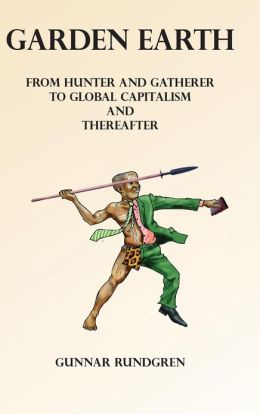
The publication of Garden Earth is now imminent. This is the proposed book cover. Do you like it?

There is a poll on the right side for you to fill in. It is perfectly anonymous.

And you can also make more elaborate comments below.
What the book is about? Read here....

Saturday, December 8, 2012

Ten reasons to build another word


     The difference between reality and rhetoric in which all are said to be equal and to have the same opportunities is simply too great. Our use of both mineral resources and living resources, with their origin in photosynthesis, is now at a level that simply cannot be sustained.We have now reached a stage where we need to divert more attention to building a new world than to fixing the old one. 


1.   Our relationship with nature is characterized by over-exploitation of raw materials and natural resources. Certainly, history shows that we have a remarkable capacity to overcome the limitations of our natural environment. Nevertheless, our use of both mineral resources and living resources, with their origin in photosynthesis, is now at a level that simply cannot be sustained. This can be expressed in different ways such as that we are soon reaching ‘peak oil’; that our ecological footprint is already one and half Earth; that we are already using more than half of the entire biosphere; and that wilderness is now only marginal compared to human-dominated ecosystems.
2.   We know that the release of greenhouse gases, largely the effect of extraction of fossil fuels and degradation of natural resources, will lead to marked changes in climate, resulting in great human suffering and material costs. In addition, we have caused severe reduction of biological diversity, the very web of life on earth. We have manipulated other life processes, such as the nitrogen cycle, to such a scale and in such a way that it will most certainly lead to severe disruptions.
3.   We have unleashed 100,000 chemicals, but we have no idea how they affect us. We take medicines, eat food additives and indirectly consume pesticides we spray on crops. Drinking water and the air we breathe are full of man-made chemicals. We have very little knowledge about the long-term impact on us of the cocktail of chemicals we spread, and we know even less about how it affects our living environment.
4.   The production and productivity revolution, which we explain with entrepreneurship, the superiority of capitalism and an individual’s strive for personal gain can equally be interpreted as the result of one thing: access to external sources of energy, primarily fossil fuel. Use of energy is also the cause of many problems, most obviously the greenhouse effect. At least equally serious is that energy is the engine in almost any other resource depletion and degradation of ecosystem services. But the cheap energy sources are drying up and, more importantly, their efficiency is dwindling.
5.   With the commercialization of farming and the introduction of chemical fertilizers, we no longer have to reproduce our production ability and capacity within the system itself. To replenish natural capital, fertility, labour and genetic resources are bought over the counter, thus separating production and reproduction. This system is commercially efficient, but very inefficient in its use of energy; it is threatening the long-term fertility and capacity of the soil. Despite the emphasis on production, a billion people go to sleep hungry every day.
6.   The system does not have sufficient self-correcting feedback loops to keep in check income inequality; the only thing that can keep it running is a constant economic growth so that those at the bottom, after all, will be a little better off every year. This is not primarily an economic problem but a social and moral problem. The difference between reality and rhetoric (in which all are said to be equal and to have the same opportunities) is simply too great.
7.   The capitalist model of development was most successful in countries that industrialized first, followed by countries that had different comparative advantages in certain development stages. But large parts of humanity are outside of the development, including both the individuals who are left behind in industrialized countries and those whole countries that have no comparative advantages to exploit. Just like not all communities could make the transition from gathering and hunting to farming, many communities today cannot make the transition to a capitalist society because they lack the right conditions.
8.   The values, attitudes and mechanisms that form the foundation of capitalism are obstacles to the harmonious development of society. Competition is promoted at the expense of cooperation, self-interest at the expense of solidarity and commitment to others, private property at the expense of commons and exploitation at the expense of stewardship or nursing.
9.   The combined effects of those values, industrial technology, capital accumulation and market competition drive endless growth and consumption. It is certainly within human nature to be a little dissatisfied, to want more, to explore new opportunities. Without those properties, we would probably never become human beings in the first place. It is in society’s nature to contain these desires so that they continue to benefit us all. With the capitalist takeover of society, these restrictions don’t work any more, and we are all trapped in a treadmill of ever-increasing consumption. This consumption, driven by several of the factors mentioned above, has made us healthier, wiser, more beautiful and perhaps happier to begin with, but it has long crossed a line after which ‘more things’ do not mean more well-being.
10. That things are not a lot worse than they are is a result of the deep and strong properties of humanity and of our larger organism, our society. We do our best to mitigate the ills produced by our economic system. When old social institutions break down, we build new ones; when old values and culture lose their meaning, we develop new ones. Ultimately, we will also build a new world. We have now reached a stage where we need to divert more attention to building a new world than to fixing the old one. 

These ten points are from the introduction  of Garden Earth which is due to be published within a month. I will keep you posted...