|
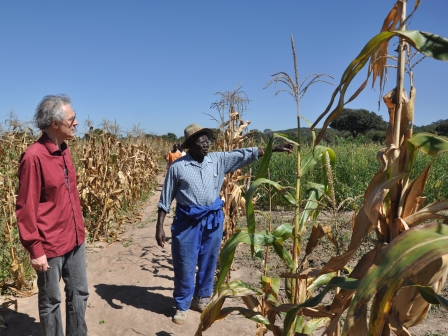
| Seb's maize. Photo Richard Mulonga |
The maize is towering over
a sea of vigorous weeds. In some cases the greenery has pulled down the stalks
and it is almost hard to believe there will be any harvest out of that field.
Seb Scott, however, assures me that his maize will yield some 7 tons per
hectare. The weeds are actually intentionally planted Lablab beans (Dolichos lablab). Seb is growing maize
without machinery; i.e. he and his partner hand-hoe the fields, or just sow by
hand in the mulch with an ingenious piece of tube. They also grow organically; instead
of using government subsidized fertilizers he use green manure crops to supply
nitrogen to his plants.
 |
| Some of the Mkandawire children eating their breakfast |
Seb is not the only
farmer I visit this day in Zambia
in the end of April 2012. My first visit went to Fred
and Susan Mkandawire. They grow maize on a hectare of land and they harvest
a ton, just enough to keep the family alive. Maize is what they eat for
breakfast, lunch and dinner. They don’t starve, but their margins are very
small. It seems that they can sell a surplus of 250 kg, worth around 50 dollars
this year, which is far from enough for the school fees for the five children.
The Mkanadawires are using chemical fertilizers and work totally manually on
their farm.
 |
| Godfrey Boma and his sunflower, Photo: Richard Mulonga |
When he stands next to
his great organic sunflowers, it is hard to believe that Godfrey Boma is 81
year old. After all, life expectancy in Zambia is below 40 years. Godfrey
is a former miner and small business man who became a farmer at an age where
the normal Swede stops working altogether. His and his wife Katherine’s farm is
9 hectares of which 4 hectares are farm land. He uses own oxen for plowing. A
better – and more timely - land preparation, better weeding and higher use of
chemical fertilizers are all contributing to that he harvest around 5 tons per
hectare of maize - more than double the national average. That is five times as
much as Fred and Susan, but still less than Seb.
Godfrey also has a plot of
organic production, Instead of the monoculture of maize which is typical for
conventional maize production (such as Mkandawire’s and his own) the organic
plot has ten different crops in smaller plots or grown together (so called
companion cropping). When I asked how organic and non-organic compares, he
says: ”It is 50-50. Organic is nice, there are no problems with disease, I
don’t use any chemicals and have less cost. But it is more work”.
The visits show that
it is possible to increase yields a lot. It is possible to do it with
conventional methods and it is possible to do it with organic methods. It is
possible to do it in a small scale farm or in a large scale farm. It also shows
that poverty, in the sense of limited resources, as for the Mkandawires, is
most likely a cause of low productivity in farming, rather than low
productivity being the cause of poverty.
Zambia has been used as an example of successful
agriculture policy, a proof that with more fertilizers one can produce ”more
food”. Perhaps there is limited success on that count, even if the Ministry of
agriculture’s own
research shows that most of last years high yields crops can be explained
by good rains.
Zambia’s agriculture budget is to a very large extent
orientated to subsidies of chemical fertilizer and government procurement of
maize, to a price considerably above world market prices. And clearly it works
in the sense that it results in increased maize production. Anything else would
be highly surprising. Higher prices will
lead to higher production, as it pays to use more resources for the same piece
of land. As we can see above productivity per hectare can increase with
different production methods. Fertilizer probably plays a marginal role for the
increase of maize production in Zambia.
In 2010/11 Zambia had a
bumper crop of maize, and the result is that Zambia has a stock pile of more
than 1 million ton, when the new season starts. The minister of agriculture,
Emannuel Chenda tells the Post (May 1) that the huge surplus is a challenge,
but continues by saying ”I am aware of that potential markets exist beyond our
region in places such as the Horn of Africa. He doesn’t seem to understand that
there is no shortage of food in the world; the people of the Horn of Africa
simply can’t buy it, as little as the poor in Zambia. The Zambian Farmer reports in their April
issue that a very big proportion of the maize stock pile is simply rottening. Approximately a third of the
maize in stock has gone to waste in bad storages. The authorities are now
burning the rotten maize to
make space for the new crop!
Many are critical to
the fertilzer support:
”A ‘one size fit all’ approach to
fertilizer and seed regardless of differences in agro-ecological zones and soil
types has been responsible for poor yields per hectare experienced each year.
All farmers are made to plant the same variety or range of seeds (short
maturing or medium maturing or long maturing) using same type of fertilizers
(D-compound and Urea) despite agriculturists knowing that differences in soil
fertility require adjustments in input applications. This has resulted in
significant drop in yield against yield potentials to as low as 10 bags per
hectare against the potential 50-70 bags.”
Daniel Kalala from the
Kasisi Agriculture Training
Center says that
”fertilizer subsidies is the number 1 election campaign strategy”. Others point
to the rampant
corruption involved in the program. The Farmer Input Support program costs Zambia 700bn
Kwacha per year (some 133 million dollars).
This is enough to buy more than 500,000 ton maize – enough to feed some
2-3 million Zambians. By only supporting maize production with fertilizers and
seeds, the government induces bad management practices (mono-culture) as well
as bad nutrition of rural families, as they will grow more maize and less of other crops.
All those issues
aside, the story of food and who gets it and who doesn’t has very little to do
with agronomic issues or with the use of more GMOs, or more fertilizers. The
farms I visited show that it is access to resources (including know how) as
well as markets that is most important for the productivity of the land and not
if the farm is organic or not. How we farm is still a very important issue for
how we maintain and enhance our social and natural capital, When it comes to
food, distribution is a much bigger challenge. And distribution, in turn, has a
lot to do with markets. And markets don’t distribute food to those that have no
money to buy for.


 During the past 30 years, much of America’s most fertile farmland has been lost to wasteful development. The National Resources Inventory The NRI, conducted by the USDA Natural Resources Conservation Service (NRCS) in cooperation with Iowa State University’s Center for Survey Statistics and Methodology, is a survey of the nation’s non-federal lands that tells the story of farmland loss by the numbers. The most recent NRI, covering the 25-year period between 1982 and 2007, reveals that more than 23 million acres of America’s agricultural land have been lost to development—an area the size of Indiana. (www.farmland.org)