Showing posts with label Zambia. Show all posts

Wednesday, May 9, 2012

Markets don't distribute food to those without money


Seb's maize. Photo Richard Mulonga
The maize is towering over a sea of vigorous weeds. In some cases the greenery has pulled down the stalks and it is almost hard to believe there will be any harvest out of that field. Seb Scott, however, assures me that his maize will yield some 7 tons per hectare. The weeds are actually intentionally planted Lablab beans (Dolichos lablab). Seb is growing maize without machinery; i.e. he and his partner hand-hoe the fields, or just sow by hand in the mulch with an ingenious piece of tube. They also grow organically; instead of using government subsidized fertilizers he use green manure crops to supply nitrogen to his plants.


Some of the Mkandawire children eating their breakfast
Seb is not the only farmer I visit this day in Zambia in the end of April 2012. My first visit went to Fred and Susan Mkandawire. They grow maize on a hectare of land and they harvest a ton, just enough to keep the family alive. Maize is what they eat for breakfast, lunch and dinner. They don’t starve, but their margins are very small. It seems that they can sell a surplus of 250 kg, worth around 50 dollars this year, which is far from enough for the school fees for the five children. The Mkanadawires are using chemical fertilizers and work totally manually on their farm.

Godfrey Boma and his sunflower, Photo: Richard Mulonga
When he stands next to his great organic sunflowers, it is hard to believe that Godfrey Boma is 81 year old. After all, life expectancy in Zambia is below 40 years. Godfrey is a former miner and small business man who became a farmer at an age where the normal Swede stops working altogether. His and his wife Katherine’s farm is 9 hectares of which 4 hectares are farm land. He uses own oxen for plowing. A better – and more timely - land preparation, better weeding and higher use of chemical fertilizers are all contributing to that he harvest around 5 tons per hectare of maize - more than double the national average. That is five times as much as Fred and Susan, but still less than Seb. 

Godfrey also has a plot of organic production, Instead of the monoculture of maize which is typical for conventional maize production (such as Mkandawire’s and his own) the organic plot has ten different crops in smaller plots or grown together (so called companion cropping). When I asked how organic and non-organic compares, he says: ”It is 50-50. Organic is nice, there are no problems with disease, I don’t use any chemicals and have less cost. But it is more work”.

The visits show that it is possible to increase yields a lot. It is possible to do it with conventional methods and it is possible to do it with organic methods. It is possible to do it in a small scale farm or in a large scale farm. It also shows that poverty, in the sense of limited resources, as for the Mkandawires, is most likely a cause of low productivity in farming, rather than low productivity being the cause of poverty.

Zambia has been used as an example of successful agriculture policy, a proof that with more fertilizers one can produce ”more food”. Perhaps there is limited success on that count, even if the Ministry of agriculture’s own research shows that most of last years high yields crops can be explained by good rains.

Zambia’s agriculture budget is to a very large extent orientated to subsidies of chemical fertilizer and government procurement of maize, to a price considerably above world market prices. And clearly it works in the sense that it results in increased maize production. Anything else would be highly surprising.  Higher prices will lead to higher production, as it pays to use more resources for the same piece of land. As we can see above productivity per hectare can increase with different production methods. Fertilizer probably plays a marginal role for the increase of maize production in Zambia. In 2010/11 Zambia had a bumper crop of maize, and the result is that Zambia has a stock pile of more than 1 million ton, when the new season starts. The minister of agriculture, Emannuel Chenda tells the Post (May 1) that the huge surplus is a challenge, but continues by saying ”I am aware of that potential markets exist beyond our region in places such as the Horn of Africa. He doesn’t seem to understand that there is no shortage of food in the world; the people of the Horn of Africa simply can’t buy it, as little as the poor in Zambia.  The Zambian Farmer reports in their April issue that a very big proportion of the maize stock pile is simply rottening. Approximately a third of the maize in stock has gone to waste in bad storages. The authorities are now burning the rotten maize to make space for the new crop!

Many are critical to the fertilzer support:
”A ‘one size fit all’ approach to fertilizer and seed regardless of differences in agro-ecological zones and soil types has been responsible for poor yields per hectare experienced each year. All farmers are made to plant the same variety or range of seeds (short maturing or medium maturing or long maturing) using same type of fertilizers (D-compound and Urea) despite agriculturists knowing that differences in soil fertility require adjustments in input applications. This has resulted in significant drop in yield against yield potentials to as low as 10 bags per hectare against the potential 50-70 bags.”
says Action Aid in a report.

Daniel Kalala from the Kasisi Agriculture Training Center says that ”fertilizer subsidies is the number 1 election campaign strategy”. Others point to the rampant corruption involved in the program. The Farmer Input Support program costs Zambia 700bn Kwacha per year (some 133 million dollars).  This is enough to buy more than 500,000 ton maize – enough to feed some 2-3 million Zambians. By only supporting maize production with fertilizers and seeds, the government induces bad management practices (mono-culture) as well as bad nutrition of rural families, as they will grow more maize  and less of other crops.

All those issues aside, the story of food and who gets it and who doesn’t has very little to do with agronomic issues or with the use of more GMOs, or more fertilizers. The farms I visited show that it is access to resources (including know how) as well as markets that is most important for the productivity of the land and not if the farm is organic or not. How we farm is still a very important issue for how we maintain and enhance our social and natural capital, When it comes to food, distribution is a much bigger challenge. And distribution, in turn, has a lot to do with markets. And markets don’t distribute food to those that have no money to buy for.  

Friday, May 4, 2012

The monuments of the city are built on the backs of poor rural people

When going from Lusaka towards the farm of Susan Mkandawire we meet a constant stream of guys on bicycles on their way to Lusaka with heavy loads of charcoal. One of them is Christoffer Finsoni on this picture. He is a farmer but earns most of his cash from charcoal making and marketing. He carries 4 bags of 30 kg charcoal on his bicycle some 30 km to the market in Lusaka.

We often here the story about ignorant rural population that destroys their environment by cutting down the trees for cooking. But the reality is a lot more complex. Christoffer and his likes are mainly living in the "organic economy" based on biological and renewable resources. Wood (charcoal) and human power (as in bicycle) are the main energy sources. When I meet him in my car I represent the fossil fuel economy and the global industrial system. What strikes me is the direction of the stream of resources.

Many believe that the stream is from the rich global fossil-fuel economy to the poor, but is it?

Andrews family doesn't use char coal for their cooking, they use fire wood. Char coaling for the market in the city is a bigger threat to their forest land. And who is buying the char coal? Well it is certainly not the poor, they use twigs, corn cobs, stalks and other waste for their cooking. It is rather rich people in the city that drives deforestation. A similar case is the cutting of forests for conversion to grazing land. Most of that meat is destined for rich people. A similar thing is the idea to make bio char from bio mass. Again, poor peoples resources are used to enable the rich to continue a life style that is not sustainable. 

In the same way, the notion that urban living is more environmentally friendly as claimed by many, is just a delusion. The city has always been a parasite on the rural areas and most of the destruction in rural areas are caused by "city life and industrialism". This is based on inequality, privilege and violence.

Thursday, May 3, 2012

Keep your ear to the ground!


Photo: Richard Mulonga
Susan Mkandawire in Kasisi, Zambia prepares food for her family of seven. Today’s lunch is Nsima. She uses own maize, a bit of cooking oil from the shop, pumkin leaves from her own farm and salt. This is the typical lunch and dinner most days. Breakfast: maize porridge.
 
This is the first job in the project
Keep your ear to the ground!


Which is the title of a book being written by journalist Ann Helen Meyer von Bremenand agriculture consultant and writer Gunnar Rundgren. It is commissioned by the largest environmental NGO in Sweden, the Swedish Society ofNature Conservation (www.snf.se) and will be their yearbook for 2013. 
Breakfast for some of the Mkandawire kids, Photo: Richard Mulonga
The main theme of the book is if it is possible to provide food for a growing population in a sustainable way. The book will look at agriculture development in a global and historical perspective to inform the reader of the forces that shape agriculture – and relate it to our diets and the landscape.  It will describe main challenges for agriculture such as water, erosion, nutrient supply and oversupply, biodiversity and competition between food production with other land-uses, such as bio-energy, conservation and built infrastructure. 
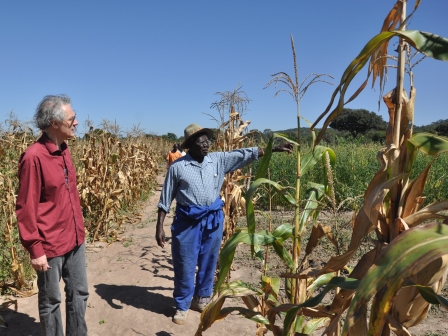
81 year old Godfrey Boma shows me his organic plots. Photo: Richard Mulongo

How agriculture is shaped by forces of technology, markets, policy and demography will be described. Special features will show this in the practice based on visits to countries such as Brazil, the US, India, the Netherlands and Sweden. Not only problems will be highlighted; from each country examples showing a path for a truly sustainable agriculture will be showcased.  

The book will discuss some of the prevalent perceptions or myths about farming and diets such as the need for GMOs and chemical fertilizers, the effect of increasing meat consumption, the effect of the farm frontier expansion. It will also present one or more scenarios for a truly sustainable agriculture.

The work with the book will be done in the period April to November 2012, with the research phase in April to August 2012. It will be published, in Swedish, in December 2012. 

Susan does the heavy hoeing, preparing the land. Fred, the husband cuts the grass with a panga. Photo: Gunnar

Wednesday, October 14, 2009

Biofuel in many shapes


I have been on a trip to Ethiopia and Zambia. Discussed biofuel in both places. Biofuel comes in many shapes and forms and I don't think it is appropriate to take a firm stance against or for biofuels as such.

It is quite clear that biofuels as such does not have the potential to replace all oil used. Not even for todays transport and even less with the growth of economies and population. There is simply not enough land for that. At the same time that can hardly be an argument biofuel. With that logic all alternative sources of energy useless as none of them will be enough - alone. Then there is this complaint that biofuels increase food prices or creating a lack of food. I have been arguing against this argument before and this year we see how little truth there is in that argument. Last year when food prices spiked many blamed that on biofuel. But today when the wheat price is almost falling through the floor, where are all these voices? What do they say now?

Of course, there can be such a competion, in the same way as there can be competition between animal feed and food, between tobacco and food, between wool and food (sheep raising for wool were allegedly the main reason for the big Irish famine, rather then potato blight as often said), betweem cotton and food, between roads and food (as most roads are built on prime agriculture land). But humans have always produced biofuels and bio energy: Firewood, charcoal, horses and oxen for traction etc. In Sweden some fifteen percent of our land was used to feed horses before.

In Zambia I visited Bruno's Jatropha (see picture), a local entrepreneur that has raised some 1 million Jatropha seedlings. His idea is that smallholders grow it as a hedge row along their fields. He says that 1 million hectare of Jatropha would satisfy all Zambias energy needs. Zambia as a land-locked country without oil is in a desperate need of energy. During my visit they run out of petrol, and that happens quite often. Zambia has plenty of land that can be used for Jatropha or other biofuels, such as ethanol from cane.

Of course there is totally another story if big biofuel projects chase people off the land, but that is no different then when they do that for producing rice or cotton. For those whose land is grabbed it makes little difference what the land is used for...

We must cut down on energy use. There are no silver bullets, not even solar energy will for a foreseeable future be enough. In theory it could but we look perhaps hundred years ahead for that energy party. Today we need to save.