Showing posts with label book review. Show all posts

Monday, November 4, 2013

Systematic collapse or collapsing systems? Review of Orlov's The Five Stages of Collapse


In the parking lot of the guest house where I stay in Banga, Burundi, 105 people were killed in the civil war which ravaged the country from 1995 to 2005. It is a coincidence that I read Orlov’s book The Five Stages of Collapse in Burundi. This small, but densely populated country on the shores of Lake Tanganyika, experienced a deadly kind of collapse in the shape of a civil war. Over 200,000 people were killed in that war.

How does Burundi fit into Orlov’s stages of collapse? Not so well, I am afraid.

Orlov does not spend a lot of time convincing people that collapse is imminent. His readers would have already understood it. Orlov says he wrote the book to help us deal with collapse; we can not avoid it, as it is unavoidable, but survive it, and possibly find our way back to a nice society. His second cardinal accomplishment is to provide us with “taxonomy of collapse.”

Stage 1: Financial collapse. Faith in “business as usual” is lost.
Stage 2: Commercial collapse. Faith that “the market shall provide” is lost.
Stage 3: Political collapse. Faith that “the government will take care of you” is lost.
Stage 4: Social collapse. Faith that “your people will take care of you” is lost.
Stage 5: Cultural collapse. Faith in the goodness of humanity is lost.

The taxonomy is quite helpful. The presentation of collapses as stages which occur in a certain logical order is more problematical. For instance, while there are examples of financial collapse which trigger commercial collapse which trigger political collapse, there are also examples of collapse that are mainly driven by political issues, which in turn might influence finances and markets. Burundi is a case of a political collapse, and perhaps a social collapse, coming before the commercial collapse. Some of Orlov’s own examples, such as the collapse of the Soviet Union and the fate of the people Ik, also contradict the idea that a collapse follows a certain order. To my knowledge financial collapse did not trigger the fall of the Soviet Empire.

It may be a fair assumption that a collapse of the current financial global market system - and thus of modern society - will start in financial markets (as has already happened), and cascade further according to Orlov’s trajectory.  Then again, how can we be sure about that?

Orlov’s perspective on the market economy is damning. He analyzes how global competition drives all economic agents into economically efficient behavior, simultaneously making them inefficient from other perspectives. The selling of one’s labor is described as “desexualized prostitution.” Trade and market relations have been allowed to take command of a too large part of our lives. We care for family, friends and kin, and normally do not interact with them as a market, and engage in monetary transactions. Money and market relationships should, according to Orlov, be reserved for dealing with those you cannot trust, and, largely, for non-essential goods. This, today, is turned on its head. 

When Orlov says that a commercial collapse is not so bad, since we can fall back on a gift economy for essentials and use the market only for luxuries, he assumes that the essentials can be provided within the cozy circle of kin and friends. This might be possible, but it also assumes that our essentials do not include a large number of modern products and infrastructure. Are cotton clothes essential? Are sugar, telephones, computers, bicycle chains, etc., essential? None of them would easily materialize in a barter economy limited to kin and friends.

Orlov’s views of how social collapse will unfold are not pleasant. He does not claim to serve us only what is agreeable either. However, I find his views a bit too negative. I also find them contradictory. He makes much of a story of two communities living side by side: one, a typical middle class, well-educated, well-behaved community with law-abiding citizens, and the other, a typical criminal underworld community with its citizens engaged in drugs, black marketeering and crime. He thinks it is apparent that the criminal sub-culture is superior in hard times. To me that seems to contradict his praise for “mutual aid” as promoted by Pyotr Kropotkin(a Russian anarchist), someone whom he attributes many interesting pages to.

Orlov certainly has a point when he writes, “Under emergency conditions, the previously enacted rules, laws and regulations will amount to an essentially lethal set of inflated standards, unachievable mandates and unreasonable restrictions, and attempting to comply with them or enforce them is bound to lead to inaction at best and armed conflict at worst.” There are probably few, if any, good ways to de-complexify complex societies. Perhaps, I just have a higher faith in humanity to adjust, for better or for worse, to new conditions. In discussing social collapse, Orlov puts his faith (!) in religion being the institution that can take us over to another new social contract and civilization. His argument is based on the premise that religions have been able to survive many social collapses and to some extent have provided a refuge for civilization.

The strategy to try to survive the collapse by being self-sufficient is not a viable one. It may work for a few people but “for the rest, it might be better to abandon the idea of finding a safe place to be, and to concentrate instead on discovering a safe way to be—in company with others.”  In other parts of the book, though, he takes a much more individualistic perspective, and the reader is advised to hoard items which might come in handy when financial and commercial systems have made money meaningless. In line with this is also the analysis of who is best adapted to survive a collapse: they should be indifferent to suffering; have the will to survive; have the ability to persevere in spite of loneliness and lack of support from anyone else, and, have “the sheer stubborn inability to surrender in the face of seemingly insurmountable odds, opposing opinions from one’s comrades or even force.”

Orlov sees human social bonds and actions as primitive, leading us to act as a herd of sheep. We have to turn to the solitary geniuses for our salvation. They are more highly evolved according to him, and it is thanks to “brilliant loners and eccentrics” that progress is made. Later in the book, he emphasizes family and similar bonds as being of utmost importance and central to humanity. I wonder if I missed something, or, did he?

The contradictions might have been resolved with more critical editing. Orlov also rants and goes off into side-discussions that are only vaguely related to the main thread of the narrative. For example, he dismisses charities and philanthropy as demeaning (they might be, but it is hardly a central discussion for the stages of collapse); he has a distinctly gender-biased discussion about how men and women react to the threat of collapse; and he discusses the merits of various national languages in some detail, without really making clear to us how Chomsky’s Universal Grammar has anything to do with cultural collapse. They do not add much to the main discourse, though some of them can be amusing and interesting. 

Orlov should be credited for daring to challenge many established views and promoting concepts that are not so often promoted, even within the collapseological community. He has the guts to question the prevailing market religion, not only because it is giving undesired results, which many agree with, but more importantly, because it is built on the wrong foundation.

One can easily be provoked by Orlov, but, then again, this seems to be his mission. After all he wants us to think for ourselves and not just accept what he says. The prose is also full of memorable and entertaining statements such as, “The intelligence of a hierarchically organized group of people is inversely proportional to its size, and mighty military empires are so big, and consequently so dumb, that they never, ever learn anything.” I encourage you to take on Orlov’s challenge.

Start by reading the book.

Dmitry Orlov was born in Russia but moved to the US as a teenager. For the past five years he has been experimenting with off-grid living and renewable energy by giving up the house and the car. Instead, he has been living on a sailboat, sailing it up and down the Eastern Seaboard, and commuting by bicycle. He believes that, given appropriate technology, we can greatly reduce personal resource consumption while remaining perfectly civilized.

Monday, August 5, 2013

The world after money


Blindness to the impact of non-economic factors on economic processes, belief in the infallibility of free markets and the reliance on irrelevant statistics such as the GDP worked reasonably well during the economic expansion that reached its peak in the late twentieth century. But the end of cheap energy, which doubtless is a reality, means that the challenge is no longer in managing abundance but in managing the end of abundance. That is the key message in Archdruid John Michael Greer’s* The Wealth of Nature: Economics as if Survival Mattered, New Society Publishers. 

Greer discusses economics from a no-nonsense perspective and links it to its original meaning of householding: labour, land, pins, baskets and bags of wheat. He discerns three layers of the economy. The real primary economy is the natural resources we utilize in what we normally see as economic processes in factories, mines and fields. In Small is Beautiful, British economist Eli F Schumacher points out that the primary economy must always come first because it constitutes the foundation of production of secondary goods.

In the secondary economy, it is usually possible to substitute one set of goods for another if the supply of the second set of goods runs short or the price gets too high. This forms the basis of economic theories. But it is an assumption that does not apply to natural or primary goods. Greer says, “A failure to distinguish between primary and secondary goods is at the root of a great deal of today’s economic nonsense.”

The production and exchange of goods and services among human beings is a subset, a fairly small one, of a much larger economy that embraces the entire natural world. But in today’s “economy”, instead of adjusting to that the secondary economy has been dwarfed by yet another layer – the financial economy. This is supposed to be worth many times more than the value of all the actual goods and services in the world. Ironically, this third layer was originally just a small off-shoot of the secondary economy; it was a tool for improving the operations of the secondary economy.

Though the growth of the tertiary economy is based on debt, this debt is all but real. Our real debt is to the future generations and to Nature; it is neither the paper debt issued by the government nor the digital debt issued by the banks. In this way, we have turned the economy upside down. The virtual, tertiary economy built on abstractions is referred to as “the market”. It dictates the rules of the secondary economy and ignores the preconditions of the real primary economy.

All attention to date – and the debate between left and right and between neo liberals and social democrats – is about the arrangements evolved to address the relationship within and between the secondary and tertiary economies. The primary economy of Nature, the base of the entire structure, has essentially no place in the economic policy of today’s industrial nations; “it means that mismatches between the primary economy and the other two economies not only won’t be addressed — they won’t even be noticed,” says Greer.

One important reason why this could happen is the use of fossil fuels. We have unleashed natural assets (the primary economy) on a scale never dreamed about before. Therefore, as Schumacher says, “Energy cannot be treated as one commodity among many, without reducing economics to gibberish, because energy is the gateway resource that gives access to all other resources.” The link between GDP and use of energy is more or less self-evident with this view. Energy extraction and economic growth interacts in a positive feedback loop, i.e., a loop where the components reinforce each other. But as Donella Meadows points out in Leverage Points: Places to Intervene in a System, positive feedback loops are mostly self-destructive.

This can’t go on forever. The whole industrial age can be seen as the “mother of all bubbles” driven by the fantasy of infinite economic growth on a finite planet. This mega bubble has spawned a second bubble of financial speculation, for which the main vehicle is money.

According to Greer, there are at least three problems with the money economy. The first is its dominating power. This means that almost all economic exchange is driven towards monetary exchange; the creation of an economic monoculture. The second distinctive feature is that it makes it harder, not easier, to value certain very large classes of goods and services. Prominent among these are Nature’s values and the social values of our communities, culture and society. The third is that money functions as a good in its own right, and the right to use it functions as a service. The entire world of finance, from savings accounts and installment loans up through the dizzying abstractions of today’s derivative markets, unfolds from this third property of money.

Greer sees a strong link between bubbles and distribution of wealth: “It’s not an accident that the most devastating speculative bubbles happen in places and times where the distribution of wealth is unusually lopsided.” When wealth is better distributed, more of it will circulate in the productive economy of wages and consumer purchases. He also sees a more global side of this inequality: “One important consequence of the industrial system was a massive distortion of patterns of exchange in favor of the major industrial nations,” i.e., the poverty of the Third World countries is an integral part of the prevailing global system. Greer also points to the role of money and the tertiary economy in the distribution of wealth. I find those three observations very interesting and plausible. I would have appreciated if the Wealth of Nature had analysed them more and if they could have been more clearly addressed in the final chapters.

There are a number of flaws in economic theory. For instance, in theory, the production and price of a commodity are entirely determined by the balance between the desire of consumers to buy it and the desire of producers to make a profit from producing it. That is actually only valid when either supply or demand is not constrained by factors outside the economic sphere. Very often there are such constraints – not only natural limits but also limits of a political or technical nature. After all, many brilliant ideas never materialize for a number of non-economic reasons. Greer also shows how cut-throat competition in a laissez-faire market doesn’t always produce improved access to better and cheaper goods and services, as Smith argued it would. Instead, it is one of the main driving forces for the concentration of shops and suppliers, so much so that now one needs a car and has to live in a city to access services that were available everywhere fifty years earlier.

Greer is deep into the “collapse narrative”. He stands for a “long descent” version and not a chaotic, rapid, dog-eat-dog descent, according to the established typology in the peak-oil, end-of-growth sphere. He even wrote a book titled The Long Descent. At times he may still sound like one of the end-of-the-world doomsayers: “A decade from now, let’s say, when half the American workforce has no steady work, decaying suburbs have mutated into squalid shantytowns and domestic insurgencies flare across the south and the mountain west....” For me that is hardly an example of a “long descent”; it is, instead, a rather rapid collapse. The collapse will also be very deep according to Greer, and human population is bound to shrink “as malnutrition becomes common and public health collapses.” (I discuss the various collapse narratives in Chaotic collapse or long descent?).

He foresees a future in which the secondary economy suffers from chronic underinvestment, and collapsing infrastructure becomes a dominant factor in daily life. A growing fraction of our supplies of energy, resources and labor have to be used for bringing the energy that keeps the entire economy moving. This functions as a tax, in kind, on every productive economic activity.

Like many others, he refers to earlier collapses to make his case. In particular, he refers to the collapse of the Roman Empire, admittedly more relevant than the collapse of the culture of Easter Island or the lost Viking colonies of Greenland, as a case of the collapse of a complex global empire, which is what we can call the capitalist civilization. He builds heavily on Giambattista Vico’s Principles of a New Science Concerning the Common Nature of Nations and on Joseph Tainter’s Collapse of Complex Societies, which is perhaps better known than the former.

Apart from the main narrative about the three economies and the collapse, Greer also discusses our patterns of thinking. Our prevailing rational paradigm is based on “what exists is limited to what can be known; what can be known is limited to what can be measured; and what can be measured is treated as though it was identical to its measurements.” Because we can’t measure real wealth, we use money as a rough-and-ready way of sorting out the relative value of different kinds of wealth. Most economists talk about money when they think they’re talking about wealth. This confusion also blocks our minds in trying to find solutions for the situation. It makes our minds orientated to ways of finding money to invest in the green transition or to finance the welfare state. Even for our personal life, we look for economic security in the sense of having enough money to live a good life. But as he points out: “Over the longer term, it’s safe to assume that the vast majority of paper assets now in circulation, whatever the currency in which they’re denominated, will lose all their value”

In addition to money, our civilization is also obsessed with technological progress to a religious extent. “The faith in progress has drawn strength from the unquestionable fact that for the last three centuries those who believed in the possibilities of progress have generally been right.” People and societies, therefore, will cling to technology as the savior. New problems will be solved by technological remedies, and “shiny new machines” will doubtless push industrial civilization further into descent like an ancient Greek tragedy. “Put another way, a civilization that lives by the machine can expect to die by the machine as well.” Greer doesn’t put a lot of faith in discussions about the green economy. That thought relies on the modern religion of progress, a belief that the accumulation of technical knowledge is the main source of our wealth. But in reality, our wealth as well as our massive technical progress is driven by fossil fuel extraction. “The explosion of technical knowledge was a consequence of that, not a cause.”

Many of those that agree there will be a big turnaround still believe we can pick and choose the technologies we like and bring them with us to the future. In particular, the Internet is one of those technologies which is claimed to be useful. Greer is not convinced: ”Very few people realize just how extravagant a supply of resources goes to maintain the information economy.... each one of the big server farms that keep today’s social websites up and running use as much electricity as a midsized city.”

That it may not be possible to maintain the Internet has to do with what he calls the Economics of Contraction. This contraction will pose an additional challenge to the future, as most of our technologies displaced older technologies that provided the same services on a more sustainable basis. As the industrial age winds down, human muscle will again be the main source of wealth and it will make no sense to use scarce resources to do things that human labor can do equally well. How much it costs to equip a worker to do any given job will become a central economic issue, rather than how much it will cost to equip a machine with an operator.

While he is convinced of the need for change and the inevitability of change, considering the dwindling energy supplies, Greer doesn’t advocate a radical revolution. “The evidence of history suggests that with societies, as with other natural systems, change happens most successfully by way of simple mutations rather than complete reshapings.” He puts his faith in a mix of reform politics, monasteries (!) and, I believe, in the laws of contraction acting as a new environmental factor giving us humans quick – and harsh – feedback on the ways we chose.

As I grapple with these questions, I am taking a special interest in the concluding chapters. However, I find that many of the prescriptions fall short of adequately addressing a predicament of the magnitude Greer explains. He uses the USA of the 1950s as an example of something that worked: very strict regulation of the “tertiary” economy, but a laissez-faire attitude for the material economy. It did work, certainly; but it worked not as much by the virtue of the policies, as by the fact that it was the upgoing period of the mega bubble. He suggests we should increasingly pay for our use of Nature; a thought shared by most ecological economists, and increasingly by liberal mainstream economists as well. He doesn’t discuss the possible drawbacks of this way of monetizing Nature, and how it could affect power relations in society. Corporations should be treated more like natural persons, i.e. held accountable by law. But he fails to address that most of the evil-doing by corporations is perfectly legal; not only legal but mandated by law to maximize profits from the activities. Greer suggests that all taxes would be on the primary economy and the tertiary economy. This works well for one of the two main roles of the tax system, rewarding some behaviour and discouraging others. But I fail to see how we could build a sustainable public sector based on a tax system like this. The more successful the policies are the less taxes will be gained.

Greer points out that those who are most vehemently in favour of a free market are often those that argue for privatization of the commons, overlooking the fact that the market itself is a prime example of a commons. Perhaps the future of money itself could be to transfer it into a common good?

Greer advocates monasticism, i.e. preserving culture within the monasteries. His argument is about those monasteries carrying culture from one glorious period to the following one, through a period of decline, for example, from the Roman Empire to the Renaissance. However, it seems a little difficult to see the relevance of those as a survival strategy for humanity. Most people didn’t survive the Middle Ages in the monasteries, and the Arabs, I believe, did more for carrying the culture of ancient Greece to the Renaissance, than others. We don’t even know if the Middle Ages were so bad, do we?

While I have reservations about some of his proposed measures, I am quite convinced about the trajectory that Greer describes – a trajectory of reduced complexity and relocalization. These are driven by hard factors and not political whims. On the contrary, politics still tries to address the failures of our civilization with more of the same.

The current drive for local food and self-sufficiency is more than a fad or a political project. It is a natural response to economic contraction, collapse in complexity and dwindling energy. It is also about individual survival. Many will move towards direct production of goods and services for their own use, using local resources. This is both a step towards the “world that will emerge after money” and a safe bet for the individual. Just as our society, fossil fuel, the religion of progress, extreme division of labour and our consumerism are all part and parcel of the same process, any future change will also have to be coherent between individual choice, prevailing ideologies and the big societal processes.

The Wealth of Nature provides many insights which are useful for this future.

*John Michael Greer (born 1962) is an American author who lives in Cumberland, Maryland. He currently serves as the Grand Archdruid of the Ancient Order of Druids in America, a position he has held since 2002.

He blogs on http://thearchdruidreport.blogspot.se/

Friday, July 26, 2013

Brown: Full Planet & Empy Plates


writes Lester R. Brown in Full Planet, Empty Plates: The New Geopolitics of Food Scarcity (Earth Policy Institute).

The world food situation is deteriorating. Grain stocks have dropped to a dangerously low level. The World Food Price Index has doubled in a decade. The ranks of the hungry are expanding. Political unrest is spreading. On the demand side of the food equation we have a rapidly increasing population and people moving up the food chain, consuming grain-intensive livestock and poultry products. In addition, in some countries, notably the USA, huge quantities of grain is used for bio fuels. 

At the same time, water shortages, soil erosion and heat waves are making it more difficult for farmers to keep pace with demand. New technology can’t compensate for the increasing gap between supply and demand. In the worst case scenario, the whole civilization is threatened.

The book contains a lot of facts, some particularly noteworthy:
-In India and China more than 300 million people live on grain which is produced with unsustainable irrigation practices that pump water at a rate surpassing recharge
-A person in India consumes in average 170 kilograms grain while an American utilizes 640 kilogram. The difference is caused by the American using eighty percent of the grain for meat, milk and egg. 
-The grain used for ethanol in the USA 2011 equals the quantity that could support 400 million people on a global average consumption level.
-For sixty years, increase in grain yields has been impressive, but yield increases have slowed down. Between 1950 and 1990 yields per hectare increased in average 2.2 percent per year, while the last 20 years yields increased only 1.3 percent per year. In some countries with highly developed farming, e.g. in Western Europe, yields don’t increase at all.
Use of US corn crop.
Brown is clearly no supporter of bio fuel. He worries that cars will literally take food from the poor. The fusion of food and fuel trade and production means we there will be competition for grain between the owners of 1 billion vehicles and the poor. And as the average owner of an automobile earns 30,000 dollars per year and the poor just a few hundred dollars per year, it is not hard to know who will have the upper hand. While I share some of his concerns about the effects of increased bio fuels, I do think that Brown simplifies the discussion a bit too much. He claims that other sustainable technologies are available to feed our transport sector, e.g. electrical cars. But not even in the USA which is blessed with abundant natural resources there is any chance to run the transport sector in a sustainable. The question should not be “what shall fuel our cars?”  but rather, how can we redesign our whole transport sector.  

In the last chapter, Brown talks about the solutions. They are largely to stabilise population (a constant theme of Brown’s), eradicate poverty, reduce meat consumption and trash those policies that push bio fuel expansion, notably the mandatory requirements to blend petrol with ethanol in the USA and the EU.
While not being anti-GMO, Brown doesn’t see any great potential for genetic modification to further increase grain yields. This is largely because seed breeders have already tapped most of the potential for increased yields. Similarly he doesn’t see many other technological advances as we are approaching limits set by the climate and the photosynthesis itself. Therefore, on the side of production, we have to stabilize the climate, use water more efficiently and protect the top soil.

By and large, most of the discourse is convincing, but Brown does underestimate the positive and negative effects of the markets on food production. In most parts of the world there is still a huge potential to increase yields – if prices motivate farmers to intensify production. I miss a discussion about the negative effects of unfettered global competition on local food production in many parts of the world. Without those economic and social perspectives we can’t fully understand farmers’ behaviors and choices (or lack of choice) and therefore we are bound to fail in addressing the underlying problems. I also think he largely ignores the enormous dependency of fossil fuel that our food system has in all its chains, from inputs such as fertilizers to the global distribution chains.

The book does drive across that we are moving towards increased competition for basic resources such as land and water. Competition between poor that are hungry and rich that want to drive cars, between multinationals that buy up land and local populations of smallholders. But also, as shown by Brown, between farmers and cities. Many farmers in the US has chosen to let their land revert to desserts when they sell water rights to cities. In this way, expansion of cities creates new desserts.

The web site for the book does contain a wealth of information, including the full data sets used for the research for the book. http://www.earth-policy.org/books/fpep

Sunday, June 2, 2013

Someone is reading

The sales of my book Garden Earth is progressing, albeit a bit slowly. I have got some interesting feed back from some readers and a few reviews have been published:
“While this book represents serious and well researched scholarship, abundant with factual data from authoritative sources, it is written in a very accessible style with a sense of personal warmth and lighthearted humor that keeps one’s interest without excessive jargon. [...]  This work gives us an excellent tool for understanding agriculture and food systems through a social ecology compatible lens, and a valuable contribution to the discussion of how to bring about a society that is rational, prosperous, equitable and ecologically based.”
Writes Grace Gershuny in a review of Garden Earth at the web site of the Institute for Social Ecology
You can read the whole review here.

"If you want to read only one book on sustainability, I warmly recommend this one! This one gives me hope for the future. But we are still facing the biggest challenge in the history of the modern human being."
writes Kristian StÃ¥lne in a recent review of Garden Earth.  The book is used as literature in a university course on Sustainable Transition.

Meanwhile this blog now has some 5,000 page views per month and my Swedish blog some 2,500 page views per month. 

Thursday, May 23, 2013

African Experiences in Resilience and Sustainability


I have had the pleasure of being one of the co-editors of the book, Organic Agriculture: African Experiences in Resilience and Sustainability, which is now published by the FAO.
The book is available for download at: http://www.fao.org/docrep/018/i3294e/i3294e.pdf

The publication stems from the conference on Mainstreaming Organic Agriculture in the African Development Agenda, held in Lusaka, Zambia, from 2 to 4 May 2012. All papers and presentations from the conference is available here.

Ten of the papers of that conference has been reworked into this beautiful book.The different chapters in the book document sustainability experiences, including: mainstreaming organic agriculture into African development approaches; community-based livestock systems combining holistic range management; indigenous ethno-veterinary practices and customary systems of resource management; ecofunctional intensification through management of legumes, systems of rice intensification and integrated farming; and smallholders’ knowledge harnessed through family farmers learning groups and customized information and communication technologies.
 
Included in the book is the Lusaka Declaration on Mainstreaming Organic Agriculture into the African Development Agenda, which was an outcome of the Conference. Among others it said:

We agree that organic agriculture  plays a key role in sustainable development, food security, poverty reduction, environmental security, climate change adaptation, human health, preservation of indigenous knowledge, plant varieties and animal breeds as well as socio-cultural development. We shared international research results confirming that the adoption of organic agriculture practices significantly increases yields and improves livelihoods and food security in Africa.  Based on locally available renewable resources instead of purchased chemical inputs (over 90 percent of which are imported in sub-Saharan Africa), organic producers are less vulnerable to international input price volatility. Moreover organic agriculture is climate smart agriculture, as it produces lower emissions and also provides much greater resilience in times of climate extremes such as drought and heavy rains.  

The Lusaka Declaration also urges all African Governments to include organic agriculture in their policies and agricultural development agenda, including their Comprehensive Africa Agriculture Development Programme (CAADP) Country Compacts and Investment Plans, in consultation with the organic agriculture stakeholders in their countries.

Wednesday, April 3, 2013

Anything too big to fail is too big!


Why on Earth is it Eaarth with an extra ‘a’? Perhaps it is a smart trick to draw attention to the book: Eaarth: Making a life on a Tough New Planet. However I do realize that Bill McKibben has chosen this to convey a very serious message—the message that the blue-green grand oasis we have seen on the pictures taken from Apollo 8 has become a very different planet; our old familiar globe is suddenly melting, acidifying, flooding, and burning in ways that we never experienced before. “It’s a different place. A different planet. It needs a new name. Eaarth”, he says.

In the first half of the book McKibben makes a strong effort to justify this dramatic expression. He does that well, I must say. The ice caps are melting, species are becoming extinct, wildfires are raging, record heat is being recorded every season and strong storms and floods are growing more frequent and severe, washing away our roads and bridges. He says that even “on the old stable planet” we are falling hopelessly behind. Today, one in every four bridges in the United States needs major repair or upgrades. And it's all going to get worse, even if we curb emissions today–which we clearly don’t.

Like many modern writers, McKibben focuses a lot on the connection between energy and economic growth. The more you produce the more energy you need and the more energy you use, the more things you produce. I believe this link is now well established.

Some people think we shouldn’t paint too gloomy a picture of the situation, as it may make people depressed and thereby passive. McKibben is clearly not in this camp. Neither am I. But even my appetite for doomsday meets its match here. I am afraid that spectacular weather events are somewhat overused to prove that global warming is here and that it is going to be hell. He claims that the “great boreal forest of North America is dying in a matter of years”. I remember that I sat crying in my spruce forest some 30 years ago when we had a rapid dying of forests in Sweden and other parts of Europe. The whole forest would be wiped out we were told. Today we have more trees than ever before!

It takes a few examples like these to undermine the story. But I don’t want to do that. McKibben is basically right, even if he might be wrong in some details, and uses too many “events” and not enough science to build the case.

Perhaps he is also overemphasizing on climate change being the single most pressing issue for our civilization. He does point to peak oil and a few other indications to show that the system has reached its limits, but climate change stands out as clearly the number one issue to be solved. While I dread climate change, I do think human civilization can survive it. But it will cost. And when energy is scarce and many other resources are depleted, we might not be able to afford the things we need. Having said that, climate change is certainly a threat that needs immediate action and attention.  

On page 99 he shifts attention to “after the flood”. Because there will be an after.
”the trouble with obsessing  over collapse, though, is that it keeps you from considering other possibilities...There is no real room for creative thinking....The rest of this book will be devoted to another possibility – that we might choose instead to manage our descent. That we might aim for a relatively graceful decline.” From there McKibben tries to explain how such a new civilization would look like and how we would reach there.

And it is this part of the book that is most interesting—at least for someone who no longer needs to be convinced of global warming. While our current civilization heralds risk, speed, complexity and expansion, the new world will be built on robustness, dependable technologies, locality, and resilience. McKibben builds a credible case for how the local, slow and close will help us out, “we’re talking walk or trot or jog, not canter or gallop”, comparing the shift with the difference between a thoroughbred and a workhorse of sturdy build.

Written in the aftermath of the biggest bail-out in history (the book was first published in 2010), McKibben says that anything too big to fail is by definition too big, advocating smaller units and less complexity. His own small state of Vermont, small scale farming, farmers markets and distributed power (people producing their own power from wind, sun, biogas etc.) are examples of how smaller units can work well—and bring other qualities. For instance, on average, people visiting a farmers market have ten times as many conversations per visit than those visiting a supermarket. The change will partly be driven by us choosing to do things, buying local for instance, and things we are forced to do such as repairing the local road because the central government can’t afford it, or fixing a local power source when the central supply has collapsed.  

Bill McKibben sees mostly good things with the transition that will come, the transition that has to come regardless of whether we want it or not. But he is not immune to the advances of contemporary society and its value.

”... our national and global project has been about more than accumulation and expansion, more than cars and factories. It’s also been about liberation – the slow but reasonably steady progress of valuing more and more people....The process that made us anonymous to our neighbors carried real benefits not just costs”.

The Internet is the savior here; it is both a global project that knits us together and something that allows restless globetrotters such as McKibben and myself keep in contact with the rest of the world without necessarily accruing air miles. But is the Internet really so resource saving? I have my doubts about it.   

Much of what McKibben advocates make sense. My main concern is that he overlooks the effects of the enormous inequalities in societies and the logic of the capitalist economy. The models of communities working nicely together are not applicable for a civilization where one percent has fifty percents of the assets and where half of the population shares a mere one percent of all wealth. Capitalism is both a cause and a result of this unprecedented period in history and it seems unrealistic to believe that capitalism can survive the descent into a steady-state economy with a smaller footprint. And it seems even more unrealistic to expect that it will bring us there! Without addressing this, the graceful descent is not likely to come true, or at least not be graceful.

It is worth reading on both sides of the Atlantic, on both sides of the Pacific as well as at the shores of the Indian Ocean.  

Check out Bill McKibben's Official Site for much more information about Eaarth.
Bill McKibben (born 1960) is an American environmentalist, author, and journalist who has written extensively on the impact of global warming. In 2010, the Boston Globe called him "probably the nation's leading environmentalist" [3] and Time magazine described him as "the world's best green journalist."[4]
In 2009, he led the organization of 350.org, which organized what Foreign Policy magazine called "the largest ever global coordinated rally of any kind," with 5,200 simultaneous demonstrations in 181 countries.
(Wikipedia)

Wednesday, March 13, 2013

Lagom is good enough


Lagom, a Swedish word, is perhaps a key concept for a really sustainable society.  According to popular but contested folk etymology, it is a contraction of "laget om" ("around the team"), a phrase used in Viking times to specify how much mead one should drink from the horn as it was passed around so that everyone received a fair share. The closest you could come in English would be: just right”.

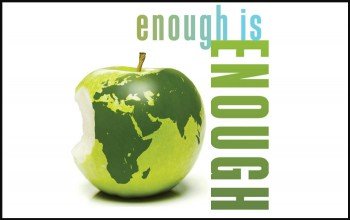
Rob Dietz and Dan O'Neill authors of Enough is Enough, take on the task of how to build a sustainable economy in a world of finite resources. They say, ”Perhaps the most important number is one - one single blue green planet with finite resources that we all must share”

Enough Is Enough: finally a book of practical solutions to restore your hope!The book is well written and the arguments are convincing. Apart from all the facts in the book, each chapter has an introductory story with a nice personal touch. Contrary to most books in the genre, Dietz and O'Neill spend more pages explaining how a no-growth economy would look like rather than why perpetual growth is neither possible nor desirable. They do both jobs well.

Both authors are affiliated with the Center for Advancement of the Steady State Economy (CASSE). And “steady-state-economy” is the term the center use to describe a no-growth economy. They do ask their readers to come up with a more catchy and sexy term. However, trying to change the world is very different from selling soap, and I believe we underestimate people when we assume that we have to sell” them a catchy phrase.

In the first part of the book, Dietz and O'Neill debunk the ideas of decoupling” and trickle-down economics”. They do that well by providing a number of facts. For example, for every $100 of economic growth, only 60 cents reach the billion poor in the world. This is based on a report from the New Economic Foundation, available here. Clearly this is a decidedly inefficient way of distributing wealth. As they state: someone is profiting from economic growth, but it is not the world's poor.”

There are a number of interesting observations or ideas discussed in the book. For example:
·      Just as several aspects of our current society have all reinforced each other—for example, population growth, competition, cheap oil and technology; crisis situations also have such self-reinforcing sides. The authors point out that we should expect such cascading effects in the process of building a steady-state economy as well.
·      The best ways to achieve well-being are those that take time, consume none or few resources, and are for free.
·      The purpose” of the financial sector is to facilitate and intermediate between business and investment, and the costs for this is a burden to the rest of the economy. The fact that the financial sector takes an ever increasing share of the economic growth is not a sign of health or of any improvements in our livelihoods.

In parts two and three of the book, Dietz and O'Neill outline the strategies of reaching a steady state economy (part two) and the actions to be taken (part three). Both parts of the book are very interesting. One can also see that here the authors, self admittedly, are in unchartered territory. This is reflected in some redundancy and a vague division between parts two and three.

They call for changes on a number of strategically selected institutions in our economy and attitudes in our society. In their opinion, investments should generate social and environmental returns instead of financial returns; labor productivity can be perused to reduce and minimize unpleasant work, but not to take away jobs that bring joy and meaning; new forms of ownership (e.g. social enterprises) need to be developed and some existing forms (e.g. cooperatives) need to be revitalized instead of us being stuck in the choice between private and public; and finally we need to rethink our relationship to nature. They refer to these four thoughts as the foundation” of a steady growth economy.

In their opinion, ten pillars of policy directions” are needed. They include:
1.     Limit resource use and waste production
2.     Stabilize population
3.     Distribute income and wealth equitably
4.     Reform monetary and financial systems
5.     Change the way we measure progress (goodbye GDP)
6.     Secure full employment (by job-sharing and guaranteed jobs)
7.     Rethink how businesses create value
8.     Replace the culture of consumerism with a culture of sustainability
9.     Stimulate political debate about limits to growth
10.  Change national goals regarding growth and improve international cooperation

With these “pillars” in place, we can move towards a society that is sustainable and equitable and where human well-being is the centerpiece of life. Dietz and O'Neill present an appealing vision of how such a transformed society could look like.

Such a transition will require changes in institutions, laws, constitutions, attitudes and distribution of wealth. I find that the book mixes “hard” and soft” factors (see the list above) in a not so clear way. In fact, for the soft factors there is often no path on how to get there. It is one thing to say that we want more equality. There is, I believe, already a broad public agreement on this, but still differences are forever increasing. This example shows that there is a fundamental need to re- distribute assets and not just to change attitudes.

Like many others, the two authors question the use of GDP measure. “What is measured is managed” the saying goes and the authors concur, but I am not very convinced by that argument; we have measured poverty or unemployment for decades, we still didn't get rid of it. It is not because Chinese leaders have decided on a number and being competent, they have a GDP growth of 9 percent; similarly, it is not because European leaders do not have sufficiently ambitious growth targets (on the contrary they have very ambitious targets which they never reach!) that their economies stumble a percent or two over decades.

In real life, the mechanisms that drive growth are rarely related to the measurement of GDP. Politics of the normal kind hardly affect GDP growth in the medium and long-term, because it is mainly the acts of corporations, the effects of technology and energy, and the growth, age and behavior of populations that determine what kind of growth we will have. In the very short term, governments can influence growth by introducing tax cuts, subsidies or austerity measures etc. The key economic agentscompanies and consumersdon't care about GDP. Companies don't invest, expand or make profits or losses with an eye to the effects of the GDP. And consumers don't buy flat screen TVs to boost the GDP. Some of the most spectacular periods of economic growth occurred before there were any GDP measurement and public GDP targets.

By all means, do away with GDP; it is a rather meaningless measure. However, don't expect that to change too many things. And therefore don't put your bets on alternative measures either. They do play a role visualizing certain developments and they are therefore good to develop, but they are no game changers.

The weakness of the book is, in my view, that the authors don't address how to change the logic of property, profit (and other forms of capital accumulation) and competition. They write A key question, then, is whether the profit motive is compatible with a non-growing economy”. In another part they say that higher labor productivity is almost always converted into higher production because business owners are beholden to profit motives. Although they do see the problems, their prescriptions fall short of addressing them. The book discusses the enormous gap in wealth in the world today, where 50 percent of the world's population shares 1 percent of global wealth. But there are no proposals in the book that will turn this around.

I look forward to the next book by Rob Dietz and Dan O'Neill where they advance their ideas further. They are on an important track: Enough is Enough is indeed good enoughLagom!

You can read the authors introduction to the book here.