Around thirty-five years ago interest in organic farming developed into a market-oriented concept, and that is when standards and certification were born, to be followed later on, by public regulations. Since then, and recently through a deep global recession, in almost all markets organic sales have maintained their growth. The area of organic farmland also continues to grow, but there are signs that there are limits to this growth. For example, in the last decade, the organic area of a few European countries has actually shrunk or been at a standstill for some years. In most cases this has been associated with changes in how those countries have implemented the European Union support programmes. Small farmers also leave organic certification, not because they stop farming organically, but because they want no involvement with the formalised organic sector and the hassle of certification.
It would be possible for all agriculture to be transformed into following organic methods. It would not be easy. Some aspects of organic farming might have to change. For example, it is hard to see how a total rejection of human waste, now prominent in organic regulations in the EU and the USA, could be combined with a full scale conversion to organic systems. Sewage systems would have to be improved so that what comes out of us could go back to where it came from, as with other cycles in nature. If organic farming was the norm for food production it would also be a logical step to abolish the practice of a special label and special certification. It would be more natural to insist that non-organic food is labelled – with warning messages if needed.
In most countries with an organic movement that has been ‘big’ for many years, most of the farmers that can easily convert to organic systems have already done so. This can be clearly seen by comparing, say, dairy and poultry farms in Northern Europe. In most Northern European countries it is relatively straightforward to convert a dairy farm to organic; the changes in management and infrastructure are not that dramatic. However, a comparable poultry operation is much harder to convert. This can be clearly seen in the proportions of poultry and milk sold respectively. Not only are poultry difficult at the production level; supply is limited and those that do convert demand good prices. So, ultimately market shares are affected as the proportion of buyers shrink when price premiums go from ten to hundred percent.
The strength of consumers’ voluntary choices as a force to change society can be seen when it comes to new technologies that transform our daily lives. Consumers use mobile phones because they are convenient and handy. Consumers buy TVs because they like to watch it. Hundreds of millions are on facebook every day. Certainly, peoples’ voluntary actions have a tremendous potential for change. The organic choice is a somewhat different choice. It is the first, and most the prominent, example of a process-oriented ecolabel, and as such a poster child for those that believe the market can fix all sorts of problem, including the lack of internalisation of costs. Producers and consumers of conventional food do not have to pay the true cost of production of conventional, non-organic food. The cost is paid by tax payers or future generations. If all external costs – that is the costs for water purification, soil degradation, health effects just to mention a few – were incorporated into the price of non-organic food those foods would be more expensive than they are today, some might be on par with organic, some perhaps remain cheaper others more expensive than organic food. The question of whether some consumers should voluntarily shoulder the costs while others can be free-riders is not only a practical one, but also a philosophical and ethical one. It may also be the reason for? that health – the only aspect of consuming organic products where the benefits are accrued by the consumer – is the killer argument in favour of buying organic products. The environmental or animal welfare benefits of buying organic foods are shared by those buying conventional food. It is rather naïve to believe that this system will be the system that carries organic production from a couple percent to the mainstream. The organic labelling system is a forerunner, but it certainly needs assistance for the transformation of agriculture to a situation where ‘organic’ is simply normal.
Leader in the upcoming issue of The Organic Standard
Thursday, August 12, 2010

Monday, August 9, 2010
A barrel of oil: a ton of maize
According to FAO, 6,000 MJ of fossil energy (corresponding to a barrel of oil) is used to product one ton of maize in industrial farming, while for the production of maize with traditional methods in Mexico only 180 MJ (corresponding to 4.8 liter oil) is used. This calculation claims to include energy for synthetic fertilizers, irrigation and machinery, but not shadow energy, i.e. energy used for making machinery, transporting products to and fro the farm, and for construction of farm buildings (FAO 2000). The energy ratio is negative (below 1) for modern rice farming and just above one for modern maize farming, while traditional production of rice and maize give a return of 60 to 70 times on energy used . FAO has also compiled average data for energy yields for developed and developing countries respectively (see table). It shows that developed countries use more than double the amount of energy to produce a ton of grain, and three times as much per hectare (the reason for it being more per hectare is that yields are a bit higher in developed countries). FAO notes that “productivity is higher” when more energy is used, and with that they mean in particular productivity per labor unit. One could of course put it the other way round and say that the productivity measured on used energy is very low. When we discuss bio-energy this discussion is suddenly very relevant.
Different kinds of agriculture production and different food also have different energy ratios. The energy ratio is very low for deep sea fishing; for meat production from feed lots and from vegetables in heated green houses . A big share (often above 50%) of the energy use in farming is for the production of synthetic fertilizers, in particular nitrogen fertilizers, and pesticides. This also means that the contentious debate about organic vs conventional (non-organic) farming has a strong element of energy dependency debate. If improved energy ratio is a primary goal for farming, skipping, or at least dramatically reducing, nitrogen fertilizers is one of the best ways to get there.
Different kinds of agriculture production and different food also have different energy ratios. The energy ratio is very low for deep sea fishing; for meat production from feed lots and from vegetables in heated green houses . A big share (often above 50%) of the energy use in farming is for the production of synthetic fertilizers, in particular nitrogen fertilizers, and pesticides. This also means that the contentious debate about organic vs conventional (non-organic) farming has a strong element of energy dependency debate. If improved energy ratio is a primary goal for farming, skipping, or at least dramatically reducing, nitrogen fertilizers is one of the best ways to get there.
Wednesday, July 28, 2010
10 million people own a third of all assets
Are you a HNWI? If so you are one of 10 million guys controlling one third of all assets. And while the world economy went into recession your wealth increased some 19 percent.
The most commonly quoted figure for "membership" in the high net worth "club" is $1 million in liquid financial assets.
The world’s population of high net worth individuals (HNWIs) grew 17.1% to 10.0 million in 2009.The world’s population of high net worth individuals (HNWIs) returned to 10 million in 2009, increasing by 17.1% over 2008. HNWI financial wealth increased 18.9% from 2008 levels to $39 trillion. After losing 24.0% in 2008, Ultra-HNWIs saw wealth rebound 21.5% in 2009. Ultra-HNWIs increased their wealth by 21.5% in 2009. In terms of the total Global HNWI population remains highly concentrated with the U.S, Japan and Germany accounting for 53.5% of the world’s HNWI population, down slightly from 2008. Source: World Wealth Report 2010. The World Wealth Report covers 71 countries in the market-sizing model, accounting for more than 98% of
global gross national income and 99% of world stock market capitalization.
World GDP, also known as world gross domestic product or GWP - gross world product, calculated on a nominal basis, was estimated at $65.61 trillion in 2007 by the CIA World Factbook
Global household wealth amounted to $125 trillion in the year 2000. The richest 2% of adults in the world own more than half of global household wealth according to a path-breaking study released today by the Helsinki-based World Institute for Development Economics Research of the United Nations University (UNU-WIDER).
well there are many different ways one can present the data of world inequality - they all have one thing in common. It is appalling.
The most commonly quoted figure for "membership" in the high net worth "club" is $1 million in liquid financial assets.
The world’s population of high net worth individuals (HNWIs) grew 17.1% to 10.0 million in 2009.The world’s population of high net worth individuals (HNWIs) returned to 10 million in 2009, increasing by 17.1% over 2008. HNWI financial wealth increased 18.9% from 2008 levels to $39 trillion. After losing 24.0% in 2008, Ultra-HNWIs saw wealth rebound 21.5% in 2009. Ultra-HNWIs increased their wealth by 21.5% in 2009. In terms of the total Global HNWI population remains highly concentrated with the U.S, Japan and Germany accounting for 53.5% of the world’s HNWI population, down slightly from 2008. Source: World Wealth Report 2010. The World Wealth Report covers 71 countries in the market-sizing model, accounting for more than 98% of
global gross national income and 99% of world stock market capitalization.
World GDP, also known as world gross domestic product or GWP - gross world product, calculated on a nominal basis, was estimated at $65.61 trillion in 2007 by the CIA World Factbook
Global household wealth amounted to $125 trillion in the year 2000. The richest 2% of adults in the world own more than half of global household wealth according to a path-breaking study released today by the Helsinki-based World Institute for Development Economics Research of the United Nations University (UNU-WIDER).
well there are many different ways one can present the data of world inequality - they all have one thing in common. It is appalling.
Sunday, July 25, 2010
We are part of society and society is part of us.
"We are governed and driven by our DNA, our brain and by our culture. It is all about information. DNA is coded information which governs some, but not all of our actions. Our brain receives impulses from the inside or the outside and processes this information and take action to improve our chances of survival. It does that in sync with our genes, but not as a slave under our genes. Our culture is the collective memory of who we are, where we came from and where we are heading. This memory, this information also guides a lot of our actions. We are formed by culture during our upbringing and in this way each generation is adapted to the prevailing culture. There is always an element of revolt as well, young generations opposing the ruling ideas and experimenting with new ideas or new ways of living. This can be seen similar as mutations on the gene level, ensuring variation and that development will take place.
In this way culture and society are rather extensions of our human bodies; we don’t really exist without it. The lonely able savage (as depicted e.g. by Rousseau) or his later followers are constructions, we were never alone. Without society we are as helpless as an ant without his anthill or a bee without a hive. Few of us would have the force, like the queen bee to establish a new colony. It is like that we should see society (not to be confused by the state), like an organism. Society is the organisational form so to say and culture is the information in its wider sense (including religion, economy etc.).
Therefore, we can’t pitch the individual against society. Sure there will be, and has always been, a tension between the independence of the individual and the demands of submission of society (I am myself an example of an individual that most reluctantly submit myself to the demands and expectations of society) – but this tension is part of the project of being a human. To see ourselves and society as integral parts of being human is a first step in thinking about how we can build a better world. And they are in contrast to (not negating, but transcending) both the socio-biological idea that we only act in the self-interest of our genes and the capitalist ideology of that each person acts as an individual in order to increase his or her direct benefits."
I am busy writing the English version of my book Garden Earth, the above is an extract from it.
Friday, July 23, 2010
To respect nature is to respect ourselves
Apart from the direct and indirect services we get from nature, nature also has great esthetical and cultural value for us. It gives us another perspective, many reference points; it is an unprecedented piece of art.
Nothing we do can compete with a piece of nature. A square meter of land contains so many organisms, with so complicated and complex relationships with each other that we can’t understand them. One gram of forest soil may contain over a million bacteria colonies. It is estimated that several million individual animals and over a thousand different species may reside beneath one square meter of soil surface (Perry 1994), and all of them are constituted by many, many cells and there is interaction between them, exchange of energy and nutrient, eating and to be eaten. Most likely a square meter of nature is more complex and contains more information than the whole internet.
There are some 100,000,000,000,000 cells in a human body. I don’t know how many bits of information there is in the cell as such, but there are some 30,000 genes in each cell. Just for the sake of getting some number say there is a million bytes of information per cell and its relation with the other cells. Then we would arrive at 100,000,000,000,000,000,000 bits which is something like 10 exabyte of information. Never heard about an exabyte? No wonder. The first terabyte (SI prefix, 1000000000000 bytes) hard disk drive was introduced in 2007, and an exabyte is a million terabyte -which in turn is a million gigabyte, to bring it down to the scale of our own hard drives.
OK number-crunchers, anyone up for the challenge of proving me wrong, don’t ask me to prove it right, I haven’t tried!
The purpose with the exercise is not to bash the internet or modern technology and to say that it is worthless and a nit-wit’s accomplishment - it is just to realise how little we know about the wonders of nature; even of ourselves. And then I have only thought about the physical expression of ourselves. Our imagination and ingenuity creates a lot more - drama, movies, songs, love, hate, sensations and emotions all over the place, yes and the internet as well....
Nothing we do can compete with a piece of nature. A square meter of land contains so many organisms, with so complicated and complex relationships with each other that we can’t understand them. One gram of forest soil may contain over a million bacteria colonies. It is estimated that several million individual animals and over a thousand different species may reside beneath one square meter of soil surface (Perry 1994), and all of them are constituted by many, many cells and there is interaction between them, exchange of energy and nutrient, eating and to be eaten. Most likely a square meter of nature is more complex and contains more information than the whole internet.
There are some 100,000,000,000,000 cells in a human body. I don’t know how many bits of information there is in the cell as such, but there are some 30,000 genes in each cell. Just for the sake of getting some number say there is a million bytes of information per cell and its relation with the other cells. Then we would arrive at 100,000,000,000,000,000,000 bits which is something like 10 exabyte of information. Never heard about an exabyte? No wonder. The first terabyte (SI prefix, 1000000000000 bytes) hard disk drive was introduced in 2007, and an exabyte is a million terabyte -which in turn is a million gigabyte, to bring it down to the scale of our own hard drives.
OK number-crunchers, anyone up for the challenge of proving me wrong, don’t ask me to prove it right, I haven’t tried!
The purpose with the exercise is not to bash the internet or modern technology and to say that it is worthless and a nit-wit’s accomplishment - it is just to realise how little we know about the wonders of nature; even of ourselves. And then I have only thought about the physical expression of ourselves. Our imagination and ingenuity creates a lot more - drama, movies, songs, love, hate, sensations and emotions all over the place, yes and the internet as well....
Tuesday, July 6, 2010
What's in a name?
At the latest European organic conference in Rome delegates discussed what should be part of the EU organic Regulation and what should not. Organic food has been in fashion for a while and some organic standard-setters, certification bodies and companies have rushed to expand the use of the term ‘organic’ into other sectors. Most prominently the term is often used for textiles and cosmetics, but also in water, salt, fisheries, forestry, building sectors, –in fact you name it and it is probably there. Parallel to this there is also the inclusion of many new aspects associated with the organic sector, e.g. its effect on climate change, biodiversity and social conditions. The term ‘Organic’ is thus moving further and further away from the ‘no chemical fertilisers, no pesticides’ market claim that it was in many countries.
Both developments are somewhat problematic. To what extent they really respond to market needs is not clear, nor is it clear whether the drive is mainly by a self-interested certification industry, or by people who like to tell other people what to do. If one sees the term as a ‘brand’ there are many reasons to question the wisdom of stretching the use of this successful brand into new areas. Normally, that leads to erosion of its image. Of course ‘organic’ is not a normal brand and does not necessarily follow the normal rules, but still there is most certainly a risk in expanding its use to cover things far from its agricultural origins. The organic sector is also not credible, or competent, as a rule maker for production categories that fall largely outside agriculture. It makes more sense that associations of craftsmen, builders or architects discuss eco-building rather than farmers and supermarkets; and that weavers, spinners and apparel makers develop textile standards. The inherent ‘values’ of ‘organic’ might not translate easily to other product segments. The same consumer that wants the t-shirt to be made with organic cotton, may simultaneously go for high-tech outdoor stuff, made by plastic and possibly with nano-particles.
The inclusion of more aspects of production in organic standards is to some extent the opposite, it is about ‘deepening’ the organic idea and proposition. Very often the rules of those ‘new’ subjects are not sensitive enough for the contradictions that may occur, and there may be trade-offs. For example, air freight of one product may mean an improvement of the livelihood of a community; or limiting green house gas emissions from agriculture may sometimes conflict with bio-diversity or animal welfare. Each new subject carries with it new values and subjective judgments. One can influence both organic producers and consumers and change values, some of them quite rapidly, in society, but it still goes that the more things added, fewer people will feel comfortable with the whole package.
The fundamental problem is perhaps the combination of a ‘do good’ system, which organic systems most definitively are, with an institution that does not have ‘do good’ as its main principle, rather the opposite – the market. Markets are driven by profits, a fundamental tenet of the market system we humans have created. Is it really realistic to expect an institution that was never intended to do good or to be fair to be that? If we look at it like that many of the inherent conflicts in the organic movement become more understandable. Organic as a concept, illustrated by the four principles of organic as developed by IFOAM, is not market-oriented at all. On the contrary, it clearly adheres to principles that go far beyond, or above, sometimes also against, the market. But the ‘organic market’ is clearly market-oriented, those that are in that market will not survive long unless they are market-oriented. It is because of the market, competition and communication with the consumers that we formulated organic standards and have certification systems. Many don’t accept this perspective but believe that the standards are – or should be - an expression of organic principles. A third group, perhaps, sees the whole idea of organic standards as an abomination; using standards to define organic methods is like using a plough for no-till farming. It is not so much about right or wrong here. Still it is quite obvious that the majority of the certified organic farmers follow the details of organic standards because they want to market their products as organic, and that organic standards, as they are written today, are written with that use very much in mind. The people developing standards should have these issues more often in mind. The itch or urge to write more rules should perhaps sometimes find sublimation in some other way?
The text above is the leader of the coming issue of The Organic Standard, the special journal for organic standards, certification and regulation which Grolink publishes and of which I am the acting "publisher"
Both developments are somewhat problematic. To what extent they really respond to market needs is not clear, nor is it clear whether the drive is mainly by a self-interested certification industry, or by people who like to tell other people what to do. If one sees the term as a ‘brand’ there are many reasons to question the wisdom of stretching the use of this successful brand into new areas. Normally, that leads to erosion of its image. Of course ‘organic’ is not a normal brand and does not necessarily follow the normal rules, but still there is most certainly a risk in expanding its use to cover things far from its agricultural origins. The organic sector is also not credible, or competent, as a rule maker for production categories that fall largely outside agriculture. It makes more sense that associations of craftsmen, builders or architects discuss eco-building rather than farmers and supermarkets; and that weavers, spinners and apparel makers develop textile standards. The inherent ‘values’ of ‘organic’ might not translate easily to other product segments. The same consumer that wants the t-shirt to be made with organic cotton, may simultaneously go for high-tech outdoor stuff, made by plastic and possibly with nano-particles.
The inclusion of more aspects of production in organic standards is to some extent the opposite, it is about ‘deepening’ the organic idea and proposition. Very often the rules of those ‘new’ subjects are not sensitive enough for the contradictions that may occur, and there may be trade-offs. For example, air freight of one product may mean an improvement of the livelihood of a community; or limiting green house gas emissions from agriculture may sometimes conflict with bio-diversity or animal welfare. Each new subject carries with it new values and subjective judgments. One can influence both organic producers and consumers and change values, some of them quite rapidly, in society, but it still goes that the more things added, fewer people will feel comfortable with the whole package.
The fundamental problem is perhaps the combination of a ‘do good’ system, which organic systems most definitively are, with an institution that does not have ‘do good’ as its main principle, rather the opposite – the market. Markets are driven by profits, a fundamental tenet of the market system we humans have created. Is it really realistic to expect an institution that was never intended to do good or to be fair to be that? If we look at it like that many of the inherent conflicts in the organic movement become more understandable. Organic as a concept, illustrated by the four principles of organic as developed by IFOAM, is not market-oriented at all. On the contrary, it clearly adheres to principles that go far beyond, or above, sometimes also against, the market. But the ‘organic market’ is clearly market-oriented, those that are in that market will not survive long unless they are market-oriented. It is because of the market, competition and communication with the consumers that we formulated organic standards and have certification systems. Many don’t accept this perspective but believe that the standards are – or should be - an expression of organic principles. A third group, perhaps, sees the whole idea of organic standards as an abomination; using standards to define organic methods is like using a plough for no-till farming. It is not so much about right or wrong here. Still it is quite obvious that the majority of the certified organic farmers follow the details of organic standards because they want to market their products as organic, and that organic standards, as they are written today, are written with that use very much in mind. The people developing standards should have these issues more often in mind. The itch or urge to write more rules should perhaps sometimes find sublimation in some other way?
The text above is the leader of the coming issue of The Organic Standard, the special journal for organic standards, certification and regulation which Grolink publishes and of which I am the acting "publisher"
Wednesday, June 9, 2010
Green Internet - a Pie in the sky?
"You will eat, bye and bye,
In that glorious land above the sky;
Work and pray, live on hay,
You'll get pie in the sky when you die."
sang Swedish born, US worker leader and poet Joe Hill, expressing how promises of a brighter future makes us accept the current status. Today "Pie in the sky" is perhaps used more to express that some promises are untenable or impractical. The promise of IT to be of use for a clean, green future looks more and more like a pie in the sky....
We here a lot of about how modern technology can provide solutions to energy consumption and global warming. And it is true that you can find a lot of smart solutions. Video conferencing is typically such a thing that could "save" a lot of energy and emissions, compared to people flying to meet. But often these new opportunities just put themselves on top of what we already are doing, and instead of replacing a flight with a video conference, we are perhaps more likely to replace our conference call with a video conference, which then was no net saving.....Anyway let us still be positive about the possibilities for saving energy through IT. But what about IT itself? I always thought that, "well, of course all this IT stuff uses a lot of energy, but compared to cars or steel mills it must be negligeable". A new report from Greenpeace makes me think differently.
According to this report 623 TWh of electricity is used to drive the servers and the internet globally. That is an awful lot of electricity, just to give you an idea:
- The USA produced some 800 TWh from ALL its nuclear plants and the total electricity consumption of ther USA is just above 4,000 TWh. (EIA).
- The total electricity production in the UK was 382 TWh year 2004 (Wikipedia)
- The total energy consumption of Sweden was 398 TWh 2006 and the electricity consumption was 130 TWh (Energiindikatorer 2008).
This is really worrying.
Even more worrying is that the forecast is that there will be used 1,964 TWh of electricity to drive the internet by year 2020.
And remember, electricity is an energy bearer and not an energy source, all this electricity must come from somewhere and there is no chance that we will produce it with solar or wind for many decades to come. And also think about that these figures are for the internet, they are not for your own laptop, your cellphone, or all the masts for their signals or even for your company's own server.....
A blog post on Greenpeace site also tells the following:
There are 50 million computer servers in the world today. And a recent report by BusinessWeek says that, of the 8 million new servers added each year, 50% are bound for data centers. That’s 4 million additional servers per year that will be used to store and deliver computing programs and services over the Internet, or “cloud”. IT Companies are quickly developing cloud-based offerings and building data centers to house servers that store all of the data the cloud delivers - email, photos, videos, entertainment, news, and computing programs. As more and more electricity is required to operate these data centers and run the servers, IT companies are looking for ways to keep their power costs low, which means cheap, dirty power. Unfortunately, a strategy that is still being employed by many IT companies to keep the overhead down is to locate data centers in places where “cheap” coal-fired electricity is available. In January, for example, Facebook commissioned a new data center in Oregon and entered a power service agreement with a utility called PacificCorp, which gets most of its electricity from coal-fired power stations. Just this week, eBay unveiled its new flagship data center, located in South Jordan, Utah, a state that derives 81% of its electricity from coal.
read more
In that glorious land above the sky;
Work and pray, live on hay,
You'll get pie in the sky when you die."
sang Swedish born, US worker leader and poet Joe Hill, expressing how promises of a brighter future makes us accept the current status. Today "Pie in the sky" is perhaps used more to express that some promises are untenable or impractical. The promise of IT to be of use for a clean, green future looks more and more like a pie in the sky....
We here a lot of about how modern technology can provide solutions to energy consumption and global warming. And it is true that you can find a lot of smart solutions. Video conferencing is typically such a thing that could "save" a lot of energy and emissions, compared to people flying to meet. But often these new opportunities just put themselves on top of what we already are doing, and instead of replacing a flight with a video conference, we are perhaps more likely to replace our conference call with a video conference, which then was no net saving.....Anyway let us still be positive about the possibilities for saving energy through IT. But what about IT itself? I always thought that, "well, of course all this IT stuff uses a lot of energy, but compared to cars or steel mills it must be negligeable". A new report from Greenpeace makes me think differently.
According to this report 623 TWh of electricity is used to drive the servers and the internet globally. That is an awful lot of electricity, just to give you an idea:
- The USA produced some 800 TWh from ALL its nuclear plants and the total electricity consumption of ther USA is just above 4,000 TWh. (EIA).
- The total electricity production in the UK was 382 TWh year 2004 (Wikipedia)
- The total energy consumption of Sweden was 398 TWh 2006 and the electricity consumption was 130 TWh (Energiindikatorer 2008).
This is really worrying.
Even more worrying is that the forecast is that there will be used 1,964 TWh of electricity to drive the internet by year 2020.
And remember, electricity is an energy bearer and not an energy source, all this electricity must come from somewhere and there is no chance that we will produce it with solar or wind for many decades to come. And also think about that these figures are for the internet, they are not for your own laptop, your cellphone, or all the masts for their signals or even for your company's own server.....
A blog post on Greenpeace site also tells the following:
There are 50 million computer servers in the world today. And a recent report by BusinessWeek says that, of the 8 million new servers added each year, 50% are bound for data centers. That’s 4 million additional servers per year that will be used to store and deliver computing programs and services over the Internet, or “cloud”. IT Companies are quickly developing cloud-based offerings and building data centers to house servers that store all of the data the cloud delivers - email, photos, videos, entertainment, news, and computing programs. As more and more electricity is required to operate these data centers and run the servers, IT companies are looking for ways to keep their power costs low, which means cheap, dirty power. Unfortunately, a strategy that is still being employed by many IT companies to keep the overhead down is to locate data centers in places where “cheap” coal-fired electricity is available. In January, for example, Facebook commissioned a new data center in Oregon and entered a power service agreement with a utility called PacificCorp, which gets most of its electricity from coal-fired power stations. Just this week, eBay unveiled its new flagship data center, located in South Jordan, Utah, a state that derives 81% of its electricity from coal.
read more
Thursday, June 3, 2010
Some consolation for us grumpy old men
I am not very active on my blog now. Sorry for that, but the first reason is that I am busy writing the English version of my book. The second reason is that it is spring! I will not bother you with reason 3-10.
So just to entertain the occasional reader I post some stolen goods, here from the BBC:
So just to entertain the occasional reader I post some stolen goods, here from the BBC:
Feeling grumpy 'is good for you'
 An attack of the grumps can make you communicate better, it is suggested |
In a bad mood? Don't worry - according to research, it's good for you.
An Australian psychology expert who has been studying emotions has found being grumpy makes us think more clearly.
In contrast to those annoying happy types, miserable people are better at decision-making and less gullible, his experiments showed.
more on http://news.bbc.co.uk/2/hi/8339647.stmTuesday, May 25, 2010
Earth as an apple
I came accross this on the Endangered Spaces blog:
Cut an apple into quarters. Put aside three of those quarters. These slices represent the oceans of our world.

What is left is 1/4. Slice it in half. Set aside one of the halves. This is the part of the Earth on which people cannot live, the poles, deserts, swamps and high mountains.

What is left is 1/8. This is where the humans live, but not necessarily where they grow their food.

Slice your 1/8 piece into four sections. Put aside three of them. What is left is 1/32. The three pieces you set aside represent the places where the soil is too poor to farm--too rocky, wet, cold or steep. These also represent the cities, homes, highways, shopping malls, schools, parks, factories, parking lots and golf courses where people live play and work--but do not grow food.
Take the 1/32 piece that remains. Carefully peel it. Look at this tiny scrap of apple peel. This represents the surface topsoil of the planet that may be farmed. This thin skin represents the thin skin on the Earth's crust upon which humankind totally depends. This soil is less than 5 feet deep and is a fixed amount of food-producing land.
Eat the rest of your apple, but save that tiny piece of apple skin. Treat is as if your life depends on it.
For more information on using this as a teaching tool, please visit this website.
Cut an apple into quarters. Put aside three of those quarters. These slices represent the oceans of our world.

What is left is 1/4. Slice it in half. Set aside one of the halves. This is the part of the Earth on which people cannot live, the poles, deserts, swamps and high mountains.

What is left is 1/8. This is where the humans live, but not necessarily where they grow their food.

Slice your 1/8 piece into four sections. Put aside three of them. What is left is 1/32. The three pieces you set aside represent the places where the soil is too poor to farm--too rocky, wet, cold or steep. These also represent the cities, homes, highways, shopping malls, schools, parks, factories, parking lots and golf courses where people live play and work--but do not grow food.
Take the 1/32 piece that remains. Carefully peel it. Look at this tiny scrap of apple peel. This represents the surface topsoil of the planet that may be farmed. This thin skin represents the thin skin on the Earth's crust upon which humankind totally depends. This soil is less than 5 feet deep and is a fixed amount of food-producing land.
Eat the rest of your apple, but save that tiny piece of apple skin. Treat is as if your life depends on it.
For more information on using this as a teaching tool, please visit this website.
Tuesday, May 18, 2010
Nitrogen in the biosphere - a cliffhanger
In a recent report by Johan Rockström and many other leading scientists, Planetary Boundaries: Exploring the Safe Operating Space for Humanity the nitrogen cycle is identified as one of three areas (together with climate regulation and biological diversity) where we have surpassed a threshold for stable development. Nitrogen is the most common compound in the air, which is composed of some 78 percent nitrogen. Most of the nitrogen is, however totally inert biologically. It can be converted into active forms, such as nitrate and ammonia through thunderstorms, fire and biological processes such as symbiotic nitrogen fixation (by Rhizobium bacteria in the roots of leguminous plants) or fixation by blue green algae, nowadays called cyanobacteria. Nitrogen is a main building block in proteins and amino acids as well as in nucleic acids like RNA and DNA. The changes in the nitrogen cycles are manifold more market than the changes in the carbon cycle. The quantity biologically active nitrogen in the biosphere has increased nine times in hundred years, most of the increase has occurred the last fifty years (see figure). Increased use of synthetic fertilizers is the dominating reason. The increase is also projected to continue from 165 million tones year 2000 to 270 millions year 2050 (Millennium Ecosystem Assessment 2005). Locally we can see great effects of the release of all this Nitrogen, while the global impact is less certain, what is certain is that there will be an impact.


As mentioned above, nitrogen plays a critical role in life processes, and the short term effect of improved availability of Nitrogen is often improved growth, e.g. that the forests grow better. Nitrogen hungry plants are favored over those that don’t need so much nitrogen, e.g. grasses a re favored over herbs and over leguminous plants. Surplus of Nitrogen and Phosphorus are according to Millennium Ecosystem Assessment one of the single most important factor for changes in ecosystems. The effluent of Nitrogen to the sea has increased with 80 percent between 1860 and 1990. However, in some areas the effluent has been more or less constant while the North Sea and coasts off China and the USA receive up to 15 times as much nitrogen now compared to hundred and fifty years ago. This run-off leads to eutrophication with tremendous effects on the composition of species, and in particular it stimulate the bloom of algae and the therewith associated dead zones, such as part of the Mexican gulf and the Baltic Sea. The use of synthetic fertilizers has lead to higher and higher levels of nitrates in drinking waters. Nitrogen also plays a role in the formation of tropospheric ozone, which leads to damage on crops and plants (MEA 2005). Synthetic fertilizers cause losses of other important nutrients such as calcium and phosphorus as well as acidification of soils and waterway (IAASTD 2009). Finally, the production of Nitrogen fertilizers is very energy consuming and in addition it incurs great emissions of laughing gas, one of the greenhouse gases. Mono-cropping of grain which is rather closely associated to the use of synthetic fertilizers leads to a reduction of carbon in soils and thereby increase the green house gases.
Agriculture represent two thirds of the emissions of nitrous oxide, the third greenhouse gas of importance. These emissions are directly related to the nitrogen cycle. The increase of livestock and even the use of chemical fertilizers are key divers. The use of nitrogen fertilizers is extremely inefficient and a lot more nitrogen is added to the soil than what is taken away with the harvest. The rest of this nitrogen “gets lost”, some of it as nitrate run off some of it as emissions of nitrous gases. In addition, nitrogen fertilizers also consume a lot of energy for their production. Studies of grain production in Great Britain and Sweden shows an almost linear correlation between use of nitrogen fertilizers and GHG emissions (KRAV 2008). Reduced use of nitrogen fertilizer should be a main strategy for reduction of GHG emissions from agriculture.
In summary, there are good, and frightening, reasons to follow closely the development of the nitrogen cycle. We should not be surprised if we find effects and costs associated with disturbed nitrogen cycles as dramatic as those of the carbon cycle. Considering how farmers and farm lands have become “addicted” to the use of synthetic fertilizers it could become a real thriller to reduce nitrogen effluents. (Extract from Garden Earth)

As mentioned above, nitrogen plays a critical role in life processes, and the short term effect of improved availability of Nitrogen is often improved growth, e.g. that the forests grow better. Nitrogen hungry plants are favored over those that don’t need so much nitrogen, e.g. grasses a re favored over herbs and over leguminous plants. Surplus of Nitrogen and Phosphorus are according to Millennium Ecosystem Assessment one of the single most important factor for changes in ecosystems. The effluent of Nitrogen to the sea has increased with 80 percent between 1860 and 1990. However, in some areas the effluent has been more or less constant while the North Sea and coasts off China and the USA receive up to 15 times as much nitrogen now compared to hundred and fifty years ago. This run-off leads to eutrophication with tremendous effects on the composition of species, and in particular it stimulate the bloom of algae and the therewith associated dead zones, such as part of the Mexican gulf and the Baltic Sea. The use of synthetic fertilizers has lead to higher and higher levels of nitrates in drinking waters. Nitrogen also plays a role in the formation of tropospheric ozone, which leads to damage on crops and plants (MEA 2005). Synthetic fertilizers cause losses of other important nutrients such as calcium and phosphorus as well as acidification of soils and waterway (IAASTD 2009). Finally, the production of Nitrogen fertilizers is very energy consuming and in addition it incurs great emissions of laughing gas, one of the greenhouse gases. Mono-cropping of grain which is rather closely associated to the use of synthetic fertilizers leads to a reduction of carbon in soils and thereby increase the green house gases.
Agriculture represent two thirds of the emissions of nitrous oxide, the third greenhouse gas of importance. These emissions are directly related to the nitrogen cycle. The increase of livestock and even the use of chemical fertilizers are key divers. The use of nitrogen fertilizers is extremely inefficient and a lot more nitrogen is added to the soil than what is taken away with the harvest. The rest of this nitrogen “gets lost”, some of it as nitrate run off some of it as emissions of nitrous gases. In addition, nitrogen fertilizers also consume a lot of energy for their production. Studies of grain production in Great Britain and Sweden shows an almost linear correlation between use of nitrogen fertilizers and GHG emissions (KRAV 2008). Reduced use of nitrogen fertilizer should be a main strategy for reduction of GHG emissions from agriculture.
In summary, there are good, and frightening, reasons to follow closely the development of the nitrogen cycle. We should not be surprised if we find effects and costs associated with disturbed nitrogen cycles as dramatic as those of the carbon cycle. Considering how farmers and farm lands have become “addicted” to the use of synthetic fertilizers it could become a real thriller to reduce nitrogen effluents. (Extract from Garden Earth)
Monday, May 17, 2010
Research Links Pesticides With ADHD In Children
CARLA K. JOHNSON, AP Medical Writer writes the 16 May 2o1o:
Children may be especially prone to the health risks of pesticides because they're still growing and they may consume more pesticide residue than adults relative to their body weight.
In the body, pesticides break down into compounds that can be measured in urine. Almost universally, the study found detectable levels: The compounds turned up in the urine of 94 percent of the children. The kids with higher levels had increased chances of having ADHD, attention-deficit hyperactivity disorder, a common problem that causes students to have trouble in school. The findings were published Monday in Pediatrics. "Exposure is practically ubiquitous. We're all exposed," said lead author Maryse Bouchard of the University of Montreal.
She said people can limit their exposure by eating organic produce. Frozen blueberries, strawberries and celery had more pesticide residue than other foods in one government report.
A 2008 Emory University study found that in children who switched to organically grown fruits and vegetables, urine levels of pesticide compounds dropped to undetectable or close to undetectable levels.
Read more
Children may be especially prone to the health risks of pesticides because they're still growing and they may consume more pesticide residue than adults relative to their body weight.
In the body, pesticides break down into compounds that can be measured in urine. Almost universally, the study found detectable levels: The compounds turned up in the urine of 94 percent of the children. The kids with higher levels had increased chances of having ADHD, attention-deficit hyperactivity disorder, a common problem that causes students to have trouble in school. The findings were published Monday in Pediatrics. "Exposure is practically ubiquitous. We're all exposed," said lead author Maryse Bouchard of the University of Montreal.
She said people can limit their exposure by eating organic produce. Frozen blueberries, strawberries and celery had more pesticide residue than other foods in one government report.
A 2008 Emory University study found that in children who switched to organically grown fruits and vegetables, urine levels of pesticide compounds dropped to undetectable or close to undetectable levels.
Read more
Monday, May 3, 2010
Finally!


Finally my book Trädgården Jorden (Garden Earth) was launched at an event at the Royal Swedish Academy of Agriculture and Forestry in Stockholm.
The event was chaired by former minister of agriculture, Annika Åhnberg. The form of the launch was that I made a 20 minutes presentation and the Janken Myrdal, professor of agrarian history at the Agriculture University and Jacop Rutqvist from the (liberal) think tank FORES commented my book. After that the audience could ask question and debate. It was a nice event. Most participants also bought my book.
Below I give the English reader a taste of the book, a rough translation of the Swedish introduction. Now as the book is published in Swedish I will start in earnest to work with the English version , which will be more than just a translation.
--------------------------------------------------------------------------------------------------
Introduction
The golden rule as formulated in the Bible is "So in everything, do to others what you would have them do to you, for this sums up the Law and the Prophets.” (Matt.7:12). It is found in various forms in most religions and philosophies, e.g. in Hinduism: " One should never do that to another which one regards as injurious to one’s own self. This, in brief, is the rule of dharma." (Mahabharata Section CXIII).
Can our - the rich countries’- lifestyle be applied by seven or even ten billion people and future generations, without harming the ecosystem and our own humanity in an irreversible way? It is one of the starting points of this book. One could call it a global golden rule. If the answer is no to the question, we can conclude that our lifestyle is not sustainable and we should take the consequences.
The human being is a great colonizer. She has spread and almost everywhere, she managed to find an ecological niche. In many of these niches her place was well-defined, her numbers were governed by the limitations of the natural environment, and she often had no opportunity to radically alter the terms thereof. Therefore, traditional communities who lived on the gathering, hunting and fishing remained relatively stable. With agriculture began a new phase. Man changed the ecosystems to a much wider extent than ever, it also led to changes in social organization with the introduction of the ruler and the slave. Agricultural society was in many ways more sensitive to disturbances, and the impact of natural phenomena could be dramatic for humanity. Soil degradation was a recurring reason for societies’ collapse or gradual decline. Plague, other epidemics and failures of key crops could suddenly throw masses of people into starvation.
The next major change was when man began to harness fossil fuels. This freed her from basically depending on her own metabolism and biomass which she took from others in nature; she could now bring incredible resources to work. Ecosystems were reshaped in an unprecedented extent. This coincided with the industrialization and the introduction of a capitalist market economy. Industrialization increased human control of nature, in principle, to all corners of the globe. We go further, climb and fly higher, dive and drill deeper, all in order to find more resources to exploit. This lead to a marked expansion of the areas in direct service of man, particularly forests and oceans. Industrialism also provided new force to the farming man. In the first stage power and tools to expand arable land (iron plows), but over time also more and more machines which increase the work performed per person. This was followed by a sharp increase in the input of energy, so that agriculture from being a net producer of energy becomes a net consumer of energy.
Our modern society has freed man from old chains and limitations and has created enormous wealth. It has meant an ever-increasing labor productivity; we can produce more per hour worked. Old prejudices and oppression have been broken down, and freedom and human rights have risen sharply. This was very direct and welcome for serfs and oppressed people. The idea of equal worth of all people is - at least in theory - universally accepted. There are several components in our modern society, which all contributed to this development. Central are political democracy, capitalism, the great use of external energy, mainly in the form of fossil fuels, great use of other natural resources and industrialization with a far-reaching division of labor.
But we have reached a point where the system exhibits a strong reduction in marginal utility, or in some cases diminishing returns. What previously was a positive force, the restless search for new countries, new areas to colonize, the liberation of man from tradition, affirmation of the individual over community, a far-reaching division of labor and that everything can be bought and sold on a market, all these contribute to destruction now. More capitalism, more oil and coal, more chimneys were perhaps great slogans during the 1800s, they were probably still good in many parts of the world during the 1900s, but today, fewer and fewer areas need it. Since 1950, oil production tenfold, and the overall economic activity in the world increased six times. Meanwhile, carbon emissions quadrupled, world population has become 2.5 times larger, and the economic gap between the 20% poorest and the richest 20% more than doubled. The global socio-economic and ecological system is thus rapidly changing and the pace of change is increasing constantly. This means that we live in an unstable system (Helmfrid and Haden 2006).
My intention is to illustrate this further, but also to make a clearer link between the ecological crisis, our well-being, our society and the economic system, capitalism. I summarize the most critical points below:
1. Our relationship to nature is characterized by over-exploitation of raw materials and natural resources. Certainly history shows that we have a remarkable capacity to overcome the limitations of our natural environment, but nevertheless, our use of both mineral resources and all the living resources with its origin in photosynthesis, are now at a level that simply can not be sustained. It can be expressed in different ways as we are soon reaching the "peak oil”, that our ecological footprint is already one and half soil and that we are already taking nearly half of the entire biosphere in direct use.
2. We have unleashed 100 000 chemicals, but we have no idea how they affect us. We take medicines and eat food additives and pesticides we spray on our food. We have very little knowledge about the long term impact on us by the cocktail of chemicals we disseminate, and still less do we know how it affects our living environment.
3. The greatest ecological challenge is the impact we have on the services we have, until now completely free, by nature, so-called ecosystem services. We know that our release of greenhouse gases, largely an effect of extraction of fossil fuels and degradation of natural resources, will lead to marked changes in climate, with great human and material costs as a result. In addition, we have caused severe reduction of biological diversity, the very web of life on earth. We are manipulating other life processes, such as the nitrogen cycle, in a scale and in such a way that it will lead to sudden crises.
4. The production and productivity revolution, which we explain with entrepreneurship, the superiority of capitalism and the individual's strive for personal gain can be equally interpreted as the result of one thing: access to external sources of energy, primarily fossil fuel. But the energy source are drying up and use of energy is the cause of other problems, most obviously the greenhouse effect. At least equally serious is that energy is the engine itself in almost any other resource consumption and degradation of ecosystem services.
5. The system does not have sufficient self-correcting feedback loops to keep income inequality in check; the only thing that can keep it running is a constant economic growth so that those at the bottom, after all, will be a little better off every year. This is not primarily an economic problem but a social and moral problem. The difference between reality and a rhetoric in which all are said to be equal and have the same opportunities is simply too great.
6. The capitalist model of development was most successful in countries which industrialized first, followed by countries which had different comparative advantages in certain development stages. But large parts of humanity are outside of the development, both the individuals who are left behind in industrialized countries and those whole countries which have no comparative advantages to exploit. Just as not all communities could make the transition from gathering and hunting to farming communities, many communities today can not make the transition to a capitalist society because they lack the right conditions.
7. The values, attitudes and the mechanisms which form the foundation of capitalism, is in contrast to the harmonious development of society. Competition is promoted at the expense of cooperation; self-interest instead of solidarity and commitment to others, private property against the interests of society; individualism above consideration of others; exploitation rather than management or nursing. Yes, the whole of society must obey the, supposedly value-free and thus objective and fair, market, rather than being guided by subjective and emotional values. We get a society whose role is to serve the market and a market whose role is to serve individuals' short-term interests.
8. It is certainly within the human nature to be a little dissatisfied, wanting more, to explore new opportunities. Without those properties, we had probably never become human beings in the first place. It is in society's nature to contain these desires so that they continue to benefit us all. With the capitalist takeover of society, these restrictions don’t work anymore, and we are all trapped in a treadmill of ever-increasing consumption. This consumption, driven by several of the factors above, has made us healthier, wiser, more beautiful and more happy to begin with, but it has long crossed a line after which more things does not mean more wellbeing.
By and large, you can see capitalism, both the economic system and the values on which it builds and advocates as a system and an ideology of colonization. It's about colonization in the classical sense, i.e. conquest of other cultures and countries, but it is as much about the colonization of larger and larger parts of nature. Our exploitation of nature is now nearly complete, and not only that, we are reducing the capital, the stocks, of raw materials the bio-geosphere built up over millions of years, so that we become poorer by the year. Contrary to the prevailing opinion, the so-called invisible hand can’t manage the economic system, let alone the ecological and social systems that are even more important for our survival.
Now we are there. We have reached the end of the road. There is nothing left to colonize. Therefore, we must replace the mechanisms and the logic that drove us here with new ways of thinking that is more suited to where we are now. Many of the required changes have already begun, albeit often on a small scale. A regime change or shift in our paradigms usually occur after small gradual changes, even those changes that sometimes manifested by sudden events, as Rome's surrender for invading Vandals year 455, the French revolution in 1789, or the fall of the Berlin wall two hundred years later. Some fifty countries have now stabilized, or even declining, populations, many of these exhibits also very moderate economic growth, and in particular growth which is not so resource materially resource intensive. Organic farming, passive heating, electric bicycles and solar energy represent some technologies which are better adapted to a resource-efficient society. The wild has found new ways to coexist with humans (the Peregrine falcon breeds in London) and humans have found new ways to coexist with the wild. Interest in local communities and direct democracy and participatory organizational forms is growing. On the international scene, we see much more dynamism and development of civil society platforms for cooperation than in the frameworks of nation states co-operation. Finally, a change of values have started, more and more people want to jump off the treadmill and focus on what gives real well-being. The change in values is reinforced by changes in population age structure. It is not about by command creating a zero-growth society or forcing people to live in subsistence villages, it is about releasing man's creative power from an idea that has done much good but which has nothing to offer us for the future.
While the rich world would do well to tighten the belt a notch or two, many people still live in poverty without the most basic amenities. More important than anything else is that Ethiopia's rural poor can control their land; that they get electric lights; clean water and effective sanitation arrangements; that the Chinese peasant can say what he wants and live where he wants without risking punishment, that the Afghan girl does not have to wear the burka and can work with what she wants and marry whoever she wants and that Brazilian landless may take part of the country's vast resources.
As a contrast to the capitalist ideology, I offer Garden Earth. Garden Earth expresses that we consider the globe as a garden that we take care of. We simply have to go back to Eden. But we can no longer do so as the innocent creatures we were when we were driven out. We can no longer be there as equals with the giraffe, the carrots and the lamb. Whether we like it or not, the future of the Earth, of Eden, is entirely dependent on us, and not just our own fate but also the other species' fates in our hands. We will have to intensify parts of the use of "our" parts of Garden Earth, if we do not, we will not “afford” to let other areas used less intensively. But intensification does not mean that we must destroy more resources. On the contrary, we shall intensify across the board, and cyclical resource loops will be the guiding principle. Just as we create different rooms in a garden, we will do it in the Garden Earth. Some spaces are our urban environment, it should be dense and intense. Other places are "wild", where we keep a low profile, but we must intervene here and there to correct things that nature can no longer manage. Between these two extremes is a range of different types and degrees and human stewardship. There are extensive, semi-wild farming systems, which do not produce so much food, but many ecosystem services. There are forests not only producing timber but also forest mushrooms, berries, game and other things we use on sustainable basis and a variety of ecosystem services. There are also intensively cultivated fields, more like gardening, some of which under greenhouses. These are near the cities and is characterized by intensive, but wise and efficient, use of resources and an intensive exchange of resources with the city.
The book is organized like this.
Part 1 provides a brief description of human development. One should not discuss the current situation or the future without a perspective back. We are still by and large a product of our history and even if we want to think of ourselves as modern, it is significant how stuck we are in the conventions regarding both our thinking and how we live. My description of the history acknowledges that economic incentives have played a small role in the development of mankind and that markets and money were marginal phenomenon until the medieval city-states, while the ecological conditions, the technical progress and social conditions were crucial, both for society at large and for the individual's behavior and values. With the introduction of agriculture followed private property, elites, oppression, the state, religion and a number of other institutions which characterized the world for a long time. Later on capitalism came with an enormous liberation of man from the shackles of the past, but she was subjected to a new, simpler, but no less cruel logic, "produce or die". With capitalism, not only the distribution of goods is built around a market, but that market will eventually, in many small and some big steps take over the entire society. Instead of the market serving society and mankind as a whole the society serves the market.
The importance of fossil fuels for the last two hundred years of development can not be stressed enough. It is unlikely that anything even close to the developments we have seen could have been done as a result of capitalism or industrialization without fossil fuels. Just as the earlier civilizations could not have developed without agriculture. The easiest way we might understand the importance is by translating the energy levels we have at our disposal to human labor units. And with that approach, we have 200 billion slaves working for us - but the good thing is that we do not have to feed them all. Industrialism is the way this energy is used to, like sailing ships for a long time was the main way to use wind energy, and the open fire for cooking is still in our day the most common way to use bio-energy.
Leo Tolstoy writes in the introduction to Anna Karenina (Tolstoy 1925) that "Happy families are all alike; every unhappy family is unhappy in its own way". From this literary achievement is formulated the Anna Karenina principle, which in general means that for things to be good, a whole series of conditions must be met, while for something to be bad just one factor wrong is enough. We can apply this principle also when discussing the development of society. I part 2 and 3 of Garden Earth I discuss the various factors which are critical to our existence and our well-being.
Part 2 describes many of the environmental and provisioning challenges that humanity faces. These challenges can be broadly grouped into over-exploitation of resources; poisoning of ourselves and nature, and the pressures on entire ecosystems and the services they do us. As fuel in all the processes that cause these challenges are fossil fuels and our own population. Agriculture is dealt with in detail because of the central role of agriculture for our survival; agriculture takes up much of the planet's surface and how we run it is very important for many critical processes, and services delivered by the nature that was there before the fields must be replaced. Agriculture is also very sensitive to the disruption of major ecological cycles (with the climate as a very clear example) and agricultural produce our food, but must also increasingly produce bio-energy and ecosystem services. The aim is not to be complete; there are numerous challenges which are not described, for example, ozone layer depletion and deforestation; over-fishing is just dealt with in passing.
I also introduce the view of nature that guides me, a vision which is in opposition to the capitalist view of nature as a source of raw materials and waste dump, but also in opposition to “deep ecology” ideas that man is an animal like any other and the idea that nature regulates itself in a way that is "good".
Part 3 is devoted to the social organism we have created, the community or society. I introduce the society as part of the human organism; upbringing and culture as part of evolution, but something that lifts us above both genes’ and self-interests short-term-ness and nearsightedness. If we see our society as a "meta-human", as an extension of the individual, the eternal opposition between heredity and environment can disappear, our society is then a part of the people and culture; values and norms other environmental factors are like society's genetic code, which is passed from generation to generation.
Many of the challenges of our social system and economy have a strong relationship with, and show similarities with, the challenges we have in relation to nature. They include, for example, that our society has no self-regulatory mechanisms for vital functions. We experience recurrent economic crises. At the same time there are ongoing environmental and resource crises everywhere on earth. But their impact may not get as much attention when in fact they should be the focus of our actions. Isn’t the collapse of fisheries a greater tragedy than the sub-prime loan crisis? Our accounts reflect only the parameters that we have agreed to keep records for, and we have become so accustomed to see only the economic factors as those being important.
We rush through both work and leisure. Are we happier? There is actually nothing to suggest that. As with natural resources, human well-being is not accounted for. It is a bit of a residual item, something you can discuss when all economic discussions are finished.
Why is that? How did that happen? Even the most materialist of us love and want to be loved, enjoys a good book or music, sees beauty in the falling leaves, just to mention a few examples. In fact, these things are much more important than the purely material. To live in a society in a social context is crucial for all people and investment in social capital may be among the most effective in creating the foundations of happiness and well being. Capitalist economy and values, however, then to break down the social fabric.
Large parts of humanity, about 900 million, live in extreme poverty (less than a dollar a day), and 2 billion live on less than two dollars a day. Eight hundred and fifty million are malnourished. Average life expectancy is below 50 years in 32 countries. Broadly speaking, poverty is located in what we call developing countries, almost all of them colonies of European countries a century ago. There is remarkable poverty, however, even in countries like the United States. Despite all the rhetoric, the capitalist system has not managed to eradicate poverty. The differences in wealth do not appear to be diminish at all, but if anything increase, which, of course, is unsustainable in the long term. The sections on economics and how society works can be provocative in an age where capitalism's final victory has been declared, and all possible alternatives is discredited. Thirty years of environmental policies shows that, despite all the rhetoric about the green economy, capitalism as a social system does not have the ability to manage the fact that natural resources are limited. Fifty years of discussions, assistance and development measures also show that the global economy offers no easy path to success - and perhaps no way at all - for those countries which are lagging behind. I criticize the inflated self-image of capitalism, but that does not mean I agree with most of the anti-capitalist demagogy. Above all, I do not buy conspiracy theories, with obese men in top hats (perhaps gradually superseded by the slender, botoxed and top trimmed women in costume) knowingly destroying nature and abusing workers. Of course, such happens sometimes, but mostly it's just behavioral patterns and the rules of the game that makes it happening. I discuss globalization, and show the benefits and some problems, as it entails. For me, the issue of globalization, is first and foremost a freedom issue, the freedom to transcend the arbitrary boundaries that originate in authoritarian and warring nation-states. That freedom should not apply just goods and capital, but even more people.
Part 4 is a summary of conclusions and policy options. By now it should be clear that I doubt we can solve the challenges we have within the capitalist paradigm. I demonstrate a number of trends which are also pointing in the direction of change. Particularly important are the demographic changes and the changes in the values attributed to them. I point to the importance of society for human welfare. It is in the organization of society we shall find the keys to how we organize ourselves in the future. Of the four spheres of the market, government, civil society and the private, capitalism has strengthened the market and the private and changed the role of the state. The future is not to let the state take over the production and distribution, but to further develop various forms of local stewardship, to let communities and civil society play a larger role.
The political discourse is mostly about things like tax rates and marginal adjustments to existing mechanisms. But the great challenges are to change the self-reinforcing processes, the positive feedback loops that exist, and even more to challenge the entire system of thought that are the basis for our view of society. I distrust utopias, but I give at least some ideas about how a radically different system would look like. That is a work in progress, which hopefully can grow stronger through the reactions I get from readers of the book.
Sunday, April 25, 2010
The myth about the need to double food production
The Soil Association writes:
In the UK and globally the future direction of food and farming is being driven almost entirely by two frequently quoted statistics. Experts such as the UN Secretary General, the UK Government’s Chief Scientist, the current Secretary of State for the Environment, Hilary Benn MP, the Conservative Party, the National Farmers’ Union and Monsanto, are all saying that we need to increase food production 50% by 2030 or that it needs to double by 2050.
A new investigation from the Soil Association reveals that the widely used statistics are based on a ‘big fat lie’.
‘Telling porkies: The big fat lie about doubling food production’, reveals that all those claiming we need to double global food production by 2050, or 50% by 2030, are wrong about the figures, are wrong about what the figures apply to, and are wrong to claim that achieving these figures will mean we will feed the hungry or end starvation.
The paper from Soil Association was noted by the Guardian
Saturday, April 17, 2010
A reminder
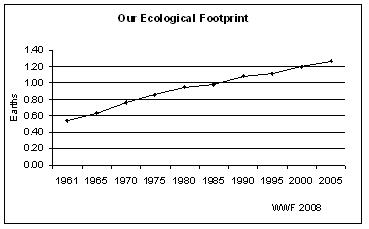
The vulcano eruption on Iceland and its consequences are brisk reminders of how dependent on nature we still are. I often hear people say that industrialism has made us less dependent on nature. That is an illusion. On the contrary, current society is dependent on much bigger parts of nature than any previous society was. Hunter and gatherers were certainly dependent on nature, but they just foraged on the surpluse of limited parts of the ecosystems. The didn't use all the mineral and fossil resources that we do today; they were not dependent on a lot of physical infrastructure like we are and they used less of the ecosystem services. A vulcano eruption on Iceland would have almost no impact on any people outside Iceland (which wasn't even populated at that time....). The same with changes in climate. We are more stuck in all our investments. ,Gatherers were of course also affected by change in climate, but they could move on or change their foraging habits quite easily.
Even compared to the agriculture civilization that preceeded us, we are as or more dependent on supply of product and services from nature. True, we produce a lot more per square meter, but we have increased the population so that all that extra surplus is needed. There is no more food surpluses today than before, rather the opposite. Storage of food is probably a lot less than in the agriculture societies. In Sweden all farms stored food for a year or so (with the less pleasant effect that they ate old food all the time). I am told that the Incas had food storages for seven years (!). True, one difference is perhaps that we can today ship food from surplus areas to deficiency areas with the help of cheap fossil fuel and modern technology meaning that local food shortages should be less devastating. But the fact is that we don't do that. 1 billion is short of food despite all our progress. (Most people forget that countries like Japan and England are less food self-sufficient than Africa, just because they can buy their food). Fodd trade is certainly nothing new, both the Greeks and the Romans were totaly dependent on food imports for their survival....
The industrial society occupies half of the biosphere, i.e. half of all biologicial production is directly in the service of human kind. In addition it uses so many minerals etc, that WWF calculates that we use like 1.5 Earth for our survival. See graph above
The illusion of that we are less dependent on nature is caused by that we live further away from nature. But that is just screwing up our perspective. The fact that we get electricity in cables and petrol frpm tubes in the petrol station doesn't mean that we are less dependent on nature for energy than the hunter sitting around the camp fire or the farmer putting another log on his hearth. On the contrary, we have never been so dependent on nature for our style of living.
Tuesday, April 13, 2010
Speaking of food miles and bio fuel
How far does a hive of bees fly to bring you one pound of honey?
More than 55,000 miles
How much honey would it take to fuel a bee’s flight around the world?
About one ounce (or two Tablespoons); no carry-on luggage is allowed!
More than 55,000 miles
How much honey would it take to fuel a bee’s flight around the world?
About one ounce (or two Tablespoons); no carry-on luggage is allowed!
Thursday, April 8, 2010
Inequality is bad for development
Yesterday evening I went to a seminar with Richard Wilkinson, who, together with Kate Picket, has written the book: The Spirit Level: Why Equality is Better for Everyone.
For me the conclusions were hardly revolutionary, that inequality is not only morally unjust but also leads to more problems in society was something I thought all along. They prove it fairly well. The also show that econimic growth above a certain limit doesn't really contribute to our well being. Also that point is not entirely new,many has made the same case before. I add some graphs that might speak for themsleves.


For me the conclusions were hardly revolutionary, that inequality is not only morally unjust but also leads to more problems in society was something I thought all along. They prove it fairly well. The also show that econimic growth above a certain limit doesn't really contribute to our well being. Also that point is not entirely new,many has made the same case before. I add some graphs that might speak for themsleves.


Friday, March 26, 2010
Peak Phosphorus
Peak Phosporus: Opportunity in the Making
Not only is the Nitrogen cycle critical for our survival AND disturbed in a way where it is out of control - the same applies to phosporus. A recent report from the iisd demonstrates how fragile our existence on this planet is when it comes to the handling of this essential makro nutrient:
"The long-term security of our global food and water supplies may be impacted by the mismanagement of our phosphorus nutrient resources. Essential to plant growth and all life, phosphorus is mined from rock phosphate deposits and synthesized into mineral fertilizers destined for agricultural fields. Easily mined rock phosphate reserves are dwindling and the constraints this could place on fertilizer production pose risks to our long-term ability to feed the planet. Excess phosphorus from agricultural fields runs off the landscape and eventually gets flushed into the ocean, where it takes millions of years to mineralize. Under the right conditions, phosphorus loads can choke water bodies as algae rapidly grow, die and decompose, depriving lakes, rivers, streams and coastal waters of oxygen. This process, referred to as eutrophication, threatens the security of our freshwater supplies and aquatic ecosystems. Phosphorus is fundamental to long-term food security, yet we mismanage it, allowing excess phosphorus to imperil our water resources. Closing the loop on our food systems and moving toward phosphorus independence are crucial to ensuring the long-term security of our food and water supplies. Treating phosphorus as a finite resource shifts our management paradigm from mitigating a noxious substance to recovering and recycling a precious element."
Not only is the Nitrogen cycle critical for our survival AND disturbed in a way where it is out of control - the same applies to phosporus. A recent report from the iisd demonstrates how fragile our existence on this planet is when it comes to the handling of this essential makro nutrient:
"The long-term security of our global food and water supplies may be impacted by the mismanagement of our phosphorus nutrient resources. Essential to plant growth and all life, phosphorus is mined from rock phosphate deposits and synthesized into mineral fertilizers destined for agricultural fields. Easily mined rock phosphate reserves are dwindling and the constraints this could place on fertilizer production pose risks to our long-term ability to feed the planet. Excess phosphorus from agricultural fields runs off the landscape and eventually gets flushed into the ocean, where it takes millions of years to mineralize. Under the right conditions, phosphorus loads can choke water bodies as algae rapidly grow, die and decompose, depriving lakes, rivers, streams and coastal waters of oxygen. This process, referred to as eutrophication, threatens the security of our freshwater supplies and aquatic ecosystems. Phosphorus is fundamental to long-term food security, yet we mismanage it, allowing excess phosphorus to imperil our water resources. Closing the loop on our food systems and moving toward phosphorus independence are crucial to ensuring the long-term security of our food and water supplies. Treating phosphorus as a finite resource shifts our management paradigm from mitigating a noxious substance to recovering and recycling a precious element."
There is meat and there is meat
The debate about meat consumption and its effects on environment and climate is so simplistic. So is also the discussions about meat and food production, where meat consumption often is claimed to be a threat to food security, as if there was any such correlation.
At least some people try to nuance the debate a bit. The last issue of Farming Matters have a number of articles about pastoralism and small-scale livestock production. Below you see a part of the editorial:
"Livestock plays an important role in the livelihoods of many farmers and herders in the South, as it contributes to the basics of food, income, and security, as well as other social and cultural functions. Actually, the world’s poorest people – nearly one billion – depend on pigs, yaks, cattle, sheep, lamas, goats, chickens, camels, buffalos and other domestic animals. For undernourished people, selling one egg may imply being able to buy some rice, and thus, instead of having one meal per day, a second one becomes reality. This is a typical survival strategy: selling high-quality foods to buy lowcost starchy food. In other parts of the world, we see an over-consumption of red meat and other animal-based food, which damages the health of many people: it is a shocking dichotomy"...... read more
At least some people try to nuance the debate a bit. The last issue of Farming Matters have a number of articles about pastoralism and small-scale livestock production. Below you see a part of the editorial:
"Livestock plays an important role in the livelihoods of many farmers and herders in the South, as it contributes to the basics of food, income, and security, as well as other social and cultural functions. Actually, the world’s poorest people – nearly one billion – depend on pigs, yaks, cattle, sheep, lamas, goats, chickens, camels, buffalos and other domestic animals. For undernourished people, selling one egg may imply being able to buy some rice, and thus, instead of having one meal per day, a second one becomes reality. This is a typical survival strategy: selling high-quality foods to buy lowcost starchy food. In other parts of the world, we see an over-consumption of red meat and other animal-based food, which damages the health of many people: it is a shocking dichotomy"...... read more
Friday, March 19, 2010
Traditions, Western Union, Churches and Taro

I spent a few weeks in Samoa, a paradise Pacific island country. My task was to be part of a technical team assisting the government in the development of a program for increasing the competitiveness of the agriculture sector. My role was to look into opportunities for commercial organic production.
It has been a treat to visit Samoa, experience its people, see the nature, enjoy the food and the sea. In eighteen days no-one was rude or aggressive. Samoans are proud of their culture and their country, rightly so I think. I can strongly recommend Samoa for a visit.
You can look at a lot of pictures at: http://picasaweb.google.se/GunneEpost/BilderFranSamoa?authkey=Gv1sRgCMH0tIPk9YLFeA#
When it comes to development, Samoa, like Bhutan that I also visited earlier this year (see my posting), is a complex case. Some things strike you in Samoa. One are the traditional villages with their special building style, the open fales , houses without walls. The village and the extended family (still) have strong positions in Samoa, land is mostly still communal (some 90 percent) and leaders of the extended families, the mathai, assign land to the members of the family. Soils are mostly rich, but some of the soils have more rocks than soil and some parts of Samoa, especially on the island Savaii, are lava fields, the younger of them hundred years old. In these soils Samoans have been growing coconuts, breadfruit, taro and bananas as well as a number of fruits. Traditionally, pigs played a big role. Later cattle, cocoa and coffee were introduced. A lot of the products are not sold in the market but are distributed within then families and villages, the meat in particular is mostly consumed at big parties. So farming is still not so integrated in the market economy.
 (cocoa growing out of the lava rock)
Missionaries brought Christianity to Samoa. I have not seen any statistics, but it appears to me that there must be in the range of thousand churches in Samoa, every village has a number of churches of competing congregations. The churches and Christianity seem to have integrated quite well with Samoan culture and is today a part of the culture and not an alien element. They have added another layer of people living on the surplus from farming, pastors. To be a pastor is a remunerative occupation and following a theological college is undoubtedly a pathway for personal income. So the farmer doesn’t only have to share his earnings with the extended family and the village but also with the congregation.
Overseas remittances play a very big role for the Samoan economy. Samoans are working in New Zealand, Australia and the USA and send money home – the signs for Western Union are as frequent as are the churches. Nobody seems to be hungry in Samoa. There is limited wealth and the wealth is distributed within the extended family.
There are a number of obstacles for a commercialization of farming. In essence this means bringing more farmers into a mainly cash-based and market based economy, both on the input and output side. It means that farmers shall sell products in a market situation, but it also means that farmers use more inputs, both hard and soft inputs, ranging from credits, fertilizers. irrigation to advisory service, business planning. In this way they can increase productivity and their incomes. But the price is increased risk. But not only that. When traditional farming systems are brought into the market economy, the change is not only technical or economic and the effects are not only for the household, but the whole village social context is disrupted, reducing the role of the village, and the extended family, as economic institutions. This was certainly the case for when farming was brought into the market economy in Europe and the same pattern is seen everywhere.
We tend to believe that social security is some modern innovation, but the truth is that all traditional societies have had social security and poor or sick people have been taken care of – within the limits of the ability of the society. That is why the introduction of the (capitalist) market economy in farming systems often result in devastating effects on the less resourced, such as famines like the one in Ireland in 1800s and those in many developing countries the last hundred years.
If people are desperately poor, say like many farmers in Sub-Saharan Africa, breaking down traditional institutions in order to unleash the innovation and investment based on private property and entrepreneurship seems perhaps reasonable. But we should still keep in mind that there will be winners and losers, and if there are no new social security systems developed replacing those of traditional societies the results can be devastating. In societies that are less poor, it is harder to see that commercialization of farming is such a sign of progress, even if the GDP is likely to increase.
When visiting some dozen farms in Samoa, I realize that many of the farm families seem to be happy with their life. Even on direct question of what they would like for their business, they come up with nothing related to increased production, higher income etc. Combine this with the effect of the remittances: lot of money coming in with little efforts from the locals and a certain shortage of labor. Add the effect of the village structure, land ownership, and churches: low incentives to invest in higher production as it will be shared by so many and low incentive to invest in the soil as it is not private. Yes, then there are simply not very big reasons for farmers to increase productivity. In particular there is little reason for why they would like to specialize and increase risk in their production, something that is often a basis for modernization of farming.
While Samoa as a whole, and the Government of Samoa, might want more commercial agriculture it is still not very clear that it is the best option for the individual farmer, which then would also be the main cause for repeated failure of “modernization efforts”, not only in Samoa but in big parts of the developing world.
Some claim that small holders never voluntarily change into the market economy but must be coerced into it through many different pathways. Sometimes by brutal means such as the British enclosures; trading monopolies or outright colonization. But more often through more subtle means: credit programs that makes them dependent; compulsory schooling that means they need to pay school fees, uniforms, books as well as they loose labor force and the children get other values; land titling, i.e. the transformation of land from communities to individuals etc. “Commercializing agriculture means ending subsistence agriculture. How can subsistence agriculture be ended? The simple answer is by huge amounts of compulsion administered by central governments. Only compulsion will induce most peasants to increase per capita production for sale on anonymous markets” says Ronald Seavoy in Subsistence and Economic Development (2000).
It is hard to accept that people should be forced to leave their traditional ways of living…..And ultimately, there is really no proof that a Swedish, German or American farmer is any happier than their Samoan colleagues. As most factors for well-being are not about money but about social and private relations, one may suspect that it is rather the other way round.
Thursday, March 4, 2010
Nitrogen fertilizers destroy soil organic carbon
Didn't we (the organic crowd) say this all the time?
http://www.grist.org/article/2010-02-23-new-research-synthetic-nitrogen-destroys-soil-carbon-undermines-
http://www.grist.org/article/2010-02-23-new-research-synthetic-nitrogen-destroys-soil-carbon-undermines-
Tuesday, February 23, 2010
Off to Samoa


I am on a work mission to Samoa. Above you see a Banyan tree. More pictures can be found at
http://picasaweb.google.se/GunneEpost/BilderFranSamoa?authkey=Gv1sRgCMH0tIPk9YLFeA#
Wednesday, February 3, 2010
Change of values?
I was recently in Japan for a few lectures. As most probably know Japan has stagnated economically the last 20 years after a period of break-neck growth since WWII. One can reflect over what that means for the people that are 20-30 years old now compared to those that are 50-70. The latter grew up in a world very improvement of standard of living was almost taken for granted, where almost everybody became richer every year. Todays young have a different outlook. The question is how do the young of today look at economic growth. My very unscientific survey (of two! young ladies) show that they don't seem to much burdened by this and that they actually seem much less obsessed with income and wealth than their parents.
Perhaps it works in a way that we adjust our expectations to what is realistically attainable. To study Japan is interesting as we all, in turns, will go into their kind of economy in the future, when populations stabilise and decrease, and we lost competitiveness to other, more energetic nations on their way up (China).
Perhaps we all can realise that we don't need more things and that there are other values in life than a new car and a swimming pool. I hope so.
Perhaps it works in a way that we adjust our expectations to what is realistically attainable. To study Japan is interesting as we all, in turns, will go into their kind of economy in the future, when populations stabilise and decrease, and we lost competitiveness to other, more energetic nations on their way up (China).
Perhaps we all can realise that we don't need more things and that there are other values in life than a new car and a swimming pool. I hope so.
Save organic from over-regulation
Just came back from Japan.
Organic agriculture as a concept is not at all new in Japan; Japan actually has contributed a lot to the global development of the organic sector. An early pioneer was Mokichi Okada who established nature farming field experiments in Japan 1935. He was later followed e.g. by Masanobu Fukuoka who promoted a kind of organic farming which was mimicking nature as much as possible. The so called Effective Microorganisms (EM) also originate from Japan. A special way of compost making, bokashi, is also a Japanese contribution to organic farming, which has spread far beyond Japan.
The figures for certified organic farming are not very impressive. In 2008/2009, 8,595 hectares were certified of which rice paddy constituted 2,810 hectares; annual crops 4,416; perennial crops 998 ha and pasture 362 hectares respectively. This corresponds to just 0.19 percent of the total arable land. The number of certified farmers is just above 3800. supervision and enforcement.
In contrast to these very modest figures, 4.7% of the farmers claim, in a survey from 2007, that they are already doing organic farming. Some estimate that the number of organic farmers outside the JAS system amounts to the double of those within the system while the member of Parliament Mr Tsurunen told me that he believes there are seven times as many, which would correspond better with the claims by the farmers. Many sources state that a considerable proportion of those that are claimed to be organic are not really following the standard, e.g. they might rotate organic crops in an otherwise non-organic crop rotation, or they might indeed use some chemical fertilizer. Regardless which figure is the correct one it is clear that third-party certification and government regulation has not unified the Japanese organic sector, rather the opposite, and that there is at least as many serious organic farmers outside the system as within.
“Until the latter half of the 1990s when the WTO regime was established they (the Government) rushed to set up rather low quality organic standards based on the Codex Guidelines and a very strict accreditation system (the revised JAS law). In doing so, they robbed the terminology ‘organic agriculture’ from the private sector, which had been taking into account the farming conditions in Japan. Since the implementation of the revised JAS law, the share of domestically produced ‘organic agricultural products’ distributed in Japan has lowered disastrously. In the meantime, those participating in Teikei and self-sufficient methods continue to work outside the market distribution framework, choosing not to use the organic JAS label.” says Katsu Murayama, an organic pioneer.
There is a fairly large number of organic farmers also in Europe and the USA that have stayed outside or quit the regulatory systems of certification. It is scandalous that those are deprived from the right to define themselves and their producs as organic by zealous (or perhaps just incompentent?) regulators. But--- in all fairness, to a large extent the sector itself is to blame for calling in the governments in the first place.
Organic agriculture as a concept is not at all new in Japan; Japan actually has contributed a lot to the global development of the organic sector. An early pioneer was Mokichi Okada who established nature farming field experiments in Japan 1935. He was later followed e.g. by Masanobu Fukuoka who promoted a kind of organic farming which was mimicking nature as much as possible. The so called Effective Microorganisms (EM) also originate from Japan. A special way of compost making, bokashi, is also a Japanese contribution to organic farming, which has spread far beyond Japan.
The figures for certified organic farming are not very impressive. In 2008/2009, 8,595 hectares were certified of which rice paddy constituted 2,810 hectares; annual crops 4,416; perennial crops 998 ha and pasture 362 hectares respectively. This corresponds to just 0.19 percent of the total arable land. The number of certified farmers is just above 3800. supervision and enforcement.
In contrast to these very modest figures, 4.7% of the farmers claim, in a survey from 2007, that they are already doing organic farming. Some estimate that the number of organic farmers outside the JAS system amounts to the double of those within the system while the member of Parliament Mr Tsurunen told me that he believes there are seven times as many, which would correspond better with the claims by the farmers. Many sources state that a considerable proportion of those that are claimed to be organic are not really following the standard, e.g. they might rotate organic crops in an otherwise non-organic crop rotation, or they might indeed use some chemical fertilizer. Regardless which figure is the correct one it is clear that third-party certification and government regulation has not unified the Japanese organic sector, rather the opposite, and that there is at least as many serious organic farmers outside the system as within.
“Until the latter half of the 1990s when the WTO regime was established they (the Government) rushed to set up rather low quality organic standards based on the Codex Guidelines and a very strict accreditation system (the revised JAS law). In doing so, they robbed the terminology ‘organic agriculture’ from the private sector, which had been taking into account the farming conditions in Japan. Since the implementation of the revised JAS law, the share of domestically produced ‘organic agricultural products’ distributed in Japan has lowered disastrously. In the meantime, those participating in Teikei and self-sufficient methods continue to work outside the market distribution framework, choosing not to use the organic JAS label.” says Katsu Murayama, an organic pioneer.
There is a fairly large number of organic farmers also in Europe and the USA that have stayed outside or quit the regulatory systems of certification. It is scandalous that those are deprived from the right to define themselves and their producs as organic by zealous (or perhaps just incompentent?) regulators. But--- in all fairness, to a large extent the sector itself is to blame for calling in the governments in the first place.
Tuesday, February 2, 2010
Gardens in Japan
This entry isn't philosophical or deep in any sense. Just want to share some pictures of beautiful Japanes gardens I just visited in Tokyo and Kyoto.
Enjoy
You can see more of them at http://picasaweb.google.se/GunneEpost/JapanGardens#
 Koishikawa Karokuen Garden, Tokyo
 Golden Pavilion, Kyoto
 Entsu Ji Temple, Kyoto
 Heijan Jingu, Kyoto
 Heijan Jingu, Kyoto
 Kyiomizu-dera, Kyoto
Enjoy
You can see more of them at http://picasaweb.google.se/GunneEpost/JapanGardens#
 Koishikawa Karokuen Garden, Tokyo
 Golden Pavilion, Kyoto
 Entsu Ji Temple, Kyoto
 Heijan Jingu, Kyoto
 Heijan Jingu, Kyoto
 Kyiomizu-dera, Kyoto
Wednesday, January 27, 2010
Back from Druk Yul
I have been a lazy blogger lately. There were all the hollidays, then I spent a lot of time with the Swedish edition of my book, Garden Earth. I have also spent ten nine day for a trip to Bhutan, called Druk Yul, the Land of the Thunder Dragon in Bhutanese. The main task for me there was to participate in a workshop by the ministry of agriculture on "Organic Agriculture Strategy, and Standards and Certification Systems". The workshop was successful and I believe the Bhutanese will crafty a strategy for development of a simple and practical system for their own national market. For the export market they have not many options as the rules of the importers rule...
Compared to other countries, the Bhutanese government has been very pro-active in the promotion of organic agriculture. It has a vision that all of Bhutan should be organic, but it treads slowly in the implementation. Only a decade earlier Bhutan promoted use of pesticides, but most farms don’t use any inputs. Important features of the organic development in Bhutan are:
- a three-pronged approach were organic is recognised as relevant for household food security production; as a local market strategy and for export marketing. The emphasis is on local market development
- many farms in Bhutan are integrated farms where crop production, livestock and collection of wild product interacts with each other and contributes to the household livelihood. Some seventy percent or more can be characterised as “organic by default”
- most export production is wild collection and medicinal herbs
- all schools have agricultural training and own school gardens, they are organic since a few years
- when it comes to extension the policy of the government is that the starting point is that advise is organic. If there are farmers that want to be non-organic they can also get advise for that, thus quite the opposite to the approach in most other countries
- one (out of four) research centre is dedicated for organic production

The picture is from the stupas of Dachu La seen through prayer flags.
Bhutan is a fascinating country that makes huge efforts to preserve their culture and the environment. It is very beautiful and people are calm and peaceful. I went o Bhutan overland and it is a very interesting experience to pass the Indian border to Bhutan. On the one side there are millions of people, very busy commerce, people being agitated and a bit pushy (don't take this as being critical to Indian people they are nice), on the other side it is laid back and relaxed.
Perhaps the serenity comes with a certain price as well: Bhutan is one of the poorer countries in the world and half of its GDP is development aid. Interestingly enough most aid comes from India, which itself recieves aid, but for the Indians this is mainly strategic - to keep Bhutan out of Chinese influence, and the Bhutanese seem to be able to capitalise on this.
The forests, which make up 70 percent of the land are protected, and there is no hunting and no fishing allowed. There is a ban on tobacco and there are plenty of regulations that aims at preserving nature and culture. This combined with that it is a very government heavy country makes the private sector and NGOs weak. Entrepreneurship is not well developed. For me it felt a bit strange that it was so cold in the houses while all that forest was just next door (mind you, I have been heating my house with firewood for more than thirty years).
In a way Bhutan exemplifies another choice than the mainstream capitalist way. And it is very nice and a fabulous place to visit. However, I am not sure it is so fabulous as a model for other countries. I would rather like to see a third way than have to choose between a commercial, industrialised consumer society and the somewhat museal Bhutan way.
I will always look back to Bhutan with fondness and hope I can go there again.
I have uploaded three videos of my trip overland from Bhutan to Siliguri in India. The Bhutan part of the road is quite scary, 180 km takes six hours, because it is so steep and the road is narrow. The India part is scary just because...it is India!
Paro-Phuntsoling
Border to Siliguri (India)
Siliguri
Perhaps the serenity comes with a certain price as well: Bhutan is one of the poorer countries in the world and half of its GDP is development aid. Interestingly enough most aid comes from India, which itself recieves aid, but for the Indians this is mainly strategic - to keep Bhutan out of Chinese influence, and the Bhutanese seem to be able to capitalise on this.
The forests, which make up 70 percent of the land are protected, and there is no hunting and no fishing allowed. There is a ban on tobacco and there are plenty of regulations that aims at preserving nature and culture. This combined with that it is a very government heavy country makes the private sector and NGOs weak. Entrepreneurship is not well developed. For me it felt a bit strange that it was so cold in the houses while all that forest was just next door (mind you, I have been heating my house with firewood for more than thirty years).
In a way Bhutan exemplifies another choice than the mainstream capitalist way. And it is very nice and a fabulous place to visit. However, I am not sure it is so fabulous as a model for other countries. I would rather like to see a third way than have to choose between a commercial, industrialised consumer society and the somewhat museal Bhutan way.
I will always look back to Bhutan with fondness and hope I can go there again.
I have uploaded three videos of my trip overland from Bhutan to Siliguri in India. The Bhutan part of the road is quite scary, 180 km takes six hours, because it is so steep and the road is narrow. The India part is scary just because...it is India!
Paro-Phuntsoling
Border to Siliguri (India)
Siliguri
Subscribe to:
Posts (Atom)