Wednesday, May 9, 2012

Markets don't distribute food to those without money


Seb's maize. Photo Richard Mulonga
The maize is towering over a sea of vigorous weeds. In some cases the greenery has pulled down the stalks and it is almost hard to believe there will be any harvest out of that field. Seb Scott, however, assures me that his maize will yield some 7 tons per hectare. The weeds are actually intentionally planted Lablab beans (Dolichos lablab). Seb is growing maize without machinery; i.e. he and his partner hand-hoe the fields, or just sow by hand in the mulch with an ingenious piece of tube. They also grow organically; instead of using government subsidized fertilizers he use green manure crops to supply nitrogen to his plants.


Some of the Mkandawire children eating their breakfast
Seb is not the only farmer I visit this day in Zambia in the end of April 2012. My first visit went to Fred and Susan Mkandawire. They grow maize on a hectare of land and they harvest a ton, just enough to keep the family alive. Maize is what they eat for breakfast, lunch and dinner. They don’t starve, but their margins are very small. It seems that they can sell a surplus of 250 kg, worth around 50 dollars this year, which is far from enough for the school fees for the five children. The Mkanadawires are using chemical fertilizers and work totally manually on their farm.

Godfrey Boma and his sunflower, Photo: Richard Mulonga
When he stands next to his great organic sunflowers, it is hard to believe that Godfrey Boma is 81 year old. After all, life expectancy in Zambia is below 40 years. Godfrey is a former miner and small business man who became a farmer at an age where the normal Swede stops working altogether. His and his wife Katherine’s farm is 9 hectares of which 4 hectares are farm land. He uses own oxen for plowing. A better – and more timely - land preparation, better weeding and higher use of chemical fertilizers are all contributing to that he harvest around 5 tons per hectare of maize - more than double the national average. That is five times as much as Fred and Susan, but still less than Seb. 

Godfrey also has a plot of organic production, Instead of the monoculture of maize which is typical for conventional maize production (such as Mkandawire’s and his own) the organic plot has ten different crops in smaller plots or grown together (so called companion cropping). When I asked how organic and non-organic compares, he says: ”It is 50-50. Organic is nice, there are no problems with disease, I don’t use any chemicals and have less cost. But it is more work”.

The visits show that it is possible to increase yields a lot. It is possible to do it with conventional methods and it is possible to do it with organic methods. It is possible to do it in a small scale farm or in a large scale farm. It also shows that poverty, in the sense of limited resources, as for the Mkandawires, is most likely a cause of low productivity in farming, rather than low productivity being the cause of poverty.

Zambia has been used as an example of successful agriculture policy, a proof that with more fertilizers one can produce ”more food”. Perhaps there is limited success on that count, even if the Ministry of agriculture’s own research shows that most of last years high yields crops can be explained by good rains.

Zambia’s agriculture budget is to a very large extent orientated to subsidies of chemical fertilizer and government procurement of maize, to a price considerably above world market prices. And clearly it works in the sense that it results in increased maize production. Anything else would be highly surprising.  Higher prices will lead to higher production, as it pays to use more resources for the same piece of land. As we can see above productivity per hectare can increase with different production methods. Fertilizer probably plays a marginal role for the increase of maize production in Zambia. In 2010/11 Zambia had a bumper crop of maize, and the result is that Zambia has a stock pile of more than 1 million ton, when the new season starts. The minister of agriculture, Emannuel Chenda tells the Post (May 1) that the huge surplus is a challenge, but continues by saying ”I am aware of that potential markets exist beyond our region in places such as the Horn of Africa. He doesn’t seem to understand that there is no shortage of food in the world; the people of the Horn of Africa simply can’t buy it, as little as the poor in Zambia.  The Zambian Farmer reports in their April issue that a very big proportion of the maize stock pile is simply rottening. Approximately a third of the maize in stock has gone to waste in bad storages. The authorities are now burning the rotten maize to make space for the new crop!

Many are critical to the fertilzer support:
”A ‘one size fit all’ approach to fertilizer and seed regardless of differences in agro-ecological zones and soil types has been responsible for poor yields per hectare experienced each year. All farmers are made to plant the same variety or range of seeds (short maturing or medium maturing or long maturing) using same type of fertilizers (D-compound and Urea) despite agriculturists knowing that differences in soil fertility require adjustments in input applications. This has resulted in significant drop in yield against yield potentials to as low as 10 bags per hectare against the potential 50-70 bags.”
says Action Aid in a report.

Daniel Kalala from the Kasisi Agriculture Training Center says that ”fertilizer subsidies is the number 1 election campaign strategy”. Others point to the rampant corruption involved in the program. The Farmer Input Support program costs Zambia 700bn Kwacha per year (some 133 million dollars).  This is enough to buy more than 500,000 ton maize – enough to feed some 2-3 million Zambians. By only supporting maize production with fertilizers and seeds, the government induces bad management practices (mono-culture) as well as bad nutrition of rural families, as they will grow more maize  and less of other crops.

All those issues aside, the story of food and who gets it and who doesn’t has very little to do with agronomic issues or with the use of more GMOs, or more fertilizers. The farms I visited show that it is access to resources (including know how) as well as markets that is most important for the productivity of the land and not if the farm is organic or not. How we farm is still a very important issue for how we maintain and enhance our social and natural capital, When it comes to food, distribution is a much bigger challenge. And distribution, in turn, has a lot to do with markets. And markets don’t distribute food to those that have no money to buy for.  

Friday, May 4, 2012

The monuments of the city are built on the backs of poor rural people

When going from Lusaka towards the farm of Susan Mkandawire we meet a constant stream of guys on bicycles on their way to Lusaka with heavy loads of charcoal. One of them is Christoffer Finsoni on this picture. He is a farmer but earns most of his cash from charcoal making and marketing. He carries 4 bags of 30 kg charcoal on his bicycle some 30 km to the market in Lusaka.

We often here the story about ignorant rural population that destroys their environment by cutting down the trees for cooking. But the reality is a lot more complex. Christoffer and his likes are mainly living in the "organic economy" based on biological and renewable resources. Wood (charcoal) and human power (as in bicycle) are the main energy sources. When I meet him in my car I represent the fossil fuel economy and the global industrial system. What strikes me is the direction of the stream of resources.

Many believe that the stream is from the rich global fossil-fuel economy to the poor, but is it?

Andrews family doesn't use char coal for their cooking, they use fire wood. Char coaling for the market in the city is a bigger threat to their forest land. And who is buying the char coal? Well it is certainly not the poor, they use twigs, corn cobs, stalks and other waste for their cooking. It is rather rich people in the city that drives deforestation. A similar case is the cutting of forests for conversion to grazing land. Most of that meat is destined for rich people. A similar thing is the idea to make bio char from bio mass. Again, poor peoples resources are used to enable the rich to continue a life style that is not sustainable. 

In the same way, the notion that urban living is more environmentally friendly as claimed by many, is just a delusion. The city has always been a parasite on the rural areas and most of the destruction in rural areas are caused by "city life and industrialism". This is based on inequality, privilege and violence.

Thursday, May 3, 2012

Keep your ear to the ground!


Photo: Richard Mulonga
Susan Mkandawire in Kasisi, Zambia prepares food for her family of seven. Today’s lunch is Nsima. She uses own maize, a bit of cooking oil from the shop, pumkin leaves from her own farm and salt. This is the typical lunch and dinner most days. Breakfast: maize porridge.
 
This is the first job in the project
Keep your ear to the ground!


Which is the title of a book being written by journalist Ann Helen Meyer von Bremenand agriculture consultant and writer Gunnar Rundgren. It is commissioned by the largest environmental NGO in Sweden, the Swedish Society ofNature Conservation (www.snf.se) and will be their yearbook for 2013. 
Breakfast for some of the Mkandawire kids, Photo: Richard Mulonga
The main theme of the book is if it is possible to provide food for a growing population in a sustainable way. The book will look at agriculture development in a global and historical perspective to inform the reader of the forces that shape agriculture – and relate it to our diets and the landscape.  It will describe main challenges for agriculture such as water, erosion, nutrient supply and oversupply, biodiversity and competition between food production with other land-uses, such as bio-energy, conservation and built infrastructure. 
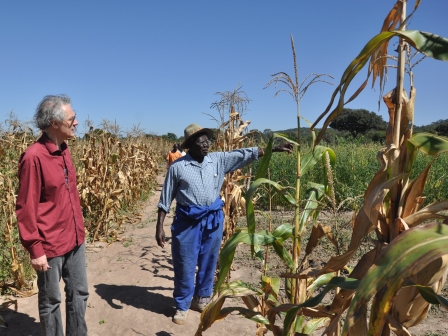
81 year old Godfrey Boma shows me his organic plots. Photo: Richard Mulongo

How agriculture is shaped by forces of technology, markets, policy and demography will be described. Special features will show this in the practice based on visits to countries such as Brazil, the US, India, the Netherlands and Sweden. Not only problems will be highlighted; from each country examples showing a path for a truly sustainable agriculture will be showcased.  

The book will discuss some of the prevalent perceptions or myths about farming and diets such as the need for GMOs and chemical fertilizers, the effect of increasing meat consumption, the effect of the farm frontier expansion. It will also present one or more scenarios for a truly sustainable agriculture.

The work with the book will be done in the period April to November 2012, with the research phase in April to August 2012. It will be published, in Swedish, in December 2012. 

Susan does the heavy hoeing, preparing the land. Fred, the husband cuts the grass with a panga. Photo: Gunnar

Sunday, April 22, 2012

The rise of civil society?

Why are we only discussing the state and the market?

The figure tries to depict how various activities have moved from different spheres during the growth of the capitalist society (to the Left) and where they might go in an alternative development (to the Right). With the introduction of capitalism and market economy, many things were moved out from the family, local communities and civil society (the local communities, e.g. the villages, are here seen as part of civil society rather than as part of the state). The role of the state also increased initially: the state organized education, built infrastructure, health care, etc. It also regulated the family and civil society increasingly.

In the later phase of capitalism, more and more has been moved to the market; some aspects of life, like religion, have been relegated to the individual, mainly because they are no longer seen as essential for social order. Civil society organizations have been further weakened, mainly because the market has penetrated most of its space and realm and because of the attitude and values of the market economy. Individualism and competition have not been conducive for civil society.

In the future, we should strive for more activity in the local communities and civil society and less activity in the market sphere as well as in the central government. Also the private sphere should regain some of its relevance, in particular regarding food production and preparation and other household services.
(from Garden Earth)

Thursday, April 19, 2012

Your 200 square meters of concrete and asphalt

One of our environmental footprints is the sealed area of the planet:

Uppsala from the south, highways and shopping malls spread on fertile plain, Photo: Kolbjörn Örjavik

The total sealed soil surface of the EU area in 2006 was estimated to be around 100 000 km² or 2.3 % of the EU’s territory, with an average of 200 m² per citizen. Member States with high sealing rates (exceeding 5 % of the national territory) are Malta, the Netherlands, Belgium, Germany, and Luxembourg. Furthermore, high sealing rates exist across the EU and include all major urban agglomerations, and most of the Mediterranean coast. The latter experienced a 10 % increase in soil sealing during the 1990s alone.  Assuming an unabated linear trend, we would convert, within a historically very short time frame of just 100 years, an amount of land comparable to the territory of France and Spain combined. Moreover, it is not only the absolute land take figure that matters but the spatial distribution and the value and availability of the land taken. For example, settlement areas cover 5 % of Austria’s total territory, but this figure soars to around 14 % when Alpine areas unsuited to urban or infrastructure development are excluded. When looking at the conversion of agricultural land, land take matters even more as the share of arable land in Austria is about 16 % only. In the case of the Italian Emilia-Romagna Region, some 95 % of the land take between 2003 and 2008 occurred in the fertile plain soils that cover only half of the Region. (from the Guidelines on best practice to limit, mitigate or compensate soil sealing from the EU)
I wrote about this in a post just a few days ago:

Paving the land - and taking it back again

The EU report above has some good recommendations. 

Limiting soil sealing means preventing the conversion of green areas and the subsequent sealing of (part of) their surface. The re-use of already built-up areas, e.g. brownfield sites, can also be included in this concept. Targets have been used as a tool for monitoring as well as spurring progress. Creating incentives to rent unoccupied houses has also helped in limiting soil sealing. Where soil sealing does occur, appropriate mitigation measures have been taken in order to maintain some of the soil functions and to reduce any significant direct or indirect negative effects on the environment and human well-being. These include using, where appropriate, permeable materials instead of cement or asphalt, supporting ‘green infrastructure’, and making wider use of natural water harvesting systems.

But it also introduce another version of of the idea that we can "compensate" or "offset" the effects of our behaviours. So, in a similar way as we can 'offset' our carbon emissions by planting trees in Africa, we can 'compensate' soil sealing: 

"The eco-account system is based on determining the ‘ecological costs’ of development projects involving soil sealing through the attribution of eco-points. Developers have to ensure that compensation measures of equal value are being carried out somewhere else. Ecopoints are acquired at officially authorised compensation agencies, which are responsible for their attribution and redemption and for overseeing the system."

So next step is that we can pay for re-claiming land in Africa for us to continue building high-ways. A strange world indeed.  

Tuesday, April 17, 2012

Paving the land - and taking it back again


"Restoring to fertility land covered with concrete is an enormous task, but not an impossible one. So, Lorenza Zambon, actress and gardener, tells the story of a couple in Turin, Italy, who decided to give to their children a patch of fertile land as a gift. It was a lot of work; concrete had to be cut and broken to pieces and the rubble carried away. Then, restoring the fertility of the soil took truckloads of dirt, charcoal, and more. Zambon doesn't tell us how long the task took nor how much it cost, but surely it was slow, messy and expensive. It was also a subversive idea: in the generally accepted view, paving the land means "developing" it, and that means making money. So, destroying property to restore the fertile soil is something that nobody in his/her right mind would - normally - do."
writes Ugo Bardi on his blog post about the increasing encroachment on agriculture land by roads, houses etc. It is very hard to get accurate data for exactly how much land is paved over or "built" in the world. Data from Denmark looks like this. 

Danish land use (ministry of environment 2004)
 4.1 %, 4.3 % and 4.4 % of the EU territory was classified as artificial surface in 1990, 2000 and 2006 respectively. This corresponds to a 8.8 % increase of artificial surface in the EU between 1990 and 2006. In the same period, population increased by only 5 %. In 2006 each EU citizen disposed of 389 m² of artificial surfaces, which is 3.8 % or 15 m² more compared to 1990. Unsustainable land use trends can be observed in Cyprus, Denmark, the Netherlands and Portugal where land take is growing considerably faster than population growth. Furthermore, there are several new Member States also affected by unsustainable land use trends due to continuing land take and at the same shrinking populations. Policy targets for land take. Quantitative limits for annual land take exist only in six Member States: Austria, Belgium (Flanders), Germany, Luxembourg, the Netherlands, and the United Kingdom. In all cases the limits are indicative and are used as monitoring tools. This can be read in a recent EU report. I write more about this report in the post EU farm land increasingly sealed. 

In Garden Earth I write:

Roads and petrol stations—the crops of the modern times

The statistical basis for assessing how much land human beings have taken in direct use for buildings, roads, etc., is surprisingly weak. Literature quote figures from 1.5% up to 9%. In Sweden 3%, 1.29 million hectares of the land, is built on in some way. Land for housing was 29% of this; roads, railroads and airports 31%; industries, etc. 11%. Of course, Sweden is sparsely populated. In the county of Stockholm 15% of the land is built upon whereas in the northernmost county of Norrbotten only 0.6% of land is built upon. There were 550,000 kilometres of roads (some 60 metres per person) covering 345,000 hectares of land (SCB 2004). In the more densely populated Denmark, human infrastructure is calculated to cover almost 20% of the land area (Danish Ministry of Environment 2005). During the 1960s, 7% of European farm area was encroached upon by roads and 15% of the agriculture land of Great Britain was built upon (Montgomery 2007). By 2010, the United States lost almost 10 million hectares, more than 2.5% of farmland, to human infrastructure since 1950 (Talberth et al. 2007). Eastern United States has a larger proportion of its total area (4–5%) in urban and suburban landscapes than in other regions (H. John Heinz III Center 2008).

We need to do something with the ongoing encroachment of agriculture land by built infrastructure. It is scandalous that soils are not protected by any international conventions. As far as I understand it is not even on the agenda in the upcoming Rio + 20 meeting.
Time for a soil convention!

Update 19 April:
Apparently the EU Commission released some guidelines about "soil sealing"
http://ec.europa.eu/environment/soil/pdf/soil_sealing_guidelines_en.pdf
and there is an upcoming conference about it:
http://ec.europa.eu/environment/soil/conference_may2012.htm 

Tuesday, April 3, 2012

Growing with love and care, Organic agriculture grows in Africa

Growing with love and care, Organic agriculture grows in Africa
 ‘Organic agriculture is extremely important in human life. The food we eat today is grown without real love and care for human life’, says Zambia's First Republican President Kenneth Kaunda, one of the prominent speakers at the 2nd African Organic Conference in Lusaka, Zambia. The conference will attract some 300 participants from more than 40 countries and four continents.

 Organic agriculture in Africa is growing rapidly. More than 1 million hectares of arable land and at least 530,000 farmers are certified, according to organic standards in Africa. Uganda and Ethiopia have each more than 100,000 certified organic farms and Tanzania some 85,000. Most of the certified organic production is sold for exports, but there are good organic markets in South Africa and Egypt and emerging markets in countries such as Senegal and Kenya. Many more farmers, from Morocco to Madagascar, from Cairo to Cape Town, practice organic farming for the benefit of local communities and the environment.
From being ignored or even oppressed by government, organic farming is increasingly recognized for its contribution to food security, poverty alleviation and the environments.
The President of South Africa, Jacob Zuma, told delegates at COP 17 in Durban in December:
‘Several studies show that the use of organic methods of farming by small producers in developing countries can lead to an increase in crop yields and thus enhance food security among the poor. Sustainable crop and livestock systems provide ecosystem services that restore productivity, conserve soil, water and biodiversity, take away carbon, regulate climate and provide landscape and cultural values.’ 
The Executive Council of the African Union has recently adopted a decision on organic farming. The decision calls for the establishment of an African organic farming platform based on available best practices.  

The conference in Lusaka 2-4 May, provides an opportunity to showcase the contribution that organic agriculture already makes and discuss how it can be scaled up to meet the combined needs of more food production, maintaining the environment and increasing income. ‘It makes us proud that Zambia is becoming a pioneer in climate-smart agriculture. Our expectations are that the conference will be a practical learning and implementation experience.’ said Munshimbwe Chitalu, OPPAZ chief executive officer. Topics addressed range from organic policies and action plans, private sector initiatives, research and options for cooperation on organic standards in Africa. Research findings and studies of best practises form a major part of the conference. The full programme is available at
 
 The Second African Organic Conference Mainstreaming organic agriculture in the African development agenda will take place in Lusaka, Zambia, from May 2 to 4, 2012.
The conference is organized by the Organic Producers and Processors Association of Zambia (OPPAZ) in cooperation with the Ministry of Agriculture and Livestock of Zambia, the United Nations Conference on Trade and Development (UNCTAD), United Nations Food and Agriculture Organization (FAO) and Grow Organic Africa under the auspices of the International Federation of Organic Agriculture Movement (IFOAM) and the African Union. Registration is open until 10 April at
 http://africanorganicconference.com/index.php/registration
More information at www.africanorganicconference.com.
 Contacts:
 Munshimbwe Chitalu, OPPAZ, gmchitalu@gmail.com, tel. +260-21-1263 070
 Gunnar Rundgren, Grow Organic Africa, gunnar@grolink.se, tel. + 46 70 518 0290
 Hervé Bouagnimbeck, IFOAM, h.bouagnimbeck@ifoam.org, +49-228-92650-23
 Sophia Twarog, UNCTAD, s ophia.twarog@unctad.org, tel. +41 22 917 5082


-------------------------------------extended information--------------------------------------
 What is organic agriculture?
 Organic agriculture is a production system based on active agro-ecosystem management rather than on external inputs. It builds on traditional agriculture and utilizes both traditional and scientific knowledge. Certified or uncertified, organic agriculture offers a wide range of food security, economic, environmental and social benefits.
Organic agriculture builds soil fertility and structure by restoring carbon and nutrients to the soil through sustainable land and water management techniques such as composting, cover crops, mulching and crop rotation. This can help African crops reach their full potential of yielding two to four times more than they currently do. 
 Research shows that organic agriculture is a good option for food security in Africa – equal or better than most conventional systems and more likely to be sustainable in the longer term. An analysis of 114 cases in Africa revealed that a conversion of farms to organic or near-organic production methods increased agricultural productivity of 116 per cent. Moreover, a shift towards organic production systems has enduring impact, as it builds up levels of natural, human, social, financial and physical capital in farming communities.
  •     Under the Environmental Action Team project in Kenya, maize yields increased by 71 per cent and bean yields by 158 per cent. Moreover, increased diversity in food crops available to farmers resulted in more varied diets and thus improved nutrition.
  •      For 20,000 farmers in Tigray, previously one of the most degraded regions of Ethiopia, crop yields of major cereals and pulses have almost doubled through the use of ecological agricultural practices such as composting, water and soil conservation activities, agroforestry and crop diversification.
  •      In Uganda, an in-depth study of 331 farmers found that those engaged in certified organic export production had significantly higher incomes than their conventional counterparts. Conversion to organic was fairly easy, involved little risk and required few, if any, fixed investments. The organic households became more food-secure due to higher incomes.
 More resources:
 Reports from earlier conferences
 FAO web site for organic agriculture
 IFOAM Africa Office
 UNCTAD policy brief and other resources
http://archive.unctad.org/en/docs/presspb20086_en.pdf
 President Zuma’s speech:
http://www.thepresidency.gov.za/pebble.asp?relid=5431

(this is a press release for the conference, I am much involved in the organization of it)

Wednesday, March 28, 2012

We are people through other people

What Drives Us?
We are people through other people (Bantu proverb)
Homo economicus and Homo geneticus
Two widespread perceptions or theories interpret or explain all human efforts and motivation from one single factor. One is socio-biology, which sees human agency as just a reflection of the selfish interest of genes to multiply, and the other is economicism and the invisible hand, which interprets all human actions as motivated by economic stimuli; that is, all traits that are ‘profitable’ will be chosen and will ultimately dominate. These two theories are not contradictory. Socio-biology is perhaps more applicable at the private level and economicism at the societal level. The more extreme proponents of both theories try toexplain all human behaviours with their respective theory, for instance that we chose partners on the basis of economic considerations alone.

Socio-biologists, with some support from the theory of natural selection, consider egoism of genes to be the engine of all developments and actions. They don’t deny that people can act altruistic but explain altruism as something that is driven by egoism in the first place.The fact that young men waste their genes as canon feed in a meaningless war—or in a dignified battle for freedom for that matter—is explained by the fact that they (or rather their DNA) can ‘count’ on the genes of their sisters being spread and, in such way, their own genes can live along. Or some other far-fetched explanation. 

That the world is not filled by rapists cannot be well explained by this theory but can well be understood with a societal perspective of human beings. If the desire for rape were genetic, only through a systematic killing of the infants born out of rape could it be contained, especially if there were no societal mechanisms against it (and such an infanticide would again be a societal response). Socio-biologists also fail to explain why women in high-income countries don’t have so many children. They could manage to raise four, and well up to ten, children and all would survive, spreading their genes much more effectively than with the current two children. Despite all these objections, it is quite clear that many human actions can be explained on rather simple evolutionary grounds—anything else would be sensational.

Simpleton economicists and their popularizers want to explain all human actions by economic drivers. Also, many Marxists tend to see the acts of different groups to be fully dependent on their economic standing in relation to as opposed to production factors—here the concept of ‘class’ is critical. The reasoning goes from self-evident things to very cumbersome explanatory models. History shows that economic motives and personal gain were in no way important drivers before capitalism. Material wealth has, for sure, always been attractive, but social status and power have always been more important. And economic wealth was not the route to these; many cultures despised trade and entrepreneurship. 

The basic error is the perception that economic drivers are superior to all other drivers and that all other drivers can be ‘translated’ into money. If one studies certain periods in history one might indeed get this impression. The strength in the reasoning is that the economic driver is a forceful paradigm with many self-reinforcing loops. And as a society is built along this paradigm, human beings consciously and subconsciously create a world that rewards exactly this; in such a way it becomes self-fulfilling. But this is not truer than the statement that the most important driver for human development is the ability of an individual to throw a spear farther than anyone else. This ability was most likely very important in a hunter society or a war society, much more important than the ability to amass wealth.

Even the liberal economist and philosopher Friedrich von Hayek (2001) notes in his famous The Road to Serfdom, an attack on both fascism and socialism, that the ultimate objectives of a rational person are never economic; that there is no ‘economic motive’, but only economic factors that influence our ability to achieve other goals. Another version of economicism is the idea of ‘rational choice’ , that is, the idea that one can find a rational explanation to all human deeds. Also, this idea is to some extent totally self-evident and totally meaningless in the sense that irrational choices most certainly will lead to failure in the long run as this is more or less the definition of ‘irrational’; if it is successful it isn’t irrational . . .

The arguments of the economists and socio-biologists can complement each other and don’t necessarily contradict each other. Also, the economists and socio-biologists are often the same people, or the same people use their arguments alike. If economic wealth also leads to higher levels of reproduction, they most certainly complement each other. While there are some indications that success is attractive, it doesn’t seem to translate into rich people or rich societies having more children than poor people or poor societies. Modern population patterns seem to support a totally opposite view. The poor have more children and today they also have more surviving children. Both theories forget the importance of the social and cultural context.

We are tamed by culture
Many look towards animals for guidance on which behaviours are ‘natural’, with the
understanding that what is ‘natural’ is good or right or, at least, inevitable. And, for sure, many interesting parallels exist between human and animal behaviour. But the search in nature for examples of certain behaviours is often coloured by what people want to see. For some reason, many tends to look a lot more towards chimpanzees than bonobos. Both species are equally close to human beings, so why are comparisons drawn mainly with the aggressive chimpanzees? Chimps live in aggressive patriarchates whereas bonobos live in matriarchates, using sex for social interaction and conflict resolution. While social hierarchies do exist among bonobos, rank plays a less prominent role than in other primate societies. Isn’t it so that human beings project what they want to see in the examples they seek? Space doesn’t allow any major digression into gender, but if there is any area where the most meaningless comparisons with nature are made, it is here. Even human reproduction is described in terms of male activity and female passivity, while reality might be quite different.

Nature has such diversity that one can find almost any behaviour there.The long adolescence of a human being is long and slow for a (evolutionary) reason. Whileone can envision human beings growing up in a few years, like horses or cows, or in half a year, like dogs or pigs, in reality human beings need a lot more time. A newborn chimp’s brain weighs around 60% of a grown-up chimp’s brain, whereas a newborn human’s brain weighs just 24% of an adult human’s brain (Gärdenfors 2003). It takes human beings some 12–18 years to grow up, and this time frame seems to get longer as society becomes more and more complex. Humankind has to learn so many things and, more importantly, human beings need to be ‘socialized’. Some even qualify the human brain as a bio-cultural organ (Weltzer 2011), with layers of accumulated cultural learning. Through culture, society harnesses and adapts some genetic heritage.

For instance, let us look at reproduction. In almost all cultures, human beings wait to reproduce long after they reach sexual maturity; in many societies, parents try—admittedly, sometimes unsuccessfully—to control their offspring’s choice of mate. Most rules and customs in society are mainly about the preservation of society and not so much about biology. Ultimately, behaviours that are taught must, in the end, be considered as ‘natural’ as other behaviours that are more clearly genetically conditioned, and they areas much or as little ‘good’ as behaviours that are genetically conditioned. Society andculture are a part of the human species. Without society, without culture, without the mastering of fire or without language (which is a very good example of a social innovationthat is essentially human), we are simply not human beings one is simply not a human being. 

Therefore, the argument that genetically conditioned behaviours are more important or more ‘real’ than culturally conditioned behaviours is a denial of humanity. This is not incontradiction to the survival of the genes because human genes are most common with those of the family, then with those of society and, finally, with those of humanity at large. It is also not in contradiction to the human quest for utility as individuals, which the
economists claim is the predominant force. Human society and cultures recognize both behaviours but have always reined in their forces.

Mutual aid
The Russian geographer, and anarchist, Peter Kropotkin wrote Mutual Aid: A Factor of Evolution (1902) in response to ‘social Darwinism’ and, in particular, to Darwin’s supporter Thomas H. Huxley’s essay ‘The struggle for existence in human society’ (1891), where Huxley applied Darwin’s observations to human society, citing ‘survival of the fittest’ as the predominant force in shaping human society and development. Kropotkin was strongly against Huxley’s perspective. He supported Darwin’s theories about natural selection, but believed that, at least in Huxley’s version, it overemphasized the struggle between individuals of the same species. Kropotkin looked at other animals, but in particular at human society, and claimed that mutual aid is an important principle both in nature and in human development. He cited the cooperation in mediaeval cities, in village communities and workers’ cooperatives as successful examples of mutual aid. He showed how such self-organized voluntary systems operated the fisheries in the Caspian Sea, the Volga and the Urals.

And today, open-source software development is a good example of the successful application of mutual aid. ‘Perhaps in the end the open-source culture will triumph notbecause cooperation is morally right or software “hoarding” is morally wrong . . . , but simply because the closed-source world cannot win an evolutionary arms race with open-source communities that can put orders of magnitude more skilled time into a problem’ (Raymond 2000).

Recently, Sloan Wilson (2003) showed the importance of human cooperation (among others in the form of religion) in his book Darwin’s Cathedral: Evolution, Religion, and the Nature of Society. He gives an example to better understand how ‘groups’ or ‘societies’ can be ‘adaptive units’, that is, subject to ‘laws’ of evolution at the level of the group and not only at the level of the individual. Males of some species can kill infants in order to mate with the mothers. This would be, and is, a successful reproduction strategy for them, but not for the mothers, the infants, the group or the species. Human beings (human society) have a moral revulsion against such practice and the person trying it would be excluded from the group. Such a group would be better adapted and more successful than a group that did not have such moral codes. In this way, moral systems have evolved by group selection to suppress self-serving (but group-damaging) behaviours. Sloan Wilson notes, however, that ‘those groups of males who do not kill each other’s offspring might well kill the offspring and appropriate the females from other groups’ (2003: 38). This puts the solidarity of us our own group (people, tribes whatever category) and our hostility
towards ‘the other’ in an understandable evolutionary context. One can lift the discussionone level higher though, where the survival of the entire species depends on the human ability to adapt to new situations (such as climate change). Such a situation would then assign adaptive group properties to the whole species and be a ground for universalism.

All these are just examples of  that societies also are evolutionary, adaptive organisms, where the cooperation of individuals are almost as important as the cooperation of cells within the body.

The unit of survival is not the individual
Perhaps it would have been wiser or better to have grown a thick fur than to have built houses, and to have developed more body fat and flippers to swim better, but that was not the adaptive response of humankind. I venture that the speed of human development and the complexity of human society don’t allow for a sufficiently rapid genetic adaptation of the individual. Gregory Bateson says: ‘the unit of survival is a flexible organism-in-its-environment’ (2000: 457). I believe that ‘environment’ should here be understood to encompass ecosystems,
but also culture and society; all of these work together as adaptive responses, and it is only by taking care of all of them that one we can meet the challenges of the future.

Sunday, March 18, 2012

Green growth sounds nice, but can it deliver?

"The difficulty lies not in the new ideas, but in escaping from the old ones "
John Maynard Keynes
A new UNCTAD Discussion Paper (No. 205) written by Ulrich Hoffmann reviews the fallacies of green growth in coping with climate change and the implications for development space.The main results of the analysis can be summarized as follows: Many economists and policy makers advocate a fundamental shift towards “green growth” as the new, qualitatively-different growth paradigm, based on enhanced material/resource/energy efficiency and drastic changes in the energy mix. “Green growth” may work well in creating new growth impulses with reduced environmental load and facilitating related technological and structural change. But can it also mitigate climate change at the required scale (i.e. significant, absolute and permanent decline of GHG emissions at global level) and pace?  
The UNCTAD Discussion Paper argues that growth, technological, population-expansion and governance constraints as well as some key systemic issues cast a very long shadow on the “green growth” hopes. 

The focus on green growth is largely a re-packing of the 25 years old sustainable development, of which we heard a lot but seen very little. It may rather give excuses to do nothing really fundamental that can bring about a U-turn of global GHG emissions. The proponents of a resource efficiency revolution (called eco-efficiency, factor 4 or factor 10 or lately simply green growth) need to scrutinize the historical evidence, in particular the combined effects of economic and population growth.
 Furthermore, they need to realize that the required transformation goes beyond innovation and structural changes to include democratization of the economy and cultural change. 
 Climate change calls into question the global equality of opportunity for prosperity (i.e. ecological justice and development space) and is thus a huge developmental challenge for the South and a question of life and death for some developing countries, and a question of global solidarity for the others.

The paper is available at:
http://www.unctad.org/en/PublicationsLibrary/osgdp2011d5_en.pdf 

The paper is welcome and its origin in a UN organization gives it high credibility.

Read more:

Eco-efficiency and de-coupling are not delivering
Poverty, Property and Profit
Jackson's Cinderella economy
Green Economy a win-win-win?

 Now, this should not be taken as if I would be against all the good new green innovations, such as organic farming, solar energy, electric cars etc. But it is important to realize that our challenges go beyond what can be fixed with a few technological changes and consumer choice in a market economy. This is clearly seen in the case of organic farming. It has grown tremendously in the last 25 years, but still only represent one percent of the global food market. The underlying drivers of the capitalist economy works in the other direction, and the consumers who pay extra for organic products are paying for market failures in the lingo of neo-liberals, but I would call it policy failure or even more dramatic:

systems failure. game over


Thursday, March 15, 2012

growth is the religion of capitalism

There is no land left to settle, the last frontier we have left to civilize is ourselves.
(Jewel Kilcher, from the album cover of This Way, 2001)

In nature, some species are pioneers or colonizers; they are the first to invade ‘new’ lands, such as land created by lava from a volcano, the land after a forest fire, the naked land after a mudslide or other kind of erosion or land rising from the sea. These species prepare the land for a richer life. Normally, they are specialists in living on limited nutrients, such as lichens and moss. Human beings are also a kind of colonizer, even if certainly not the first ones to take new land into possession. The Swedish psychiatrist Nils Uddenberg (1993), in his book Ett djur bland alla andra?, writes that ‘the colonization stage of humanity is over. There is no new land to conquer; we have to learn how to live from the land we already have. Other paradigms have to replace the pioneer mentality.’.


This train of thought is not at all shared by those who see how the restless energy of capitalism constantly expands our world. ‘The conquest of the air may well be more important than the conquest of India was—we must not confuse geographical frontiers with economic ones,’ says Schumpeter (1942: 117), and his words are repeated today by almost all defenders of the existing system. In a limited sense he was correct; the airline industry perhaps has the same gross output as the GDP of India, and if it doesn’t, one can throw in the mobile networks, radio and television, all using the air for the service they provide.

But Schumpeter was also wrong because he didn’t see that the economy is a subsystem of nature and not the other way round. Although it is true that economic, geographic or biological limits should not be mixed up, this doesn’t mean that the economy can move any of the other limits. It just means that when one has reached the limit, expansion will have to take place somewhere else, which is exactly what is happening all the time and which is why capitalism is based on colonization and not on living within limits. Which is also why growth is the religion of capitalism, without it, it will crumble.
(Extract from Garden Earth)

Monday, March 12, 2012

Nuclear power only possible with state backing.


'The Dream that failed' is the headline of the special report on nuclear energy in The Economist.Despite generous government research-and-development programmes stretching back decades, a new spring for nuclear does not look likely. The Economist says
"Innovation tends to thrive where many designs can compete against each other, where newcomers can get into the game easily, where regulation is light. Some renewable-energy technologies meet these criteria, and are getting cheaper as a result. But there is no obvious way for nuclear power to do so. Proponents say small, mass-produced reactors would avoid some of the problems of today’s behemoths. But for true innovation such reactors would need a large market in which to compete against each other. Such a market does not exist."

It is interesting that one of the reasons for why such markets don't exist any longer is the kind of de-regulation that The Economist has promoted for decades, and which most governments have adopted. It is then only logic that  it is almost only in countries where the government is regulating heavy that nuclear power has a future, for example in China. But not even in China is the future that bright. The Chinese plan to install more wind power than nuclear power the decades to come. But China is simply so weary of its energy future that it makes bets on all sorts of energy, well knowing that many of them will fail, and that NO energy source can quench the thirst of a business as usual Chinese expansion. 

The journal has also a realistic take on safety, giving some credit to those that highlighted the dangers: 'nuclear plants can be kept safe only by constantly worrying about their dangers'. 

Usually, techno-optimist the Economist, dismiss putting much faith in heavily promoted Generation III or Generation IV nuclear power plants. The fundamentals are simply not there and in more than fifty year, despite enormous money spent on research there have been no major break through for practical workable solutions, just a lot of hyped "new" technologies that never result in any commercially viable solutions. 

The Economist concludes that renewable energy is likely to play a much bigger role than nuclear in the future. Energy from renewable sources has also become much cheaper as new technologies develop and innovations come into play - while nuclear energy is just getting more and more expensive for every year.

And still we are not really calculating the true price for that technology. The costs for keeping storage for thousands of years are obviously not at all covered by anybody today. In the end they will end up neglected like other tombs for eternity, such as the pyramid - and then at a certain point tomb raiders, or some kids will fall into them....

Saturday, March 10, 2012

Technology is rarely neutral


This is a sad hoax, for industrial man no longer eats potatoes made from solar energy; now he eats potatoes partly made of oil. 
(Howard T. Odum, Environment, Power, and Society, 1971)


The Greeks knew the power of steam and built the first steam engine as a plaything; they even knew the principle behind electricity. Water toilets were developed in Egypt some 5000 years ago and were used by the Romans, but it took thousands of years before they came into common use. The wheel was known in Latin America, but was not used productively before Columbus. The first faxes were developed in the nineteenth century but it took another 100 years for them to become common.[1] Fuel cells, which are seen as technology for the future, have been around for more than 150 years, but never reached the stage of a technological breakthrough. The first steam engines in Sweden stood idle, collecting dust, mainly because they were not profitable and partly because there were no competent operators (Hård and Jamison 2005), a situation similar to that of a lot of technologies that are, mistakenly, introduced in developing countries today. All these examples show clearly that the existence or the knowledge of a technology doesn’t mean it will be used. 

Many reasons exist for why a technology is or is not used. The word technology comes from Greek techne, meaning ‘art’, and we know that a lot of technology was (and still is) used for pleasure, for the demonstration of power or for religion. Realms with a large population and a small elite whose wealth is based on extortion of the masses most likely developed very few productive innovations, the majority being developed to amuse and entertain the rulers. Therefore, technological development was very slow in the big agrarian empires.

War and conflict have been forceful drivers of innovation, comprising examples of the importance of government-supported innovation. The Egyptians knew of the wheel, yet their slaves used sledges to pull boulders for the pyramids. But the use of the wheel rapidly spread in its military application in the form of the chariot. One can also compare the spread of the saddle and the spur with the spread of the harness. The saddle and the spur were of critical military importance and gave a marked advantage to the armies using them, so they spread rapidly. The harness was mainly used for draught animals in farming and spread across the world very slowly (Lönnroth 1977). Modern examples of innovations with a military origin are pasteurization, the Internet and antibiotics. Communications is another area in which innovation was (and still is) very strong. Innovations in shipbuilding or navigation played a major role in determining which people would rule. The supple Viking ships could reach into narrow fjords and rivers and were key to the Viking expansion; later the cogs of the Hanseatic League took over, owing to greater capacity (Lönnroth 1977). Thus, societies that developed quicker or safer means of communication or those of higher capacity had a marked advantage over others. 

The Chinese emperors were sceptical to technological development as it threatened stability. The Japanese are another example. Japan first came in contact with guns in the sixteenth century. In the early seventeenth century, it produced more and better guns than any other country in the world. However, the samurai, the military nobility, felt threatened by this foreign invention and gradually managed to curb production and licensing. Ultimately production ceased altogether, and resumed only when the first American warships appeared in Japanese waters in 1853 (Diamond 1997). In France, the scythe was not allowed to replace the sickle for a long time because there were communal rights to graze cattle on stubble, the value of which would be lost if a scythe were used (Boserup 2005). 

Technology is not neutral. It serves the interest of the social group that develops it. With its symbolic power it supports the legitimizing ideology of society and the worldview it represents. Think of the steam engine or the space ship not to speak of the atomic bomb. Schiermeier et al. write that nuclear energy has ‘benefited from decades of expensive research, development and purchases subsidized by governments; without that boost it is hard to imagine that nuclear power would currently be in use’ (2008: 18). Technology has also enabled development of the modern city and the relative independence of its hinterland. The early cities were, with a few exceptions, built on the relationship with the surrounding agrarian landscape. A lot of production occurred in the farms and the economy of the city and its hinterland was interwoven. With the Industrial Revolution, the transport revolution and capitalism, cities could free themselves from ties to their hinterland for raw materials, labour and markets. Thus, workers in Manchester spun cotton from the United States, picked by African slaves, and sold the fabrics in India.  

Technology also creates or cements power relationships and patterns of exploitation in various ways. Mostly, technological developments lead to suppliers of raw materials getting a rough deal compared to those who use the products of a certain technology. This is the basis for accumulation of capital, for profit, in industrial processes where ‘raw materials + work + cost of production’ has a lower value than the product resulting from these inputs. The same holds true in international trade or in the international division of labour. Alf Hornborg (2009) goes as far as stating that technology in a fundamental way is about such price relationships and a tool for exploitation; there is no technological rationality separate from issues of distribution.


[1]            To soon be forgotten again. Young readers will probably have to look up ‘fax’ in Wikipedia to check what it is.

Tuesday, March 6, 2012

Eco-efficiency and de-coupling are not delivering


To quibble with this kind of system [capitalism] about its values, to frighten it with visions about the consequences of growth, is to quarrel with its very metabolism.
(Murray Bookchin, Toward an Ecological Society, 1980)

Commerce and industry appear to have taken environmental issues to heart. Many environmental organizations are either oriented to big business, such as the Natural Step or Forum for the Future, or formed by big business, such as the World Sustainable Business Forum. Organizations such as the World Wildlife Fund, Sierra Club and Rainforest Alliance increasingly orient themselves towards the industry. Environmental considerations are regarded as profitable; examples of saving energy, saving materials or saving water are repeated again and again to show how human beings, and the industry, without any sacrifice can have a smaller environmental footprint. The signs about saving water, detergent and energy are in hotel rooms all over the world. Eco-efficiency, including Factor 4 or perhaps Factor 10, is talked about. The United Nations launched a new initiative in 2009, when the financial crisis surfaced and climate change still was on everybody’s lips, the ‘Green Economy’. The message in all this is quite consistent, and has its origin in the report of the Brundtland Commission, Our Common Future (United Nations 1987), which was the starting point for the widespread usage of the term ‘sustainable development’ in 1987. ‘What is needed now is a new era of economic growth—growth that is forceful and at the same time socially and environmentally sustainable, writes Gro Harlem Brundtland in the foreword to the report (United Nations 1987: xii). One learns that it is possible to combine economic growth with social and environmental development; not only that, the message is actually that more economic growth is needed to deal with these challenges, and that a free market is best situated to deal with the issues. But as we will see this is an illusion, a delusion or just wishful thinking.

Those who argue that the market economy can deal with the environment and resource use in a good way are very fond of terms such as ‘eco-efficiency’ and ‘de-coupling’. They refer to inverted u-curves or Kuznets curves that are supposed to show that, at a certain stage, increased growth will reduce environmental problems instead of increasing them. It is shown that energy per GDP unit goes down in high-income countries or that use of other raw materials per GDP unit is less. In the period 1975–1993, the total material need per GDP unit decreased in Germany, Japan, the Netherlands and the United States (WRI 1997). Deforestation is often rampant in countries in early stages of their growth, but tends to go down with increased income and finally reverses in high-income countries; no nation where annual per capita GDP exceeded US$ 4600 had a negative rate of forest volume (Kauppi et al. 2006). 

Meanwhile, the average American will, during his or her lifetime, consume some 450 tons of construction materials, 18 tons of paper, 23 tons of wood, 16 tons of metals and 32 tons of chemicals. Consumption of raw materials in the United States increased 17-fold whereas population trebled between 1900 and 1990 (Carley and Spapens 1998). The global GDP grew from US$ 19 trillion (constant 1995 dollars) in 1980 to US$ 35 trillion in 2002, a growth of 83%. The materials use, meanwhile, increased from 40 billion tons to 55 billion tons, a growth of 36%. Expressed as kilogramme per dollar it means a reduction from 2.09 to 1.55 kilogrammes per dollar, but still the total use increased substantially (Giljum and Hinterberger 2004). The first long-term global study says

Humanity currently uses almost 60 billion tons (Gt) of materials per year. In particular, the period after WWII was characterized by rapid physical growth, driven by both population and economic growth. Within this period, there was a shift from the dominance of renewable biomass towards mineral materials. Materials use increased at a slower pace than the global economy, but faster than world population. As a consequence, material intensity (i.e. the amount of materials required per unit of GDP) declined, while materials use per capita doubled from 4.6 to 10.3 t/cap/yr. (Krausmann et al. 2009: 2697)

Figure 15.1 Materials use by material type (1900–2005).
Source: Krausmann et al. (2009).

Between 1900 and 2005, the only periods of absolute de-materialization coincided with economic recessions and the two world wars (see Figure 15.1). Across the whole period, materials use grew much faster than the population but slower than the GDP. Use per person thus doubled in the period whereas use per GDP unit decreased to only 40% of what it was earlier. Biomass, which is among other sources for human nutrition, seems to be linked primarily to population growth, whereas the use of non-renewables is much closer linked to economic growth (Krausmann et al. 2009). And the other way round as well, the energy expert Robert Hirsch (2008) estimates that a decrease of oil supply by 1% percent will shrink the GDP also by 1%. 

Emissions and resource use in some rapidly developing countries, such as China, are to a large extent the result of export to high-income countries. Most high-income countries are net importers of emissions and pollution that take place in the exporting countries (see earlier discussion about greenhouse gas emissions) and they also ‘use’ a lot of resources in exporting countries. In sync with increased consumption, transports are increasing, and for them there seems to rather be the opposite of de-coupling. Between 1990 and 1999, the growth of transport within the European Union was higher than the growth of GDP (SCB 2003). Global maritime transports are also increasing at a pace quicker than the GDP. The International Maritime Organization predicts that, in the absence of correcting policies, emissions from ships may grow by 150%–250% between 2007 and 2050. Aviation is also growing exponentially. Technological improvements have not at all sufficed to compensate for the emissions from the growing transport sector. New aircraft are 70% more fuel-efficient than those designed 40 years ago. A further 20% gain by 2015 over 1997 levels seems attainable, and perhaps a 40%–50% gain by 2050. However, such improvements are insufficient to keep emissions and resource use at reasonable levels in view of aviation’s rapid expansion (UNEP 2008, 2011).  

There are certainly areas where industries have been able to grow and total emissions and resource use have decreased. The paper and pulp industry in Sweden has, in 25 years, gone from a big waster of resources to an almost closed system. Use of water, sulphur dioxide emissions and emissions of organochlorides have all been reduced by more than 90% (Eklund 2000). But these are exceptions. Materials use seems to flatten out in more mature economies; their economic growth is also moderate. For humanity at large it is now more interesting to see what happens in the growth economies of today. A middle-income country like Mexico shows a very strong correlation between materials use and GDP, even if GDP grows at a slightly quicker pace (Gonzalez-Martinez and Schandl 2007). 
(extract from my book Garden Earth, forthcoming)