Wednesday, March 6, 2013

Garden Earth in five ways

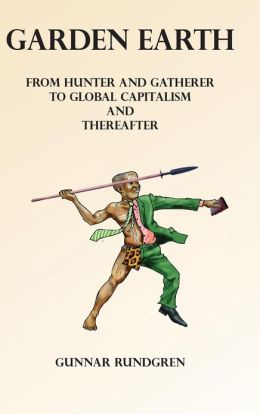
Garden Earth - from Hunter and Gatherer to Global Capitalism and Thereafter is now available in five versions. 1 paperback via Createspace and Amazon
1 hard cover via Barnes & Nobles and other retailers
1 paperback via Barnes & Nobles and other retailers
1 Kindle version vi Amazon
1 EPUB-ebook version which also should be available at ebook retailers

The price policies of the different channels is not very clear for me.

At this moment (valid to end of March) I can offer you a discount of 5 dollars, i.e. you pay 11 dollars if you order the book from  Create Space. You must use this discount code: D7RLM4N5

Garden Earth - from Hunter and Gatherer to Global Capitalism and Thereafter. 
420 pages of facts, analysis and challenging ideas.

It is published in this version as a paperback available from
Create Space
Amazon.com
Amazon.de 
Amazon.es  
Amazon.fr
Amazon.it
Amazon.co.uk
It is also available as an e-book for Kindle
Amazon.com Amazon.ca Amazon.com.br Amazon.de  Amazon.es
Amazon.fr Amazon.it Amazon.co.jp (also published in Japanese)
Amazon.co.uk
Garden Earth - From Hunter and Gatherer to Global Capitalism and Thereafter

Garden Earth - From Hunter and Gatherers to Global Capitalism and ThereafterYou can buy the paperback in this version (left) from Barnes & Nobles,
at this moment they charge $9 for it. 

The real deal is to buy the hard back  from Barnes & Nobles, currently with a $14 discount for $15.90.

Note all the price indications were valid 6 March, prices are changed by the retailers without informing us.


 Schools or courses can contact us att info (at) gardenearth.info for a discount

Tuesday, February 26, 2013

Standard makers and standard takers


In the movie the Godfather, Vito Corleone, the mafia boss (Godfather) played by Marlon Brando, is asked by his godson Jonny Fontane to help to secure a film role that will boost his fading career. The head of the film studio, has previously refused to give Fontane the part. The Godfather tells Johnny:
"I'll make him an offer he can't refuse."
The studio head later wakes to find the head of his expensive racehorse in his bed. Fontane is subsequently given the part.


Standards are necessary tools for the globalized market, based on unlimited competition between exchangeable economic units, be it companies or individuals.  Production is increasingly organized in so called value chains. And what the chain leaders have done is to give suppliers an offer they can't refuse –follow the standard. Suppliers in the chain, all the way to the farmers, and sometimes even the suppliers to the farmers, should follow the standards developed by the chain leaders. In many cases the standards also shift the costs away from the chain leader to the suppliers. I order to enforce compliance, suppliers have to use the verification mechanisms, normally private certification bodies, authorized by the chain leaders or auditors from the chain leader. 

Far to seldom do we ask questions about power when discussing standards. 
Read more in my review of the book Standards, recipes for reality.  

70,000 views

a straw man in Hanoi Jan 2012
The number of visitors to this blog is increasing, for the moment steeply. Perhaps as a result of the launch of the book. The number of page views now crossed the 40,000 limit. Thanks for reading me. And, by the way, I certainly would enjoy a bit more feed back on what I write - and I don't mean those, "nice post, please look at my website-which-has-nothing-to-do-with-the-topic" (I delete them whenever I see them). 

Updated: 6 September 2013. The number of page views are now 70,000 (there were 40,000 when I first published the post) and most months there are more than 5,000 page views.

Sunday, February 24, 2013

Organic agriculture spreads in East Africa

“When I use chicken manure that I produce from my poultry farming I am able to get 5 tons of Irish potatoes on one hectare while I use to get not more than 2 tons per hectare using chemical fertilizers. And my products are the most favored on the market and consumed before others. The price doesn’t matter, people like high quality products,” said Jean Marie Vianney Ngiruwonsanga, an organic farmer of Rulindo District,
Muhondo Sector in Rwanda.

“What struck me about the whole idea of organic farming is that with my little farm space, I could grow enough food to feed my family and supply to the market. And that is without the use of synthetic fertilizers, pesticides and herbicides that are expensive these days,” says Sally Niaisiae, an elderly mother of six in the outskirts of Nairobi, Kenya

Jennifer Kigunda's one acre land is divided into several portions, growing maize, various vegetables, and different potatoes varieties. Previously she would only grow maize and beans –the two most popular food crops with subsistence farmers in Kenya mainly grown using conventional farming methods.
“I would harvest on average six 90-kg bags of maize from the farm and on average three bags of beans,” she said. With her small family, she prefers to sell most of the harvest, fetching around 400 U.S. dollars per season, meaning she would make on average double that amount per year from the sale of surplus harvest.
But since the change to organic farming, Kigunda’s family income has increased tremendously as the sale of organic food from her farm brings in on averaged, 200 dollars per a three month season meaning that in a year, she now makes at least 3,600 dollars a year from her one acre farm, a 450 percent increase.
“We have a ready market for organic foods and we get a premium price for it at the market. What else would a farmer look for?” she asked.
Typical diverse production of African smallholder
 Organic farming proves again and again that it is capable of producing healthy and safe food in sufficient quantities, not only for the rich.  I have written about it in many blog posts here, e.g. 
Growing with love and care, Organic agriculture grows in Africa
People, Planet and Prosperity-organic agriculture as a development concept
But I also emphasis that, in the end, economic factors are determining who will eat and who will be hungry. Read: Markets don't distribute food to those without money
Read more stories from Kenya organic farming on Coast week

Farming as landscape art


At the recently concluded Biofach fair I listened to a presentation by Douglas Tompkins about his farm  Laguna Blanca in Argentina. Well listened? mostly I watched (see below). I am not easily impressed but this was spectacular.

Laguna Blanca is of 7000 acres of land in the Entre Rios province of  Argentina. Organically grown, for sure. But not only that also incredibly beautiful. Tompkins called their tractor drivers for painters.


Tompkins, who he is? Well he was the founder and CEO of both Northface och Esprit, and then he married the boss of Patagonia. He and her are the biggest private owners of conservation areas in the world, mainly in Latin America. They have also published the collected works of Norwegian eco-philosopher Arne Naess - the one who coined deep ecology.


Normally I would rant about capitalism - that it is easy to do things like this when your awash with money, but just enjoy the movie first! 

Organic certification - Is it worth it?


The main positive development reflected in the 2013 Organic Certification Directory is the rapid increase in the number of certification bodies accepted in the EU and in the US. This is driven by the EU-US equivalence agreement and by the new EU regime for direct approval of certification bodies as being equivalent. It is encouraging to see this development and it certainly shows that recognition of other systems is more a matter of political will than a technical matter. Late in 2013 a new equivalency agreement between Canada and Switzerland was announced (for more details see TOS 141). It is important that organic products imported from third countries to countries in an equivalency agreement are included in the scope of the agreement. If such products are excluded the third countries may face reduced market access as a result of these agreements.  
Organic certification bodies, The Organic Standard, Feb 2013


In Asia they still think it is fun or profitable to start organic certification bodies, while the enthusiasm in Europe and the Americas is waning. A general trend is that when governments start regulating their organic sector, a number of new actors step in to offer organic certification services to what they believe is a burgeoning market. In most cases, however, after an initial growth, numbers rapidly go down as a result of failure by certification bodies to fulfil government requirements and a lack of profit.

Worldwide, organic certification costs the sector approximately 500 million US dollars annually, which is at least 1% of the retail value of the products. The indirect costs – activities that operators do just to fulfil certification requirements, such as filling in forms, participating in the inspection, preparing inspections and responding to requests from the certification body – are probably in the same order of magnitude. Historically, most organic certification bodies were associations, foundations or other not-for-profit organisations. Today, most are for profit. But even if the cost of the service is high from the perspective of the clients, it is doubtful that there is a lot of profit generated by selling certification services.

The important question is, perhaps, not how many dollars or euros certification costs nor is it whether certification bodies make too much or too little profit. The important question is whether certification adds sufficient value to the production to motivate the investments. And this is different for different producers. For a small producer with diversified production and direct marketing, the direct and indirect costs, as well as the administrative pressure are often too high. Standards and certification, by their very nature, almost always discriminate against small and diverse production. This is especially painful for the organic sector, as diversity is a cornerstone of organic production. The solution to this problem is two-fold. First, as much effort as possible should be spent within the system to accommodate the needs of small producers. Second,  small producers should be allowed to identify themselves as organic in the market place with other tools specifically designed for them.

The number of private standards is declining, and only a fourth of the certification bodies today have their own standards, the others provide a certification service to a standard set by someone else, normally the government of their country. This is likely to result in  diminishing returns from private standards. Those that still invest in them are forced to make them differ substantially from the regulations so as to motivate consumers to select them over following just the regulations. On the one hand this creates some dynamism in the market place. On the other hand it is resource-consuming and poses huge challenges for trade. It also makes keeping a consistent message for consumer communication and fostering market recognition for organic products difficult.

The question of added value also applies to accreditation. IFOAM Accreditation has – after almost twenty years – still only got 31 accredited schemes. ISO 65 accreditation is much more widespread, but one should not believe that it gives greater added value. ISO 65 is wide-spread because some regulations, most notably the EU Regulation, require it. The added value, both in the market place and for the integrity of organic production, of ISO 65 accreditation is often, rightfully, questioned. Now that the Regulation is under review, one would hope that the EU will look into this once more.   
(first published in The Organic Standard Issue 142, February 2013)

Tuesday, February 19, 2013

A pilgrimage to the origin of global capitalism


Genoa is a maze of infrastructure, layer upon layer. Far under my feet rivers decked over since centuries are flowing, on top of them a road. My pedestrian path crossing them and the rail road is above me. In some places it is so steep that people park their cars on top of the neighbours' . Modern houses are erected on foundations that might be five centuries old. New and old mixes in an almost organic way.

And then we have the port, where old warehouses mix with modern yachts and cruise ships. And it is in the port it all started.

I have found the beautifully decorated Palazzo San Giorgio the goal for my 'pilgrimage' to Genoa to look for the origins of global capitalism. The Bank of Saint George (Banco di San Giorgio, officially Casa delle compere e dei banchi di San Giorgio) was founded in 1407, making it one of the oldest chartered banks in Europe, if not the world.

A number of prominent Genoese families were involved in the establishment and governance of the Bank, including the Houses of Grimaldi & Serra. Because the Republic's ruling oligarchs were normally prominent in Bank politics, it is often difficult to determine where the Bank's influence ended and the Republic's began.

At the end of the thirteenth and beginning of fourteenth century a trade network from China to England, From Scandinavia to Africa was established and had expanded substantially. In Europe, the main beneficiaries of this were the Italian city states, in particular Florence, Milan, Genoa and Venice, where Florence and Milan were engaged in manufacturing and trade towards the Northwest, Genoa was oriented to the silk trade, i.e. Central Asia and Venice in the spice trade, i.e. South Asia. The trade generated a lot of wealth; the value of the sea trade of Genoa was estimated to three times the revenue of the Kingdom of France. At some point in early 14th century the trade tapered off which triggered a period of fierce competition between those city-states. They were mercantile states where the traders and manufactures had a lot of influence, so competition was not only commercial but extended to a series of wars. The wars strengthened the merchants even more as the state had to borrow money from them to conduct the wars (which was non behalf of the merchants in the first place).

In Genoa it led to a private take-over of the cities finances via the Casa di San Giorgio while in Florence the most powerful family, de Medici, took over. Now the wars themselves become a commercial undertaking. “What capitalist groups could no longer invest profitably in trade, they now invested in the hostile takeover of the markets or the territories of competitors both as an end in itself and as a means to appropriate the assets and the future revenues of the state within which they operated” (Arrighi 2010). The Italian city states developed high finance, financing in particular war-making governments. It is there in Florence and later in Genoa that the toolbox of managing money and transactions develop; it is there cheques and bills of exchange are used, most transactions are made through bank transfer and the art of managing client accounts to make the capital work for you is taken to new heights. 

The Bank lent considerable sums of money to many rulers throughout Europe during the fifteenth and sixteenth centuries, gaining widespread influence. Charles V was heavily in debt to the Bank during much of his reign.Many of Genoa's overseas territories were governed either directly or indirectly by the Bank. In 1453 the Republic handed over governance of Corsica, Gazaria, and a number of other possessions to Bank officials. It was the Genovese who bankrolled much of the Spanish expansion and then later on where the ones to convert the Silver from America into gold coins to pay the armies.

In the seventeenth century the Bank became heavily involved in maritime trade, and for a time competed with the Dutch East India Company and the English East India Company.

Giovanni Arrighi, in his masterpiece, The Long Twentieth Century, Money, Power and the Origins of our Times (a must-read!)sees Genoa as the first representative of global capitalism. The merging of military might of the state with commerce and finance was the foundation of the European aggression to the rest of the world, a world that was taken by surprise by these new guys on the block. When the British also included production of goods – and weapon – with the support of fossil fuel energy, in the capitalist undertaking, the conquest was a given.

It is this narrative, a narrative of aggression based on collusion between capitalists and the state – and not the narrative of the free private entrepreneurs that innovate and exchange good with happy citizens in a market place – which is the true story of the origin of capitalism.

And what happened to the Casa di San Giorio? When Napoleon invaded Italy, he suppressed independent banks, and this led to the Bank's closure in 1805.

Saturday, February 16, 2013

Give it back to Monsanto and Syngenta

In a seminar at the Biofach fair, Dr Hubert Weiger from the German environmental organization BUND, informed us about that Glyphosate, the active ingredient of the herbicide mostly known as Roundup, is now found in people's urine.

A recent study show:
"To determine if only individuals who are in direct contact with contaminated feed or glyphosate laced compounds are at risk of glyphosate poisoning a study was conducted in December 2011 of an urban population in Berlin. The urine of city workers, journalists and lawyers, who had no direct contact with glyphosate, was examined for glyphosate contamination by a research team at the University of Leipzig. The study found glyphosate in all urine samples at values ranging from 0.5 to 2 ng glyphosate per ml urine (drinking water limit: 0.1 ng / ml). None of the examinees had direct contact with agriculture."
Glyphosate was originally mainly used on weeds to clear land for planting, but is increasinglu used to kill off the crop just before harvest, so called dessication. Syngenta’s advertising brochure says “For professional producers chemical desiccation now counts among the standard measures to assure high quality production [...]. In this context one also speaks of the “economic maturity” of crops, as the usage of herbicides allows for a safe termination of the harvesting procedure.”

The report quoted above says, "for potatoes, spraying herbicides on the field immediately before harvest (2.5 l / ha), hardens the skin and reduces its susceptibility to late blight and germination, which improved the potatoes shelf life. Active compounds of the herbicide directly enter the potato through the leaves; however, decomposition of the poison takes place in the body of the consumer."

These companies that claims patents and trademark rights on their products should be hold accountable for where they end up. Ultimately, governments should ban the use of herbicides. There are readily available alternatives available. Their use will cost a bit more for farmers - but that is a small price to pay to avoid poisoning.

Until governments have taken action, my humble proposition is that we should collect the urine and send it to Monsanto, Syngenta and the others.

Sunday, February 10, 2013

Garden Earth - a regenerative society


The coming week I will launch the book Garden Earth at the Biofach fair in Germany. Below you find the final chapter of that book. In the final chapter I talk about Garden Earth which is my metaphor for a regenerative society. A regenerative society is a society that regenerates natural and social capital instead of squandering them. 

The book is already available as a paperback and ebook at Amazon (see how to order here), and within a month or so it will also be in selected bookshops in the UK, Canada, USA, Australia and most internet bookshops around the world. It will also be available in Japanese by Dayosha. 

Chapter 33: Garden Earth
 
You may say that I’m a dreamer
But I’m not the only one
I hope someday you’ll join us
And the world will live as one
(John Lennon,‘Imagine,’ 1971)

The book Garden Earth
Hunters and gatherers lived in a wild nature, although they manipu­lated it more than most are aware. Their values, religion and society were shaped by their environment and ecological niche. A small fraction of the primary production of ecosystems was taken care of by human beings. With agriculture, it all changed. A part of nature, gradu­ally growing, was occupied fully by the human species, cleared from undesired species and put directly, and uniquely, in our service. In this way, we maximized our share of the biological production, and favoured those species that produced what we needed. Because of more intensive use, buffers were smaller and agrarian society was thus vulnerable to disturbances and shocks, such as climatic events, disease of crops and animals as well as of ourselves. Soil erosion was an ever-present threat and a cause of societal collapses or simply slow decline. Our relationship changed not only with nature but also with each other and with the society that was established to manage this new system. Human society changed from a basically egalitarian society of small bands to agglomerations of authoritarian lordships, kingdoms and empires, and from a society with very limited division of labour to a stratified society where each had his or her well-defined role. 

With the Industrial Revolution, based on fossil fuel, human control and reach expanded even more, to almost all nooks and corners of the globe. Humankind went further, climbed and flew higher, dived and dug deeper—all in the effort to find more resources to exploit. More and more parts of the living as well as the dead were put in direct service of humanity. Industrialism also brought new impetus to farm­ing. The first stage brought tools and the power to extend the land under plough, but gradually also more and more machinery to in­crease productivity per labourer. This was stimulated by an in­creased use of fossil fuel so that farming from being a net producer of energy became a net consumer. Chemical fertilizers, extracted, manu­factured and shipped from far away, were a step towards freeing agriculture from the limitations of the site, to manipulate life processes. These changes were also accompanied by increased use of pesticides and medicines. Now, when the rich supply of genes in nature doesn’t suffice, or there are natural barriers for combining them as desired, genetic manipulation is used. 

At the same time as we are dependent on more and more of the bio-geosphere, people live lives increasingly more distanced from it. The warmth doesn’t come from wood that we cut in forests, but from distant power plants, district heating or oil and gas pumped from far away. We rarely touch the soil; the green plants most touch are retarded, tamed and flower-induced pot plants, if they are not plastic. We rarely feel the hot wind on our cheek, the rain in our hair or the bitter cold in our marrow. Still, we are more dependent on nature than ever before. Nature doesn’t care for humankind because it will survive well without it, but humankind has to care about nature.

Modern society has been successful in delivering personal wealth and economic growth, for a few people, that is. It has also broken down old prejudice and expanded human rights, freed people from bonded labour and other oppressive institutions. It has come a long way in ending discrimination of women and other groups often victimized, and been extremely successful in producing more things for the health, comfort and joy of human beings. The system, however, has not been successful in replacing the old system with a new one that gives people a feeling of meaning. Personal wealth and growth have become ends in themselves to such an extent that they remind of cancer. 

The economic system and society have reached a critical limit through population explosion, unscrupulous and reckless exploitation of natural resources and constantly increasing energy use. For some resources, the limits have been passed already, which puts increasing pressure on societies, the global community of human beings and the foundations for human existence. We hunt for more and more things and satisfaction through consumption; the enormous choices haven’t made anyone happier. Unprecedented wealth is created, but it has not spread to most citizens of the world, despite everyone living in the same global economy. The gap between the rich and the poor is widen­ing. Despite constant increased productivity leisure time doesn’t increase; contrarily, one’s leisure time and private sphere are invaded by the capitalist paradigm and behaviour patterns—to consume be­comes a compulsion as strong as to work.

The capitalist system is a system of colonization, bent and suitable for geographical, physical and economic expansion. Society has now reached a stage of saturation; there is nothing left to colonize. The behaviours that were appropriate or at least acceptable for a species in rapid expansion are not the ones suitable for a life in balance. In some ways humanity seems to adapt to it—how else would one explain population ceasing to grow in developed countries? Organic farming, passive heating, electrical bicycles and solar energy represent techno­logical developments better adapted to ‘householding’ societies with regenerative economics. The wild finds new ways of cohabiting with human beings and human beings find new ways of interacting with the wild. Cooperation within civil society has increased tremendously globally and is revived locally. There is a shift in values, where more and more people want to jump off the treadmill and seek that which gives ‘real’ well-being. This maturity is reinforced by the population ageing. The values of older people are adverse to risk and expansion­ism, and are more reflective and caring.

In the discussion about growth and limitations for human use of natu­ral resources, it should not be forgotten that the poorest third of humanity needs to increase its use of natural resources, while the rest of humanity takes a break and enjoys life. This increased use is certainly not decoupled from direct exploitation of resources; it is the development of very real things such as electricity, houses, roads, water and sewage. Still, many old and new technologies can be deployed to make this growth less wasteful than previous moderniza­tion; these technologies include solar energy, distributed power, separation of water toilets from other water use, or buildings made from adobe, etc. 

Most people have not yet realized the extent of the change re­quired; humankind needs a completely new economy, a new society. Another society has to be built on values and conditions other than those of the capitalist society. It is a society oriented to closing gaps—gaps between people, between man and woman, between ruler and ruled, between ‘we’ and ‘them’, between one country and another and between man and nature. It is about unifying the many divisions that currently exist—division of labour, division between production and consumption, between work and leisure, between the individual and society, between economy and society and between beauty and efficiency.

As an alternative vision to the capitalist ideology I offer Garden Earth.

  • Where capitalism sees self-interest as the major human driver, Garden Earth is built on human needs satisfied in many ways and with voluntary cooperation.
  • Where capitalism is based on private property, the foundation for Garden Earth is stewardship of common resources.
  • Where capitalism sees nature as commons free to exploit, to mine and to use as a dumping ground, Garden Earth sees nature as our home.
  • Where capitalism sees specialization and division of labour as something very good, Garden Earth sees it as a potential evil, a risk that needs to be limited and its effects on individuals and society mitigated. 
  • Where human energy in capitalism is used for salaried labour that a few profit from, in Garden Earth people work for their satisfac­tion and for doing something for the community.
  • Where technology in capitalism is developed and chosen to maxi­mize some peoples’ profits, in Garden Earth it is selected to make life more enjoyable or transcend resource limitations.

We need each other and the existing form for our cooperation is what is called society or community. It is ruled by laws of nature, ecological conditions, human laws, norms inherent in our culture and values. The human being is part of society and vice versa. The well-being of humankind and society is intricately intertwined forever. Markets, the state, civil society and the private have roles to play in the future society. It is about expanding liberty and the notion of liberty to include also the capabilities of the individual and to resolve the false contradiction between the freedom of the individual and that of society. 

We simply have to go back to the Garden of Eden. But we can no longer do so as the hunters and gatherers who were driven out. Humankind is no longer equal to the giraffe, the carrot or the sheep, even less to the stone. Man is part of nature; thus, the well-being of human beings and of other species is intertwined. Because of the numbers, intelligence and development of the human species, we have a special responsibility for the survival of other species and for the relative stability and productivity of the earth’s ecosystems. 

Whether or not we like it, the survival of not only the human species but also many other species is in the hands of the human being.

Sunday, February 3, 2013

Energy is the substance of the economy


“The compounding mistake, ... was a wide-eyed belief that ‘globalisation’ would make everyone richer, when the reality was that the out-sourcing of production to emerging economies was a self-inflicted disaster with few parallels in economic history. One would have to look back to a Spanish empire awash with bullion from the New World to find a combination of economic idiocy and minority self-interest equal to the folly of globalization.”

 This was not written by Naomi Klein or Vandana Shiva but by Dr. Tim Morgan at Tullet Prebon, one of the largest inter-dealer money brokers in the world, in the report The Perfect Storm. It has a certain extra tang and interest when you get damning opinions about our economic system from those that profit from it and have inside insights, even if they don’t say so much different than the anti-capitalists.

The report is one of the most damning analysis of where the global economic system is headed and in particular where “the West” has gone. For coming from the finance sector it has also good insights in how important (cheap) energy is and has been in the capitalist saga. I probably helps that Dr Morgan studied history and political science.  The four interrelated trends that have brought us where we are, according to Dr Morgan are: 

First, the Western world is still mired in the fall-out from the ‘credit super-cycle’, a financial bubble so vast that it makes Dutch tulips, British south sea stock, the 1840s railway boom and “the roaring twenties” look like “little local difficulties.

Second, globalisation is now being exposed as a disaster which has driven a critical wedge between Western nations’ consumption and their production.

Third, policymakers and the public do not even have access to data reliable enough for an accurate appraisal of the predicament.

Most important – given that the economy is an energy dynamic, not a monetary construct – the critical surplus energy component is now in rapid and seemingly-irreversible decline.

“Reducing production, increasing consumption and taking on escalating debt to fill the gap was never a remotely sustainable course of action. What this in turn means is that no return to the pre-2008 world is either possible or desirable”.

The folly of the ever increasing indebtedness has been explained by many others. The reports states that: “Between 1981 and 2009, debt grew by 390% in real terms, far out-pacing the growth (of 120%) in the American economy. By 2009, the debt ratio had reached 381%, a level unprecedented in history. Even in 1930, when GDP collapsed, the ratio barely topped 300%.” Dr Morgan says that it is not the debt itself that is remarkable but how long this could go on. A main mechanism to have it going and supported by the public was the extended period of ever increasing property prices, reaching its highest level of folly in Japan where one square meter in Ginza in Tokyo fetched up to US$ 215,000, which is what you pay for 100,000 square meters of the best agriculture lands in the world (and those prices are also inflated!). Adding to the illusions was the innovation of new financial instruments, which supported lending also to those who could not afford it. While US economic growth was $4.1. trillion between 2001 and 2007, consumers increased their debt with an enormous $6.7 trillion.

The damning account of the follies of globalization was what surprises me most in the report. Dr Morgan dismisses the talk of Western economies modernizing themselves by moving from production into services as obscuring the fact that “Western consumers sold each other ever greater numbers of hair-cuts, ever  greater quantities of fast food and ever more zero-sum financial services whilst depending more and more on imported goods and, critically, on the debts used to buy them.”

Consumption by Americans increased by $6,500bn between 1981 and 2011, while consumption by their government rose by a further $1,700bn. Meanwhile, the combined output of the manufacturing, construction, agricultural and extractive industries grew by barely $600bn. Net exports of services was worth $200bn in 2011, i.e. far from sufficient in bridge the gap between consumption and production.

Dr Morgan delivers an interesting critique of the theory of competitive advantage (originating from David Ricardo) which has underpinned the globalization “project”. According to the theory, the general wealth will increase if all countries specialize in those activities in which they possess the greatest competitive advantage over others. “This logic is valid if – but only if – the scope for growth is infinite. Unfortunately, an unlimited capability for growth can only exist if the supply of resources is infinite as well.” says Dr Morgan.

I am not able to judge the accuracy of the third major cause of the mess, the distortion of data, but it is certainly remarkable. Dr Morgan claims that inflation figures, GDP figures and several other key economic data are inaccurate. The US GDP is inflated by 15% through various “imputations”, such as the “owner-equivalent rent” which includes the estimated “rent” that a house-owner would have paid for his house were it rented in the commercial market.  

”All goods and services on which money can be spent are the products of energy inputs either past, present or future.”

Many have claimed that our economy is mainly an energy equation. For example, I write in Garden Earth:
”A barrel of oil represents the energy of 25,000 hours of human toil, that is, 14 persons working round the year with normal Western labour standards. The cost for pumping the oil is not more than a few dollars per barrel, and even with an oil price of many hundred dollars per barrel, it is very cheap[...] From this perspective, our current wealth can be easily understood and demystified. Even hundreds of years ago, long before industrial society and capitalism, the person who had hundreds of others working solely for him or her could lead a comfortable life. ”

It is more unusual that persons submerged in the financial system have these insights. But Dr Morgan certainly has. He states that the economy is a physical construct based on energy rather than a financial construct based on money. We have been blinded by the fetish money (read more on this on The business plan of the factory is to produce externalities): “money is the language rather than the substance of the real economy. Ultimately, the economy is – and always has been – a surplus energy equation”.  From there he continues to discuss the huge impact on the economy that a declining Energy Return on Energy Invested (EROEI) will have. I explain EROEI in this recent post

Dr Morgan states that the average EROEI has gone down from 40:1 in 1990 to 17:1 in 2010 and might decline to just 11:1 by 2020. This would cause an average increase of energy costs with 50%. In this perspective it is worth noting that the EROEI of the famed US shale oil is somewhere around 4-5:1. With an EROEI the direct energy share of the GDP would go from 6.7% to 9.6%, and perhaps reach 15% by 2030. Notably, increased energy costs cascade through the whole economy, and will cause cumulative effects. 

Clearly, cheap energy has been one of the major drivers not only for our increasing wealth, but also for globalization and for the debt economy, “debt really amounts to ‘a claim on future energy”. Similarly, the end of cheap energy will mark a tectonic shift in our society.
   
I am a strong believer of the huge importance of energy for our society, but perhaps Dr Morgan goes just a bit too far here. The fact that a lot of development has used cheap energy as its main driver is not necessarily a proof that energy itself constitutes the essence of human society. He claims, for instance that it is likely that food production will decline with half if energy becomes scarce. True, energy has a very important role in today’s agriculture system (read for instance Why oil price and grain price follow each other or Agriculture: How cheap energy (and capitalism) increased the gaps between rich and poor), but this is also an effect of that energy is cheap.

Choosing between several options for increasing production and productivity, methods involving high energy use are likely to dominate when energy is cheap. It is cheap fossil energy that has made the widespread use of nitrogen fertilizers a cornerstone in the farming systems, but if chemical fertilizers become uneconomic to use, farmers will use more biological nitrogen fixation, nutrients that are now flushed to the waterways will be recycled etc. Cheap energy has also driven globalization and increasing international trade in foods, but many countries could produce more food if global competition was less, and prices higher. 

I missed an analysis of the effect of the demographic transition. It seems to me be a fifth important trend to consider.I also missed an analysis of which role capital accumulation and capitalism play in the system.

The report is worth while reading, and it has a number of provoking statements and amusing one-liners. 

Thursday, January 31, 2013

EROEI for dummies


I meet little Prosper carrying fire wood on his head in Butare, Rwanda. I try to ask him, the mother and the two other children if it is for the household or for sale, but fail to communicate. My assumption in this case is that it is for sale. Most poor people in the work use fire wood for their cooking. When population grows people, mostly women and children, have to go further and further to collect it. This image is a simple way to understand the concept of Energy Return on Energy Invested (EROEI) and why it matters for us and the economy.

There is little work to cut down a tree in your backyard to use for fire wood.  As fewer and fewer trees remain in your courtyard, you have to walk to collect firewood, and you may gradually have to use twigs and bushes instead of logs as trees grow scarcer and scarcer. So you end up spending more and more energy on getting a lower and lower quality of energy for the family supper.   

The first fossil fuels were easily available and there were little efforts needed to bring it up, in a similar way as the first trees in the backyard. The Energy Return on Energy Invested (EROEI) was something like 100. That is it took one liter of oil to extract 100 liters of oil. Many oil sources now yield just 10 or 20 liters for each liter used. The net effect is that we have to increase the total energy use just to keep the net energy delivered to society on the same level.

EROEI is the ratio of the amount of usable energy acquired from a particular energy resource to the amount of energy expended to obtain that energy resource. When the EROEI of a resource is less than or equal to one, that energy source becomes an "energy sink", and can no longer be used as a primary source of energy. (Wikipedia)

EROEI is often showed with a diagram like this[i]:


What we see is that when EROEI approached 5 there is a dramatic increase in the amount of energy that has to be used to produce energy. In its early days, oil frequently yielded an EROEI in excess of 100:1, meaning that 1% or less of the energy contained in a barrel of oil had to be used to deliver that barrel of oil. Not a bad bargain. Oil production today more typically has an EROEI around 20:1, while tar sands and oil shale tend to be about 5:1 and 3:1, respectively. Perhaps the effect is better seen by re-writing the graph assuming that we want a constant supply of energy (set at 100 in the graph).

 Here we see very well the extreme effects of an EROEI going below 5. If we want to get energy corresponding to 100 barrels of oil from a process that has an EROEI at 3, like shale oil, we have to produce 150 barrels as energy corresponding to 50 barrels will be used in the production process. Some of the biofuels are have an EROEI under 2, which is a rather meaningless exercise, especially considering the huge environmental impact of their production. Solar energy from photovoltaic element are in the range of 3:1-10:1. Wind energy perhaps in the range of 15:1

This has big economic effects. As Richard Heinberg writes in End of Growth
“As EROEI declines over time, an ever-larger proportion of society’s energy and resources need to be diverted towards the energy production sector.” 
I will come back to this very soon in another post.
And it also has huge environmental effect. For instance, if the US is going to build its energy supply around shale oil and tar sand the gross energy use will increase tremendously, and also its emissions of green house gases.

EROEI is mostly discussed in the phase of energy production, i.e. at the well or mine head. Another aspect of EROEI is also to consider the whole system. For instance, for solar systems, one can calculate the EROEI directly in the panel, but one should include the storage and distribution systems that are an integral part of the system. Finally, one should look at the EROEI all the way to consumption. So if the EROEI of petrol at the pump is 10:1, the EROEI of the use of petrol in the car is only 3:1, as only a smaller part of the fuel is converted into the movement of the car (Garden Earth).

There are many other aspects of relevance when discussing energy systems, for example, the quality of the source and how it can be used. For solar and wind energy there are also big problems associated with intermittence and storage.

For a rather recent EROEI update, read A Review of the Past and Current State of EROI Data Ajay K. Gupta  and Charles A.S. Hall.

For related post on this blog

Energy squeeze, Is it a trap, a cliff or just a simple adjustment?
Burning food?
It takes more energy to eat than to farm
Energy and Agriculture
There will be no nuclear power without oil
our energy debt


[i] Mearns, E. In The global energy crises and its role in the pending collapse of the global economy, Royal Society of Chemists, Aberdeen, Scotland, October 29th, 2008; Aberdeen, Scotland, 2008

Wednesday, January 30, 2013

3000 readers

Just wanted to thank the increasing number of people reading my blog. December was the first month exceeding 2,500 page views and January has already beat 3,000. Stíll a blog dwarf, but growing. I expect that my book Garden Earth will drive more traffic in the future.

Graph of Blogger page views

Tuesday, January 29, 2013

Is commercialized farming the cure for smallholders' ills?

In the period 1996 to 2011 I worked a lot with various efforts to link smallholder farmers to markets, mainly organic, in developed countries. The biggest engagement was in EPOPA:


"By 2008, 80,000 farmers contracted by EPOPA have sold organic products to exporters for approximately US$ 15 million per year. All farmers received higher prices due to the organic premium, which ranges from 10-25% over the conventional price. Taking into account the size of households, 600,000 people have benefited from the programme."
This is how the Export Promotion of Organic Products from Africa is presented as one of a limited number of case studies of "Evidence of Impact" on the joint donor web site. 

The cost of the programme for the Swedish taxpayers is one cup of coffee per taxpayer. You can read a whole book about this successful project here.

Overall EPOPA was a success. Today, linking farmers to markets is an overarching policy for almost all development agencies as well as governments. It also fits very well with a development model that assumes that more markets and more capitalism is the best path to development. Considering that small-scale farming is a main component of the livelihood of something like a third of the worlds population, and most of the worlds very poor it is only natural that there is a huge interest in how to improve livelihood of them. While I do think it works quite well, it has, unfortunately, been oversold.

A recent report from Hivos, Small Producer Agency in the Globalized Market, looks deeper into if and how smallholders can benefit from globalized markets. In short the answer is that a few of them will - and they will soon not be smallholders as the recipe for success is to grow, mechanize and buy up your neighbours farms. This should be no surprise, this is how the farm sector developed in other parts of the world. The report estimates that linking farmers into modern value chains (be they organic, fair trade or normal) may benefit only about 2-10 percent of the farms - and it will be those with the greatest assets.

The reality is that commercialization of farming is good for the economy and for a few so called progressive farms, but that most of the farms will not benefit from it. Some will become farm labourers at the farms of the more successful, or in huge agri-business plantations, other will only get a better life if there is some place for them to go. 

The report does a good job in demonstrating how diverse the group of small farmers is and therefore also their coping strategies:
"multifaceted livelihoods that use diversity of economic activities to hedge risks and make the most of scarce land, cash and other resources. Farmers may rent various plots and grow multiple crops; move in and out of different informal (and sometimes formal) markets; and combine farm income with off-farm jobs and remittances from migrant family members. With more rural people, especially youth, moving back and forth from farm to city, there are fluid frontiers between urban and rural markets, boosting the vibrancy of local economies."
The report recognise that the informal economy may actually be very important for most farmers and that the army of middlemen, often considered parasites, can play a positive role in markets for small-holders by offering easy market access and intensive competition for supply, rather than tying farmers into integrated value-chains. Those trade links are also the ones that supply the hordes of urban poor. In many parts of the world the informal economy is on the rise according to OECD reports.

The authors, Bill Vorley, Ethel del Pozo-Vergnes and Anna Barnett, concludes that
"we should not continue to expect multiple wins — on poverty reduction, food security, security of supply, ecosystem services and rural development — from the single-minded approach of including farmers and their organisations in value chains and ‘empowering’ them in markets as beneficiaries of external initiatives. to get the future right for the majority of small-scale producers who cannot readily participate in modern value chains, or for the many youth with aspirations out of farming, we must recognise other layers of the picture."

See a video from the launch of  Small Producer Agency in the Globalized Market


Other posts of relevance:
The road to food security: What works and what doesn’t?
Don't buy organic instead of changing the world - do it as part of changing the world
Traditions, Western Union, Churches and Taro
Will there be farmers?

Tuesday, January 22, 2013

Economy of the Common Good

According to an opinion poll in Germany and Austria, nearly 90 per cent of the population want an “alternative economic order”.  The author and political activist Christian Felber developed the basis for the Economy of the Common Good in his book Neue Werte für die Wirtschaft. Eine Alternative zu Kommunismus und Kapitalismus (New Values for the Economy. An Alternative to Communism and Capitalism) in 2008. In response to this publication, numerous entrepreneurs have come together in order to refine the model together with Christian Felber and have termed it “Economy of the Common Good”.
The Economy of the Common Good (ECG) want to change the driving entrepreneurial motivation shift from the pursuit of profit towards the pursuit of the common good and from competition to cooperation.


You can download a short summary of the 20 most important elements of the ECG.

And listen to an informative lecture by Christian Felber here


Some 200 companies are now busy implementing the concept. Initially they hope to attract consumers to buy the products from the companies voluntarily. However, a market based on profit-seeking and competition will not be able to reward good behaviours fully, so the initiative also promotes incentives and tax benefits for companies that follow the code of the Economy of the Common Good. 

While the proposal sounds reformist and not so radical, they don't fall far from being a "revolution" as they suggest abolishment of financial markets, private profit and want to redistribute wealth and income radically. Christian Felber underlines that any change should take place in a constitutional and democratic way. I appreciate in particular the clear analysis of the combined damage by profit-seeking and competition, which I also state in my book Garden Earth.

As a result of my long experience in the organic market and other sustainability markets I am less optimistic about how useful the various indicators and measurements they propose are in this context. Even more so as it is proposed to tie advantages such as:
‐ Lower taxes
‐ Reduced customs duties (e.g Fair Trade)
‐ Loans on more favorable terms
‐ Priority in public procurement
‐ Research cooperation with public universities
to companies based on their score in the Common Welfare Score. I simply don't believe in those kinds of ranking and scoring systems, and even less to have them as a basis for policies.

Friday, January 18, 2013

Thinking fast and slow about the world


Did you know that if you make people think about old age, they will walk more slowly? Or if you have a poll about more money to the schooling system more people will support that proposal if the poll is in a school than in the municipal building? Those are effects of what is called priming

I just read Thinking Fast and Slow by Daniel Kahneman, recipient of the Nobel Prize in Economic Sciences. He shows that if you make people think about ”money”, even by simply having dollar bills in your screen saver, people don’t only become more interested in money they also become more selfish, they are less inclined to help someone in need and show more preference for being alone. In short, the thought of money feeds individualism.

Most of the book is about how we make choices and how we form our views. Kahneman shows how intuition and emotion, stereotypes, often rule our behaviour, also when we believe that we are acting ”rationally”. Here he also deliver a criticism of the idea that people are governed by rational economic assessments, which is a cornerstone of the neo-liberal ideas, in particular those expressed by Milton Friedman at the Chicago School of Economics.

Actually, not even in the very heartland of economics are people very rational. Kahneman cites research that examined 10,000 individual private investors over seven years. On average, the shares that individual traders sold did better than those they bought, by a very substantial margin: 3.2 percentage points per year. “It is clear,” concludes Kahneman, “that for the large majority of individual investors, taking a shower and doing nothing would have been a better policy than implementing the ideas that came to their mind.”

Cabbies in New York work fewer hours in rainy days despite the fact that they earn the most per hour those days, while they sit and sweat in empty cabs in sunny days instead of going to the beach. And even when it comes to simple buying and selling we all have a tendency to value an item we have higher than what we would be willing to offer to buy it.

Kahneman says that the robots of neoliberal economics, Econs he calls them, are not real Humans. I believe that most economists and their study objects are subject to ”priming” which makes them much inclined to see all aspects of society from the perspective of classic economic theory. The bigger tragedy is that by the constant bombardment of economistic messages combined with the commercialism of the market place taking over almost all space and time of our lives, the idea that we all act as Econs is self-fulfilling to some extent.I write about this in Garden Earth:

Simpleton economicists and their popularizers want to explain all human actions by economic drivers. Also, many Marxists tend to see the acts of different groups to be fully dependent on their economic standing in relation to production factors—here the concept of ‘class’ is critical. The reasoning goes from self-evident things to very cumber­some explanatory models. ... The basic error is the perception that economic drivers are superior to all other drivers and that all other drivers can be ‘trans­lated’ into money. The strength in the reasoning is that the economic driver is a forceful paradigm with many self-reinforcing loops. And as a society is built along this paradigm, human beings consciously and subconsciously create a world that rewards exactly this; in such a way it becomes self-fulfilling. But this is not truer than the statement that the most important driver for human development is the ability of an individual to throw a spear farther than anyone else. This ability was most likely very important in a hunter society or a war society, much more important than the ability to amass wealth.


The book
Thinking Fast and Slow is very comprehensive, even though Kahneman, in typical modesty, says the target for the book is to be relevant for the gossip at the water cooler. The largest part of the book is about two sorts of thought processes, which Kahneman calls System 1 and System 2, or “fast” and “slow” in the words of the title of the book. System 1 is intuitive, often unconscious, relying on past association of ideas. System 2 is conscious, reasoning, full of effort but often lazy. For instance, even experts are rarely basing their reasoning of consideration of statistical evidence, and even scientists make a lot of errors. Kahneman readily admits that he himself is also a victim. While we might believe that it would be best to suppress System 1 and let System 2 take command all the time, Kahneman thinks that System 1 is the “hero of the book”; the skilled craftsman or professional certainly couldn’t be what they are if they didn’t work also with intuition.  

We hugely underestimate the role of chance in life. As the example of fund managers above shows you'd do just as well if you entrusted your financial decisions to a monkey throwing darts at a board. And again and again, we are fooled by our low understanding of sampling and statistics. The fact that most of the best performing schools are small is taken as a proof that small schools are better, while in reality, Kahneman says, smaller samples will always produce more variation. Not only are the best schools small, also the worst are small. Bigger schools represent a bigger sample and therefore they tend to move towards the average. The same goes for incidences of a disease; the highest rates will always come from small population groups. There are certainly a lot of interesting facts in the book.

But frankly, the book is hyped. It is described as an ”immediate classic”, ”groundbreaking”, and is compared to the works of Darwin, Smith or Kopernikus etc.  There is not much new in the book for those that have read their behaviour psychology and biology. The discussion about System 1 and System 2 are long-winded while the examples given are predominantly tests in simple game and choice experiments from universities.

The examples from real life situations are just so more interesting. For instance, the fact that Israeli parole judges would grant parole to almost 65 per cent of the cases after the judges had eaten a meal, but almost zero by the time the next meal was due! Or that the only thing that is worse at work than being alone is that your boss is with you. 

While too much text is spent on the two systems, Kahneman takes up very interesting topics towards the end of the book, but here in a too rhapsodic manner. He discusses risk assessment as well as happiness and well-being. In particular the latter deserves a better analysis than the one in Kahneman’s book. Still, the book is worth reading, and Kahneman has a humble and human attitude and sound scepticism towards overconfident science.  And you can always discuss it with your colleagues at the water cooler.  

Some reviews of the book
Svenska Dagbladet (Swedish)
Aftonbladet (Swedish)