Wednesday, August 9, 2017
Can we shop our way to a better world?
When you buy a cup of coffee for €2, the farmer gets 3-4 cents for the coffee in that cup. If you buy a cup of organic and fair trade coffee, you may have to cough-up €2.50 and the farmer will get 4-5 cents. The farmer’s income will increase by an impressive 20-25 percent. Looking at it from another perspective, it seems that you will need to spend 50 cents to increase the farmer’s income by 1 or 2 cents. This example throws up the question whether the market mechanism is efficient in transforming consumers’ willingness to pay for direct or indirect benefits of a product.
Voluntary sustainability standards (VSS) such as fair trade, organic, and eco-labels have emerged as part of a number of converging – and associated – trends such as:
- emphasizing the market and consumer choice as important tools to accomplish ethical, economic, environmental or social goals;
- facilitating government de-regulation, which leaves more self-regulation to the industries;
- holding those that bring products to the market place accountable for the quality of the products, a responsibility that extends to the suppliers of the products, and their suppliers in turn;
- introducing a stiff global competition which makes differentiation in the market place an essential survival strategy to escape ‘commodity hell’;
- organizing production into so-called value chains where each link is taken care of by independent companies that are under the constant threat of being exchanged, constantly competing with others.
Let me expand a bit on this last point.
In the movie The Godfather, Vito Corleone, the mafia boss played by Marlon Brando, is asked by his godson Jonny Fontane to help secure a film role that will boost his fading career. The head of the film studio has previously refused to give Fontane the part. The Godfather tells Johnny, "I'll make him an offer he can't refuse." One morning the studio director wakes up to find the head of his expensive racehorse on his bed. Fontane is subsequently given the part.
This is basically what the chain leaders, i.e. supermarkets or corporations, have done; given suppliers an offer they can't refuse – follow the standard. Suppliers in the chain, all the way to the farmers, and sometimes even the suppliers to the farmers, should follow the standards developed by the chain leaders. In many cases, the standards also shift the costs away from the chain leader to the suppliers. In order to enforce compliance, suppliers have to use verification mechanisms, normally private certification bodies, authorized by the chain leaders or auditors from the chain leader.
At a point in time, NGOs realized that consumer activism could be a tool to accomplish goals. This first took shape as boycott, that is refusal to buy products from companies because of their behavior. When companies tried to get away from their responsibilities by outsourcing, NGOs pointed out that those chain leaders had responsibilities for the whole chain. In some cases, this led to the NGOs initiating sustainability schemes, either in partnership with an industry or alone.
We don’t have VSS for social conditions for labour in Scandinavia – but there is a Food Justice Certified scheme developed in the USA now. Why? Because it is needed in the USA but not in Scandinavia (at least not in the same way as in the USA). VSS has emerged in the space between that well regulated by the markets and by the governments respectively. If we view their existence as a result of “policy failure” or “market failure”, it means that if the markets and governments did their job properly they would not be needed at all.
The example of the coffee cup shows that the market mechanism is not a particularly efficient tool for accomplishing non-market goals. Let me give a few more examples.
VSS is often presented as an option for small-scale farmers, but they are oversold in this regard. In general, only a small proportion of the farms will be able to participate in the new value chains. The sustainability schemes constitute one factor among many discriminating small producers, be it farmers or food processors. Farmers with more resources are able to capitalize more on the opportunities. The processes of certification also, almost inevitably, favor the rich over the poor, both in developed or developing countries.
I started an organic farm in 1977 in Sweden. From 1985 onwards, organic farms have been certified to voluntary standards. The number of organic farms in Sweden has grown from a few hundred in the early eighties to nearly 12,000. The market share has gone from 0 to 4-5 percent. Around 17 percent of arable land is organic. So this is a real success story. However, growth has slowed down despite the fact that a totally overwhelming majority of the population says that they want to eat organic food. Also, many farmers go organic mainly because of the compensation for environmental services that they get from the European Union and the government and not because of market demand. Looking at the bigger picture, the growth of the organic sector has done nothing to curb the rapid decline of farming in the country. The number of farms has halved in the same time that the organic market has developed.
Most VSS in the agriculture sector have regulations that production can't be approved if it is established on land that until recently was rainforest. If certified production becomes important, however, the net effect will be that the certified producers will buy existing land and other producers will continue to exploit the forest frontier with the money they get from selling land to the certified ones. This process has been ascertained in Brazil, where soya production – now certified as forest-friendly – push cattle ranchers to the forest zone. In reality, the impact of these standards is almost zero on deforestation, compared to government regulation. They do make consumers feel good, though.
They also are problematic to apply in situations caused by the sum of individual actions: for e.g. it is almost impossible to ascertain whether one farmer uses groundwater sustainably; it is the sum of water used by all farmers in the catchment area that will determine whether it is used sustainably or not. VSS in management of commons has existed for millennia, e.g. in the management of fisheries, forests, irrigation or pastures. But the modern sustainability schemes are based on the market and individual companies, which is contrary to the foundations of the long standing method of management of the commons.
When discussing the impact of a certain standard, it is often contrasted against a worst case scenario. The producers that first go for a VSS are, to a very large extent, those that have production already close to compliance, which is why there are many organic smallholders producing coffee, but almost no organic flower producers in the market place. Meanwhile, proponents of the schemes mostly contrast their affiliated production with worst cases of non-certified production.
I tell this not to make the case that organic farming and other VSS have failed, but to make the case that using the market and consumer purchase to accomplish policy goals is often less efficient than government regulations, direct subsidies, ban etc.
In general, VSS is not particularly efficient in dealing with problems that are rooted in fundamental structures of society, the market and the economy. They do normally work well when they are about a simple substitution of a technology, e.g. chlorine-free paper or CFC-free fridges. But things like that can – and should – be accomplished by mandatory regulations.
Ultimately, whether VSS delivers or not may be a sub-set of the bigger question, “Can we shop our way to a better world?” While I do think that we should buy organic and other products that are a better choice here and now – and to pay a bit more for them –I also firmly believe that this will only have small effects.
In State of the World 2013, Annie Leonard (the person making the excellent video Story of Stuff) points out that the focus on sustainable consumption “distracts us from identifying and demanding change from the real drivers of environmental decline…. Describing today’s environmental problems and solutions as individual issues also has a disempowering effect, leaving people feeling that their greatest power lies in perfecting their daily choices.” I couldn’t agree more.
First published 26 April 2013

Tuesday, June 13, 2017
Stop dreaming about Green Growth
Research shows - again - that the talk about Green Growth is just talk and wishful thinking.
There is no support for the notion that economic growth leads to more extensive and stringent emission policies. In contrast to conventional theories in environmental economics and political science, the dissertation concludes that economic growth is not a viable path toward greenhouse gas emission reductions and that ambitious public emission limits may lead to emission reductions, but such policies are not necessarily driven forward by economic growth.
We would all be better off if we stop being lured by Green Growth and other eco-modernist narratives.
Friday, June 2, 2017
How capitalism realized a communist dream
The
increase in eating out or buying ready-made food can be seen as an urban
household’s mirror reflection of the commercialization of farms. More and more
time is allocated to paid work, time is seen as scarce – even though data would
say the opposite – and reproducing resources in the household, or reducing
expenses are not seen as priorities. At first it might be hard to understand
how this can coincide with a record in cook book sales and a plethora of
kitchen appliances. I recently read in a newspaper that it is increasingly
common for people in Sweden to hire chefs to help them to cook (by some
perverse politics this is even tax-deductable) and I hear that in the United
States there is a service that offers to shape your hamburgers so ’you can
lean back and enjoy’ your own perfect home-made burgers.[i]
This mirrors the fate of hunting, fishing and gardening. They have moved from
being necessities for survival to expensive hobbies where the food harvested is
no longer the most important thing. The gadgets, the experience, the nerdy
knowledge of details are all expressions of this. Some may see this development
as liberty and freedom from drudgery, other see more the loss of a feeling of
belonging, the loss of one of the main rituals for bonding, social cohesion
and a driver of unhealthy food and eating habits.
Modern
consumer demand is to a very large extent created, not only (or even mainly) by
advertising, but also by industrial and commercial processes that shape our
whole world, of which advertising is just a small component. As I have
discussed earlier, governments, the food industry, the fertilizer and seed
industry giants and the supermarkets and even speculators, influence the food
chain and the choices within it. When it is our turn to choose, most choices
have already been made, by governments, by the various actors in the supply
chain from the farmers to the supermarkets and by our predecessors. And with
the enormous concentration of power in the food chain in the hands of very few
actors those making these decisions have enormous powers over our daily food.
But the lack of real choice is masked by the enormous supply of very similar
products. The conditions under which we chose our food are a lot more important
than the choices we have. In Reconnecting Consumers Producers and Food, six British researchers who studied
alternative food schemes found that people whose food schemes offered the least
choice (e.g. subscription schemes with fixed in-season contents) often ate the
widest variety of food, more fresh food and cooked more meals from scratch.
Through a lack of choice they were encouraged (and forced) to learn new recipes
and acquire new cooking skills, and they were “in closer contact with the
natural environment through their ability to appreciate the changing seasons
and by seeing food as it comes out of the ground – misshapen or with mud on.”[ii]
The individualization and commodification of food has
been a bonanza for, and perhaps the result of, the food industry. Commercial
actors can now earn money from activities that were previously out of reach of
the market (as they were done within the household), including cooking, food
preparation and processing, feeding infants and brewing. Socialist utopians,
such as Edward Bellamy,[iii]
and the Soviet Union and the Israeli kibbutzim
had a vision that we would not cook at home. We would either get ready-made
foods from factories or eat in collective kitchens. In some Israeli kibbutzes
people were not even allowed their own kettles to make tea.[iv]
This vision, or part of it, has ironically enough now been materialized through
the capitalist food industry taking over our food supply.
(Extract from Global Eating Disorder - Order Global Eating Disorder for a
10% discount at: https://www.createspace.com/5020215 using the code: GWDZZD8D)
[i] Hochschild,
A. R. 2012 The Outsourced Self. Intimate life in market times Metropolitan Books.
[ii] Kneafsey,
M. et al. 2008 Reconnecting Consumers and Producers and Food Berg.
[iii] Fernández-Armesto,
F. 2001 Food, a History Macmillan.
[iv] Ibid.
Wednesday, May 10, 2017
Food versus the city of Istanbul
Normally, I don't post article by others on this blog, but I found this article very interesting, and it is also an opportunity to thank ILEIA for all its good work during 30 years. ILEIA now says farewell.
By Sevgi Ortaç, published by ILEIA 18 April 2017, reprinted with permission.
Istanbul, like many other cities, is under heavy pressure from urban development projects. In the face of this threat, the DÜRTÜK collective supports small scale farmers in and around Istanbul by organising reliable demand for the produce from urban gardens, and by building a supportive community around them. This initiative not only provides urban residents with local and fairly priced vegetables, but is also a line of defence against the destruction of the city’s historic vegetable gardens and a space of action in Istanbul’s violent, paralysing atmosphere.
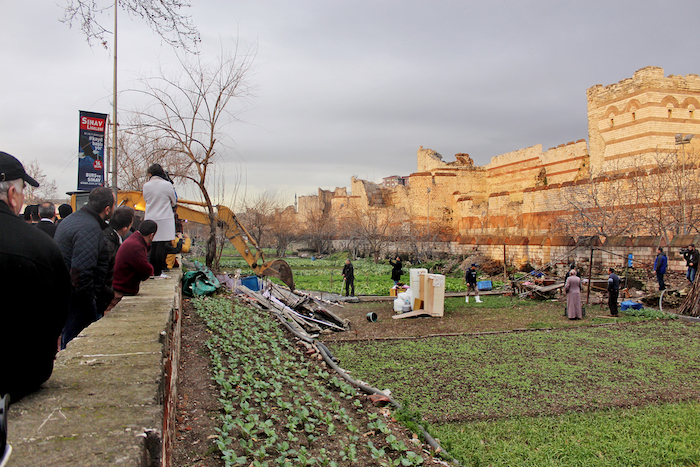
DÜRTÜK is the acronym for Producers and Consumers in Resistance (Direnen Üretici Tüketici Kolektifi in Turkish). It also means the poke or the poked, which we consider a modest and fun expression for motivating each other to take action. The DÜRTÜK collective was born in 2015 as common ground between the struggle for urban spaces and the emerging food sovereignty movement in Istanbul.
Finding common ground
In 2013, protests erupted all over Turkey in response to the violent dismantling of demonstrations against development plans that would destroy the Taksim Gezi Park, one of the few green places in the city. The protests brought together a rich multiplicity of people and groups opposing the enclosure of public spaces, destructive urban transformation projects, the ecological devastation, as well as ongoing state oppression and violence.After the ‘Gezi Resistance’, the emerging movement continued to be active in neighbourhoods in the form of discussions, protests, solidarity events, open markets, workshops, community gardens and informal food coops. DÜRTÜK was born in this process, bringing together different experiences, actors and desires.
A violent, paralysing atmosphere
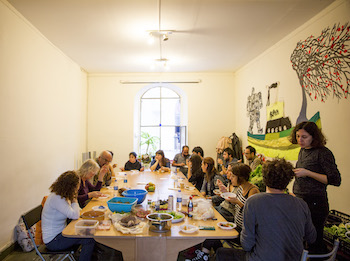
The war in Syria, the bombings by ISIS (Daesh), the termination of the peace process in the Kurdish region of the country by the Turkish state, and the attempted coup in 2016 have generated political polarisation all over the country. Journalists, academics, teachers and politicians are being imprisoned, cities and neigbourhoods burnt, and many lives lost. Schools, streets and public squares lost their liveliness. Our hopes, our imaginations, and even our mobility, have shrunk.
Persevering with the seemingly modest activities of DÜRTÜK has been significant in overcoming this paralysis. It not only supported the producers but also kept us going, as activists, consumers and citizens in trying to create spaces of solidarity.
Bostans – an edible heritage
DÜRTÜK cooperates with the small scale orchards and vegetable gardens situated in central Istanbul known as bostans that are run by professional farmers. They grow green, leafy vegetables and herbs that can be harvested various times a week. The farmers sell to (and at) open markets, restaurants and grocery stores, as well as through DÜRTÜK, and directly from the bostan. Their cultivation methods are a combination of those inherited from generations of gardeners before them and other techniques.While today only a few remain active, historically the bostans of Istanbul helped feeding the city. In fact, people depended on these gardens for survival during wars and famines. Today they are considered a nostalgic memory that is irrelevant to urban life. But nothing could be further from the truth. In recent years, bostans have convened people in defence of cultural heritage, the right to the city and urban food production.
The Land Walls: Defending and feeding the city
One of the producers we currently work with is Özkan Ökten. He works in a bostan in the moats of the ancient fort of Byzantium, called the Theodosian Land Walls of Constantinople, recognised as UNESCO World Heritage. Özkan, in his 40s, is also the head of a non-profit that aims to sustain the old and new bostans of Istanbul and supports the working conditions of its farmers.Özkan and around 20 other families make a living by cultivating the moats of the Walls. They are the second or third generation of farmers who have migrated to Istanbul to earn a living. This history of agricultural activity around the Land Walls is deeply tied to the history of the Walls, which dates back to the fifth century. As such, the Walls and the bostans together represent great urban know-how about both defending and feeding the city.
Gardening continues to be the most consistent activity in the moats and around the walled zone. Although this is keeping the area lively and productive, it is neglected both as a means to conserve the area and as cultural heritage. In recent years some of the very old and active bostans in the same area, known as Yedikule Bostanları, were destroyed by the municipality to make way for a park that will serve the surrounding gentrifying neighbourhoods.
The Mosque Garden: Threats and resistance
national heritage in 2015. Photo: Uygar Bulut
This has been an exemplary case in Istanbul of how agricultural land can be recognised as cultural heritage. But the municipality and associated construction companies are continuing to put pressure on Mehmet and Cemile to move somewhere else. The latest rumour is that the bostan will be turned into a hobby garden for the municipality so that they can make a profit from it.
The near future of this bostan is uncertain for other reasons as well. Mehmet and Cemile are old and they do not have enough strength to cultivate all their land. Because of the low prices of agricultural produce, and the equally low social status of farming in Turkey, their children do not have an interest in keeping the business going.
No recognition, no security
Urban development speculators breathing down their necks is not the only worry for farmers like Mehmet and Cemile. Although the bostans are quite central in the city and are surrounded by residential areas, the farmers struggle to get fair prices for their produce. The problem is that they cannot compete with the prices of imported, industrialised food.Moreover, despite the fact that the farmers have been cultivating their land for generations, their land tenure is insecure and they can be evicted at any moment. The land they cultivate is not considered agricultural land so they cannot formally register asfarmers. This means that they are not recognised in agricultural policies and don’t get access to public social security programmes. Combined, all these precarious conditions make the farmers in bostans hesitant to make long term investments in the soil.
Cultivating hope
Taksim, where we have our base, has been the scene of many political demonstrations and marches. It is a historically loaded place. Demonstrations are banned now, and a state of emergency has been in place since the attempted coup in 2016. Police are everywhere and constantly present. This has made many people afraid of coming to Taksim, which limits the growth of our orders. We haven’t been able to hold big meetings in the past year, and we are also having difficulty finding volunteers to invest time in DÜRTÜK‘s operations and activities.But even if there are not many weekly orders, we are continuing. We are trying to organise events and keep the discussion alive on how to continue and develop the organisation. We discuss food sovereignty in an international context, and talk about themes such as Community Supported Agriculture models in different countries and alternative economies. We organise picnics and participate in solidarity markets to find new members. We come together with other organisations to discuss issues and to gather strength.
The weekly routine of DÜRTÜK’s meetings represents hopeful, common ground for gardeners, farmers, consumers, activists and other citizens to exchange experiences about how they cope in their precarious situations, and to support each other. At DÜRTÜK, the urgent need to save and to defend agricultural spaces meets the humble labour of cultivating and reproducing everyday life.
Sevgi Ortaç (durtukgirdibostana@gmail.com/ sevgiortac@ gmail.com) is a member of DÜRTÜK and a visual artist and researcher, born and living in Istanbul.
Tuesday, April 25, 2017
There is no neutral market
People are gradually accepting that a healthy body requires healthy food produced in a regenerative farming system. But most tend to forget that this healthy relationship needs to be expressed through regenerative relationships between producers and consumers.
In the dominating narrative, The market is a neutral and disinterested institution where consumers meet producers and demand meet supply. In this view, the market can be filled with any content as long as there is a demand from consumers. If consumers want high quality regional food, or organic, or halal, or fairly traded it will in some way materialize and be supplied. Or conversely, if you are a small scale producer with diversified production, there is always an opportunity there in the market place. If you fail, it is just because you weren’t ingenious enough.
So the story goes. But is this really a correct description of The market?
 |
| Banana market in Samoa |
If you have a large farm with one or two crops you will not sell your crops with direct marketing but will be bound to large wholesale markets or being a supplier to a food, feed or biofuel industry. This also means that you will fine-tune your production according to that buyer’s demand. This will direct your choice of variety, the fertilization strategy, the time of sowing and harvesting. All in all there is a need for strict coherence between your production and the kind of market you are aiming at.
In a similar way, if you have a diverse farm with a mix of animals and plants it is highly unlikely that you can be a successful supplier to the same kind of markets. Your quantities are too small for shipping, you lack the right seed cleaner or packing technology for each of the crops, or your quality is another than demanded. So you are de facto locked out from the main market. If your farm is located close to a population center you might be able to sell your produce to affluent consumers directly or to a shop targeting those. But, even here, you will constantly be driven towards less diversity and more standardization. Your best bet if you want to keep the diversity is to become an educational farm or some kind of community supported farm. This can also be observed in all affluent countries.
If we bring the discussion even further, if you farm primarily to produce food for your family and only try to sell a surplus you will find that you are not a very interesting partner in any markets. Your supply is inconsistent, your priority is the food of the family and not of the client, and you don’t have the logistic machinery for bringing your stuff to the market. Therefore if you at all can sell, it is most likely to a middleman of some sort, who will pay you very badly. This can also be observed in most developing countries today.
The globalized food market with increasing dominance of a few retailers, a handful of food industries and wholesalers and very few input suppliers is not conducive for many kinds of producers, regardless of if there is a theoretical or potential consumer demand for their produce.
This makes it apparent that “markets” in no way are neutral towards producers and consumers. On contrary, they are based on certain types of production (and producers) and and certain types of consumption (and consumers). It is simply not true that “consumer demand” will create markets for organic, high quality, artisan regional food within the dominant market structures. Or if they do, the market will pervert the production and consumption to fit in.
This makes it quite easy to understand why the “market forces” are pushing also organic farmers in to larger scale and less diversity. As I write in Global Eating Disorder:
A study of ten organic farms in Denmark show that they too have to focus excessively on short term profits and ever-changing market requirements and have little time, energy or money to develop their farming system into a more ecologically sound system…. This experience is echoed in England and Germany. A German organic farmer explains: ‘in the beginning I carried out experimental cultivation of heritage grain varieties. But then I gave up everything that didn’t bring in money, because when the business is in the red it doesn’t make much sense’.
*
This insight makes it pertinent to discuss which kind of market that is conducive for which kind of production and vice versa. An attempt to do just that was made by the FAO in a seminar in Rome 8-9 June 2016, Sustainable value chains for sustainable food systems. The workshop report contains a lot of interesting papers on various form of “marketing”, including a paper on food self-provisioning in Hungary, i.e. clearly a non-market solution.
The paper What types of markets to support agroecology, by Maryam Rahmanian, Jimena Gomez, Lorenzo Banno and Alexandre Meybeck describes four types of solutions; producer organizations, public procurement programmes, participatory guarantee systems (PGS) and community supported agriculture (CSA). The paper questions if formal global markets can support the ecological, social and economic conditions needed for an ecological production system.
The authors also note that there is a need to consider how consumer diets are affected by the market system. I believe this is a very important conclusion. There are many observations on how our modern food system has changed the diet of the population. For instance, it is gradually recognized how the diversity in soils and farms might be reflected in the gut, and how the lack of that diversity makes people sick.
People are gradually accepting that a healthy body requires healthy food produced in a regenerative farming system. But most tend to forget that this healthy relationship needs to be expressed through regenerative relationships between producers and consumers. Some of those relationships will perhaps be new forms of markets, but I think most of them will be non-market relationships.
While I still don't have the full "theory" developed it seems to me that any form of "market" will be based on competition and division between producers and a certain degree of exploitation. None of these are conducive for sustainable and regenerative relationships.
Wednesday, April 12, 2017
Towards a new narrative of food
To
let commodity markets shape our diets and the stewardship of the land is a bad
idea. This can clearly be seen both in nature, societies and human bodies. Most
of the emerging food movements are based on other perspectives. The food system
as commons emerge as a competing narrative to food as commodity.
The
market paradigm clearly dominates how food and agriculture is discussed. For many people it goes
without discussion or reflection that food is a commodity – a product with the
main purpose to be sold by the producer and through various middle-men be
bought by the end user, the consumer. It is evident because that is how we
discuss food in the public sphere. It is evident for the consumers because of
how food is presented in shops: “buy this” “2 for the price of 1”. It is
evident for the farmers who are told to produce what is demanded by the market
and who suffer when world market prices plummet, totally out of her their
control.
But if you think about food once more, it is easy to discern many situations where we don’t look upon food as a commodity. The first food most humans eat is willingly given for free by a mother offering her breast. When we cook food for friends or family we do it outside of the market framework even if we have bought the food. The same apply when we grow food ourselves and share our bounty with a neighbour. Growing and cooking are hobbies and relaxing leisure for many, a duty without pay for others. Many foods also have cultural (or religious) meanings which transcend any market perspective.
Ulitmately, access to food is also an inalienable right. This was already agreed by world leaders in the Universal Declaration of Human Rights. It has been re-asserted ever since, for example at the 2009 World Summit on Food Security in Rome. The Special Rapporteur on the Right to Food for the United Nations, Olivier De Schutter, writes in the report to the General Assembly in August 2013: ‘The right to food has come to the fore as Governments realize that their efforts to combat food insecurity and hunger have been failing and realize the urgent need to strengthen national legal, institutional and policy frameworks’.[i]
The market is a mechanism for distribution of food. But it doesn’t work very well. To begin with, there are almost a billion people hungry – clearly the market fails to supply them with food. Further, there are huge external costs involved in food production, costs which are not reflected in the price of food. Through competition, farmers are forced, or encouraged, to externalise as much as possible of these costs. Commodification thereby promotes a perverse system.
Food processors and traders make most money from making people buy food made from cheap raw materials (corn, soy, wheat, sugar, palm oil etc.) which at the same time have a big appeal to consumers. Fat, salt and sweet are keywords. The marketing is so efficient that people buy far too much, leading to both obesity and waste.
In addition, farming has more functions than the production of food. More than half of the biological production in the terrestrial systems of the Earth is taking place in the agriculture landscapes and the management of those agricultural landscapes is our most important tool for managing nature, a nature that we are totally dependent on even in these modern times.
But the signals, the guidance, from commodity markets don’t promote good stewardship of the land. They promote specialization, larger scale, monoculture, externalization of costs and short term profit over longer term sustainability. The reality is thus a lot more complex than the narrative of food as a commodity makes us believe. To let commodity markets shape our diets and the stewardship of the land is simply a bad idea.
*
 |
Even if it sounds far-fetched, perhaps even frightening for some, there is a growing energy into a food system based on other perspectives than the one of the commodity. This can be seen “in the field” with many initiatives for new food systems relationships, such as community gardens, community supported agriculture, relationship food* etc.
The food system as commons, a shared interest and shared responsibility, emerge as a competing narrative to food as commodity. This doesn’t rule out markets as one of several mechanisms for food distribution, but does it reject market hegemony over our food supplies and their distribution. It also rejects the view that market forces and private ownership are the best ways for allocating food producing resources, such as land, water, knowledge and seeds.
Rethinking
food as a right, farming as a management system of the planet and the food
system as a commons also necessitates the building of new institutions fit for
these purposes. That includes both new relationships between producers and
consumers and public institutions and policies. But I leave that discussion to
another time.
*
There
is also an emerging academic interest in new perspectives on food. Jose Luis
Vivero Pol, a food governance researcher, has made an interesting analysis of
academic papers in The
value-based narrative of food as a commons. A content analysis of academic
papers with historical insights.
His analysis of English academic texts reveals that “food commons” or “food public good” topics
are very marginal subjects in the academic milieu with only 179 results since
1900, but with sharp increase in the eight years that followed the 2008 food
crisis. On the contrary, “food commodity” presents almost 50,000 references
since 1900.
Vivero
Pol, Tomaso Ferrando, Olivier de Schutter and Ugo Mattei, are now editing the Routledge
Handbook of Food as Commons. It will present a different normative view of
food as a commons instead of a commodity and “how the food system would change
if food was regarded and enacted as a commons.“ The title will be published in
2018 and I am looking forward to reading it.
I
have written myself on this theme, in my book Global Eating Disorder
and more specifically in the article Food:
From Commodity to Commons. In that article I write:
”The market is not a good master for a
sustainable food system. Instead we need to find new ways of managing the food
system based on food as a right and farming as a management system of the
planet Earth. The solutions should be based on relocalization of food
production and de-commodification of food and our symbionts, the plants and
animals we eat.”
There
are interesting times ahead.
* Relationsmat,
“relationship food” is a term used in Swedish to emphasise the need to form new relationhips between the
actors in the food chain, systems of co-production of cooperation.
[i] United
Nations General Assembly 2013 The Right
to Food, Interim report of the Special Rapporteur on the Right to Food, 7
August 2013, A/68/288
Subscribe to:
Posts (Atom)